How to play Sholo Guti
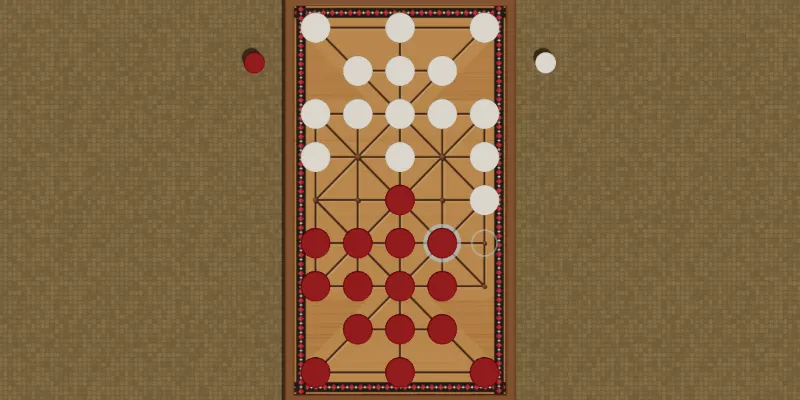
Two players, sixteen pieces each, and a board of lines with a triangle at each end.
- Players
- 2
- What you need
- A board of 37 points and 16 pieces a side
- How long
- A game takes ten to twenty minutes
What Sholo Guti is
Sholo Guti is a game for two. Sholo is sixteen and a guti is a piece, so the name says what each player has. It is played in the Terai, in Bengal and in Bihar, often on a board scratched into the ground with stones or seeds for pieces.
A piece steps along a line to the next point, in any direction. It takes by jumping a piece of the other colour that stands next to it, landing on the empty point straight beyond, and the piece it jumped comes off the board.
You win by taking all sixteen of the other side's pieces, or by leaving them with no move at all.
The board
The middle of the board is the Baghchal board: five points by five, joined by every row, every column and the diagonals through every other point. A triangle stands on the middle of each end, with three points in its near row and three on its base. That makes thirty-seven points in all.
Each player fills the triangle at their end and the two rows of the square nearest them, sixteen points. The middle row of the square is left empty. Red moves first.
Setting up
- Draw or lay out the board with a triangle pointing towards each player.
- Put sixteen pieces on the points of the triangle nearest you and the two rows of the square in front of it.
- Red moves first. Here, the colour you pick on the game page is yours for the first game and the two of you swap after it.
- Keep the pieces that come off the board where both of you can see them. The count is how a game is read.
Moving
On your turn you move one piece one step along a line to the next point, if that point is empty. Forwards, backwards and sideways are all allowed, from the first move.
A piece may only travel along a line that is drawn. Every other point of the square has diagonals through it and the rest do not, so a piece on one of those points has only four ways to go.
The triangles have fewer lines still. A base corner has two, which makes it a quiet place to keep a piece and an easy place to get one shut in.
Taking
If a piece of the other colour stands next to yours along a line, and the point straight beyond it on the same line is empty, you may jump it. Your piece lands on that point and the piece you jumped is taken off.
A jump goes in a straight line, so it cannot turn a corner. It does cross from the square into a triangle and back, because the triangles' lines carry straight on from the square's.
After a take, if the same piece can take again, it may, and the whole run is one turn. Only the piece that took may carry on. No other piece may move until the turn is over.
Stopping a run
A take is a choice. You never have to make one, and in the middle of a run you may stop whenever you like, even with another take on the board.
That is the decision this game turns on. A run that lands a piece next to an enemy with an empty point behind it gives the piece straight back, and a run that stops one take early may keep it.
Some tables play it the other way: a take must be made when there is one, and a run must be followed to its end. That makes it possible to offer a piece as bait. You can choose that on the game page.
How a game ends
You win by taking every piece the other side has. You also win by leaving them with no legal move, which happens most often to the last few pieces of a side caught in their own triangle.
A game can be drawn. Pieces that move every way can walk round an empty board for ever, so eighty moves with nothing taken is called a draw, and so is the same position coming round three times.
With sixteen pieces each a game is long, and the end of it is usually a handful of pieces chasing each other. The side with more of them should trade them off, because three against one wins and eight against six takes a long time.
Playing here
The rail above the board says whose turn it is. The rail below counts the pieces each of you has left.
Tap a piece to pick it up and the points it may go to are marked. Tap one of those to move, or tap the piece again to put it back. Dragging works too, and does the same thing in one gesture.
After a take that can be followed, the piece stays picked up with its next takes marked. Tap one to take again, or press End turn to stop there. At a forced-capture table with only one take left, the game plays it for you.
The piece that moved last is ringed and the point a piece was taken from is marked, so the other side’s turn can be read after it has happened.
Playing better
- Before you step next to an enemy piece, look at the point behind you. If it is empty, the step is an offer.
- Keep your pieces in pairs along a line. A piece with a friend behind it cannot be jumped from the front.
- The points where eight lines meet are the strong ones. A piece there reaches more and is harder to shut in.
- Before a long run, look at where it ends. The last landing point is where the reply comes from.
- Trade pieces when you are ahead, and keep your last few out of the triangles, where two lines are not enough to escape by.
Settings
Everything on the game page, before you press Play. The one house rule defaults to the game as it is written down.
| Setting | Standard | What it changes |
|---|---|---|
| Who is playing | With bots | With bots sets you against a bot. On this phone seats two people who pass the phone between turns, and the colours swap after every game. Red always starts at the near end, which suits two people sitting either side of a phone on a table. Watch the bots, the link under the button, sets two bots against each other. |
| Your colour | Red | Red moves first. The colours swap after every game. |
| Difficulty | Medium | How far ahead the bot looks. Easy throws moves away on purpose. |
| Taking | Take or not, as you like | Turn it on and a take must be made whenever there is one, and a run of takes followed to its end. Then a piece can be offered as bait, and the game becomes about forcing takes rather than avoiding them. |
| Speed | Normal | How quickly the pieces move. It does not change how well the bot plays. |
The words
- Guti
- A piece. Sholo guti is sixteen pieces, which is what each player starts with.
- Point
- A place where lines meet. Pieces stand on points and move along lines.
- Triangle
- The six points at each end of the board, where each side starts six of its pieces.
- Take
- Jumping a neighbouring enemy piece onto the empty point beyond it, which removes it.
- Run
- Several takes by one piece in one turn. It may stop whenever its player likes.
- Forced take
- The house rule that you must take if you can and keep taking while you can.
- Shut in
- Having pieces left and no legal move, which loses the game.
- Trade
- Giving up a piece to take one back. The player who is ahead wants them.
Every rule on this page is the one the app plays by. Change any of them on the game's own page before you start.