How to play Dots and Boxes
Two players, a grid of dots and a pen each. Take turns joining two dots with a line, and whoever draws the fourth side of a box claims it and draws again. When every line is drawn, more boxes wins.
It looks like a child's game, and it is one, played in the back of school exercise books all over Nepal. It also has an endgame that grown-ups get wrong for years.
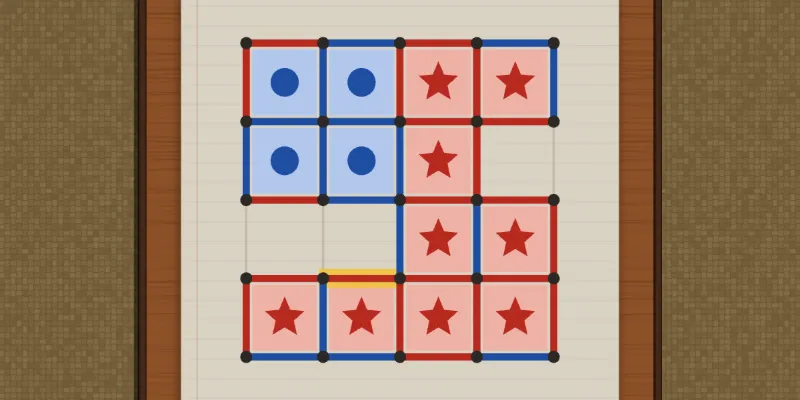
- Players
- 2
- What you need
- A grid of dots and two pens
- How long
- A game takes two or three minutes
What dots and boxes is
Dots and boxes is a game for two on a square grid of dots. On your turn you draw one line between two dots that sit next to each other, across or down, never on a slant. Every gap between two neighbouring dots can take one line, and a line once drawn stays.
Four lines round a square make a box. Whoever draws the last of the four claims that box, and it is filled in with their colour and their mark: a star for red, a round dot for blue.
The board
- The game page offers three boards: three boxes by three, four by four, and five by five. Four by four is the usual setting. Five by five is longer and gives the endgame more room.
- One player draws in red and the other in blue. You choose on the game page and keep your pen for the whole match.
- Red draws the first line of the first game. After that, the first line goes back and forth between you.
Taking a turn
On your turn, draw one line in any gap that is still empty. If that line was the fourth side of a box, the box is yours and you must draw another line. Keep going for as long as each line closes a box. A line that closes nothing ends your turn.
One line can be a side of two boxes. If both of them already had three sides, that one line closes both, and both are yours.
On the screen, touch near a gap and the line it would draw shows faintly, in your colour. Slide your finger to the line you want and lift it to draw. The line drawn last has a band under it, so you can see what your opponent did.
The third side
A box with three sides drawn is a gift to whoever moves next. So the first thing anybody learns is never to draw the third side of a box if there is any other line to draw.
Early in a game that is easy. Lines that give nothing away are everywhere. As the board fills up they run out, and sooner or later one player has no choice but to draw a third side somewhere.
Chains
By then the empty lines have joined the boxes into chains: boxes in a row, each with two sides drawn, so that taking one opens the next. A chain can also close on itself in a ring of four or more, which is a loop.
When nothing safe is left, you have to open a chain, and your opponent takes it all. So open the shortest. A chain of one or two costs you little, and every chain you open makes your opponent open the next one.
Handing back two
One trick turns the game round. When your opponent opens a long chain, take every box of it except the last two. Then, instead of taking those two, draw the line at the far end of the chain. That closes nothing and leaves the two boxes joined, so your opponent takes both with one line.
You have given away two boxes, and in return your opponent has to move again, which means opening the next chain for you. In a loop you hand back four, as two pairs.
Whoever keeps doing this is said to have control, and with long chains on the board control is usually the game. It is worth giving up the two only when what is left is worth more than two to you. The hard bot counts that before every chain.
How a game ends
The game ends when the last line is drawn, which always closes the last box. Count the boxes: whoever has more wins the game.
A three by three or five by five board has an odd number of boxes, so somebody always wins. On four by four the boxes can split eight each, and the game is a draw.
A match
A match is one, three or five games, chosen on the game page. Three is the usual setting.
Each player keeps their pen for the whole match while the first line goes back and forth. Red opens the first game, blue the second, red the third.
Every game of the match is played, and whoever wins more of them wins the match. A drawn game counts for nobody, and a match that ends level is a draw. In many exercise books the loser of a game draws first in the next, and that is a setting on the game page.
Playing better
- Take every box you are given, unless taking the last two of a chain would make you open the next one. Then hand them back.
- When you have to give something away, give the fewest boxes you can. A single box, or a chain of two opened in the middle, so it cannot be handed back to you.
- Count the long chains as they form. Near the end of the safe lines, it is worth giving up a box or two early if that leaves your opponent to make the last safe move.
- Watch the line your opponent drew last. A third side they had to draw is the start of the endgame.
Settings
Everything on the game page, before you press Play.
| Setting | Standard | What it changes |
|---|---|---|
| Who is playing | With bots | With bots sets you against a bot. On this phone seats two people, who pass the phone between turns or leave it lying flat between them. Friends online plays over a link. Watch the bots, the link under the button, sets two bots against each other. |
| Your pen | Red | The pen you draw with for the whole match. Red opens the first game. On this phone it is the first player's. |
| Games | 3 | One, three or five games. Every game of the match is played, even once one player can no longer be caught. |
| Difficulty | Medium | Easy takes a box it is given most of the time, and often draws a third side when it need not. Medium takes everything and never draws a third side while it has a choice, but takes every last box of a chain. Hard counts the chains, hands back two to keep control, and searches the end of the safe lines. |
| Board | 4 by 4 boxes | Three, four or five boxes along each edge. The bigger the board, the longer the chains and the more the endgame matters. |
| Who opens the next game | Each in turn | Each in turn shares the first line out over the match. Whoever lost gives the first line of the next game to the player who lost the last one, and after a draw the turn goes on as usual. |
The words
- Kotha banaune khel (कोठा बनाउने खेल)
- Dots and boxes in Nepali: the game of making boxes.
- Dot (थोप्लो)
- One of the points of the grid. A line joins two dots next to each other.
- Box (कोठा)
- The square between four dots. It belongs to whoever draws its fourth side.
- Chain (साङ्लो)
- Boxes in a row, each with two sides drawn, so that taking one opens the next.
- Loop (घेरो)
- A chain that closes on itself, with no end to start from.
- Control
- Being the player who takes the chains while the other opens them, kept by handing back the last two boxes of each.
- Draw (बराबरी)
- The same number of boxes each, which can happen only on the four by four board.
Every rule on this page is the one the app plays by. Change any of them on the game's own page before you start.