How to play Maths Duel
Two players, the same sums, and a clock. Whoever gets more of them right wins.
- Players
- 2
- What you need
- Nothing but a phone. The sums are made up fresh for every game
- How long
- A race takes a minute
What Maths Duel is
Maths Duel is mental arithmetic as a game for two. Both of you get the same sums in the same order, and you answer them in your head and type the answer on a keypad.
There are two ways to play. The race gives each of you a minute to answer as many as you can. The buzzer puts one sum up for both of you at once, and the first right answer takes it.
The sums are made up fresh for every game, so there is nothing to learn by heart and no list to run out of. Adding, taking away, times tables and sharing, at three levels.
The race
A race is the way to play against the bot or a friend online.
- The slip counts in, three, two, one.
- A sum goes up. Type the answer, and the moment it is right the next sum takes its place.
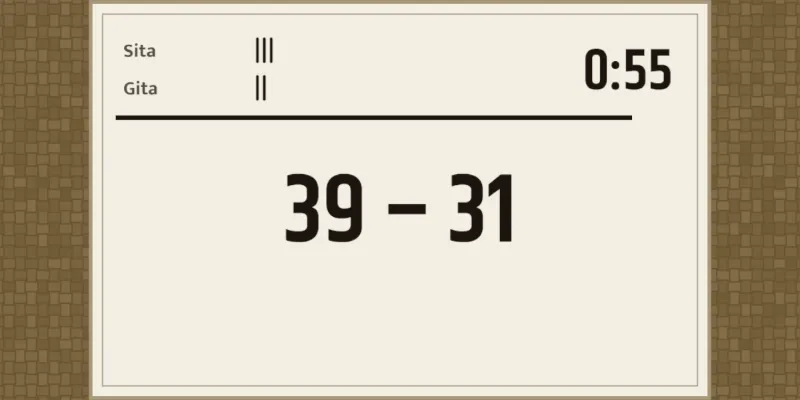
- Keep going until your time runs out. Your tally lane on the slip gains a stroke for every right answer, and so does the other player’s.
- When both of you are out of time, the one with more right wins.
Each of you works down the list at your own pace, so neither waits for the other. Online, your own time starts when your phone has counted in, so a slow connection costs you nothing.
The buzzer
The buzzer is for two people and one phone. Lay the phone flat between you. Each of you has half the screen and a keypad of your own, and the top half is turned round to face the person across from you.
One sum goes up on both halves. The first right answer takes the point, and the other half shows who had it and what the answer was. Then the next sum goes up for both.
The first to the target wins, ten points unless you choose otherwise. The buzzer is not played online, because a close answer would go to whoever has the faster connection rather than the faster head.
Putting an answer in
There is no enter key. Type the digits and the answer counts the moment they are right, with a green line drawn under it.
Type as many digits as the answer has and get them wrong, and it is a miss. The box shakes, the digits are struck through in red, and the keypad holds for half a second before it clears. At the buzzer the hold is a whole second.
No marks are taken off for a miss. The time it costs is the penalty, and it makes guessing slower than working it out. The key with the arrow takes back a digit you typed by mistake.
The sums
Every answer is a whole number of one to three digits, and never below nought. Sharing always comes out exactly.
- Easy: adding and taking away under twenty, and times tables up to five.
- Medium: two digits and two digits, and times tables up to twelve with their sharing.
- Hard: three digits and two, change from a thousand-rupee note, two digits times one, the teens times the teens, and squares up to twenty-five.
On the game page you can choose to have only adding and taking away, or only times and sharing. Whatever you choose, both players get exactly the same sums.
Who wins
In a race, whoever has more right answers when their time is up wins.
If you finish level, the one who reached that score sooner wins, each timed from their own start. Level on both is a draw, and so is a race where nobody got any right.
At the buzzer the first to the target wins. Online, a player who leaves and does not come back loses the race to the one who stayed.
Playing here
The slip in the middle shows the sum, your answer box, both tally lanes and the clock. The rule along the top of the window shortens as the time runs, and it turns red for the last ten seconds.
The keypad is at the foot of the screen, laid out like a phone’s with 1, 2 and 3 across the top. On a computer the number keys type and Backspace takes a digit back.
On a sideways phone the keypad goes down the side of the screen, on the side of your writing hand.
Watch mode sets two bots racing each other, which is a quick way to see what a quick player’s minute looks like.
Getting quicker
- Learn the times tables up to twelve by heart. Half the sums at medium are a table you either know or work out.
- For adding, take the tens first and the units after: 48 and 37 is 70, then 15, so 85.
- For change from a thousand, take each digit from nine and the last from ten: 1000 take away 365 is 635.
- Do not guess. A miss holds the keypad for longer than most sums take to work out.
- Keep your eyes on the slip and your thumb on the keypad. Looking down at the keys between answers is time.
Settings
Everything on the game page, before you press Play.
| Setting | Standard | What it changes |
|---|---|---|
| Who is playing | Against the bot | Against the bot is a race or a buzzer game with the bot. On this phone seats two people, one at each end of the phone. Online is a race with a friend on their own phone. Watch the bots sets two bots racing each other. |
| Game | A race | A race against the clock, or the buzzer, where the first right answer takes each sum. Online is always the race. |
| Race length | 1 minute | How long a race lasts: 30 seconds, a minute or two minutes. |
| Buzzer target | First to 10 | How many points win at the buzzer: 5, 10 or 15. |
| Bot’s speed | Steady | How fast the bot answers. It knows every answer, so its speed is the whole of its skill. Slow is a child counting on, Sharp a quick adult. |
| Sums | Medium | How hard the sums are. See the sums above. |
| Kinds of sum | All four | All four kinds, only adding and taking away, or only times and sharing. |
Words
- Race
- The way to play where each player gets the same list and a time of their own, and the most right wins.
- Buzzer
- The way to play where one sum goes up for both, and the first right answer takes it.
- Slip
- The piece of paper on the table with the sum, the answer box, the tallies and the clock on it.
- Tally
- A count kept in strokes, four upright and the fifth across them, the way a scorer keeps one.
- Miss
- An answer with as many digits as the right one that is not it. It costs a moment and no points.
- Carry
- In adding, the ten that goes over into the next column when the units come to ten or more. In taking away, the ten borrowed back.
- Change
- What a shopkeeper gives back from a note. In hard sums, what is left of a thousand rupees.
Every rule on this page is the one the app plays by. Change any of them on the game's own page before you start.