How to play Spades
Spades is a trick taking game for four, played in two partnerships with one pack. Spades are trump in every hand, and each player bids the tricks they mean to take. Partners add their bids together and play for the total, so the trick your partner wins is as good as your own. A side that makes its bid scores ten a trick. A side that falls short loses ten a trick.
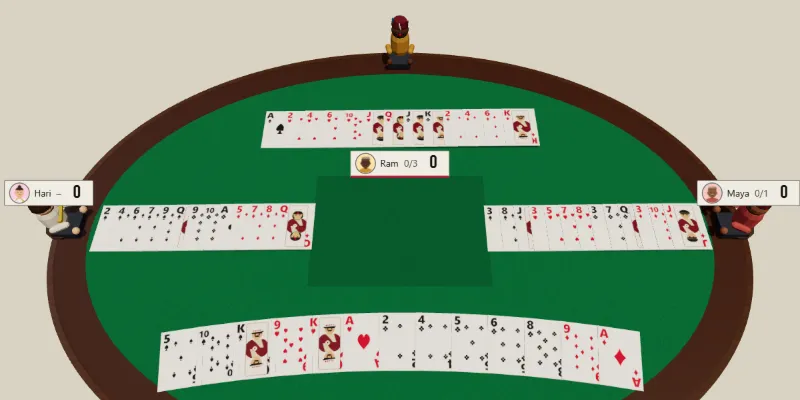
- Players
- Exactly 4, in two pairs
- What you need
- One pack of 52 cards
- How long
- A race to 300 points, five to eight hands
What the game is
Thirteen cards each and thirteen tricks a hand. You follow the suit that was led if you can, the highest card of that suit wins, and a spade beats any card of any other suit.
Before a card is played everybody bids, and the bids of two partners make one number. That number is what the side has to take between them. Ten points a trick bid when they take it. Ten points a trick off when they do not.
Two things make Spades more than Call Break with a partner. A player may bid nil and promise to take no trick at all. And a trick over the bid is only worth one point, but it is written down, and ten of them cost a hundred.
Partners
Four players sit round the table and the two opposite each other are partners for the whole match. You and the seat across from you are one side. The two on your left and right are the other.
You never see your partner's cards, and you may not tell them what you hold. All you have is their bid and the cards they play. At this table each seat's panel carries a mark: filled for your side, open for the other.
The deal
- Shuffle one pack of 52 cards. There are no jokers.
- Deal the cards one at a time, starting with the player on the dealer's left, until each player has thirteen.
- The player on the dealer's left bids first and leads the first trick. The deal moves one seat round after every hand.
The bid
Going round the table from the dealer's left, each player says how many tricks they expect to take, from one to thirteen, or nil. Each player bids once, and the bids are open, so you hear your partner's bid if it came before yours.
The two bids of a side are added, and the total is the side's contract for the hand. Bid three while your partner bids four and your side needs seven, however the seven are shared between you.
A bid of nil is different, and it has a section of its own below. A nil does not add to the side's contract. Its owner is betting a hundred points on taking nothing.
A trick
The player who leads may play any card, with one exception described below. Everybody else must play a card of the suit that was led if they have one.
If you have none of the suit led you may play anything at all. You do not have to trump and you do not have to try to win. That freedom is the first thing a Call Break player has to unlearn.
The trick goes to the highest spade in it, or, with no spade in it, to the highest card of the suit that was led. Whoever wins the trick leads the next one.
Breaking spades
At the start of a hand nobody may lead a spade. Spades stay locked until somebody plays one on a trick led in another suit, which they can only do when they have none of that suit. From that trick on, spades are broken and may be led like any other suit.
The one exception is a player whose hand is nothing but spades. They may lead one even before spades are broken, because they have no other card to lead.
Nil
A player who thinks their hand can take no trick at all may bid nil. If they take none, their side scores a hundred. If they take even one trick, their side loses a hundred.
Your partner's bid is scored on its own. If your partner bid four, your side still needs four tricks from your partner, and any trick the nil bidder takes does not help. It counts as a bag instead.
When your partner bids nil, your job changes. You win every trick you can, and above all you try to win the tricks your partner might otherwise be left holding. When an opponent bids nil, you try to make them take one.
How a hand is scored
Each side is scored on its contract. Take at least as many tricks as the side bid and it scores ten for every trick bid. Take fewer and it loses ten for every trick bid.
Every trick over the bid scores one point. These extra tricks are called bags, and the side keeps a count of them from hand to hand.
When a side's count reaches ten bags, a hundred points come off its score and the count drops by ten. So bidding too low costs you slowly, the way bidding too high costs you at once.
An example. You bid three and your partner four, so your side needs seven. You take eight between you. That is seventy for the bid and one bag, seventy one in all. Had you taken six, your side would have lost seventy.
The match
Hands are dealt until one side reaches the target score, which is 300 at this table unless you choose 200 or 500. If both sides pass it on the same hand, the higher score wins. If they are level, another hand is dealt.
Both partners carry their side's score, and both win or lose together.
Coming from Call Break
Spades and Call Break share the deck, the trump and the bid, and a Call Break player will feel at home in the first minute. These four differences are what such a player gets wrong at first.
- You never have to beat the card on the table or trump when you are out of a suit. Throw a low card and save the spade.
- Your partner's tricks count towards your side's bid. Taking a trick your partner had already won wastes a high card.
- A trick over the bid is a bag, not a tenth of a point, and ten bags cost a hundred. Once your side's bid is made, try to lose the rest.
- Spades may not be led until one has been played on another suit.
Tactics
- Count your sure tricks when you bid: aces, kings with a small card beside them, and high spades. Long spades are worth a trick each past the third.
- Listen to your partner's bid. A big bid from across the table means you can bid low and play to help.
- Bid nil on a hand of small cards with no high spade, and only when your partner has not bid nil already.
- Last to play to a trick your partner is winning, throw your lowest card.
- Watch the bag count. A side with eight bags should bid its full strength and duck every trick it does not need.
The table's settings
Everything else is fixed: one pack, thirteen cards each, spades always trump, partners opposite.
| Setting | Standard | What it changes |
|---|---|---|
| Who is playing | Against bots | Play your seat with three bots, one as your partner, or watch four bots play. Online, friends take seats and bots fill the rest. |
| Difficulty | Medium | Easy bots play their own hands and never bid nil. From medium up they play for their side: they cover a partner's nil and duck once the bid is made. |
| Game to | 300 | The score that wins the match. 200 is three or four hands, 500 is the full game. |
| Nil bids | On | Off, and every bid is at least one. |
| Ten bags cost 100 | On | Off, and a trick over the bid is a free point. |
| Spades must be broken before they are led | On | Off, and a spade may be led at any time. |
| Turn order | Counter-clockwise | Which way the turn passes, as at your own table. It changes nothing else. |
Words at the table
- Trump
- The suit that beats every other. In Spades it is always spades.
- Side
- Two partners, sitting opposite. A side bids, scores and wins together.
- Bid
- The tricks a player says they will take. A side's two bids add up to its contract.
- Nil
- A bid of no tricks at all, worth a hundred either way.
- Bag
- A trick taken over the bid. One point now, and ten of them cost a hundred.
- Broken
- Spades are broken once one has been played on another suit. Until then nobody may lead one.
- Follow suit
- To play a card of the suit that was led, which you must do if you can.
- Void
- Holding no cards of a suit. A void player may play anything.
- Hand
- One deal of thirteen tricks, from the bid to the score.
Every rule on this page is the one the app plays by. Change any of them on the game's own page before you start.