How to play Satra (17)
Also written sattra, and called seventeen or 17 in English. Some tables play a near relative as Maghe Satra, or Beg 17.
Satra is a card game for two to six players round a pot. Everybody is dealt one card, then each player draws one card at a time, trying to get close to 17 without going over. Under 14 you must keep drawing, from 14 you may stand, and exactly 17 wins the pot on the spot. Otherwise the highest hand standing takes it.
It is a family game at the festival tables, played for money there. The chips here belong to the table and are not money.
Set the table up with your own house rules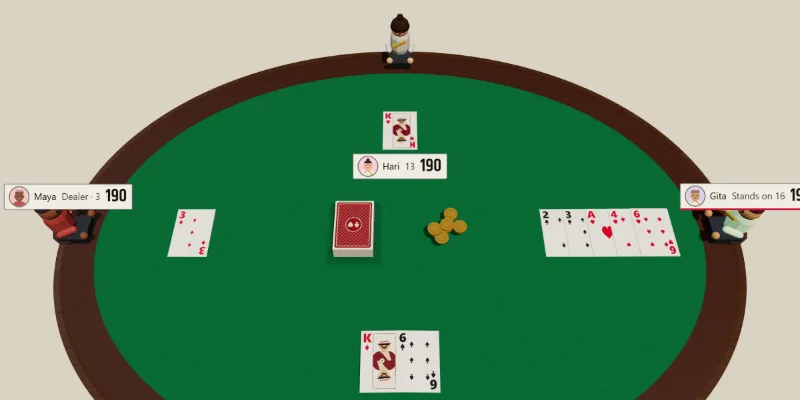
- Players
- 2 to 6
- What you need
- One pack of 52 cards and a pile of chips
- How long
- Ten deals, or until the table stops
At a glance
| Your total | What happens |
|---|---|
| Under 14 | You must draw again |
| 14 to 16 | Stand, or draw again |
| Exactly 17 | You win the pot at once |
| Over 17 | You are out of the deal |
Ace is 1, two to ten are what they say, jack 11, queen 12 and king 13. A tie goes to fewer cards, then the higher top card, then its suit.
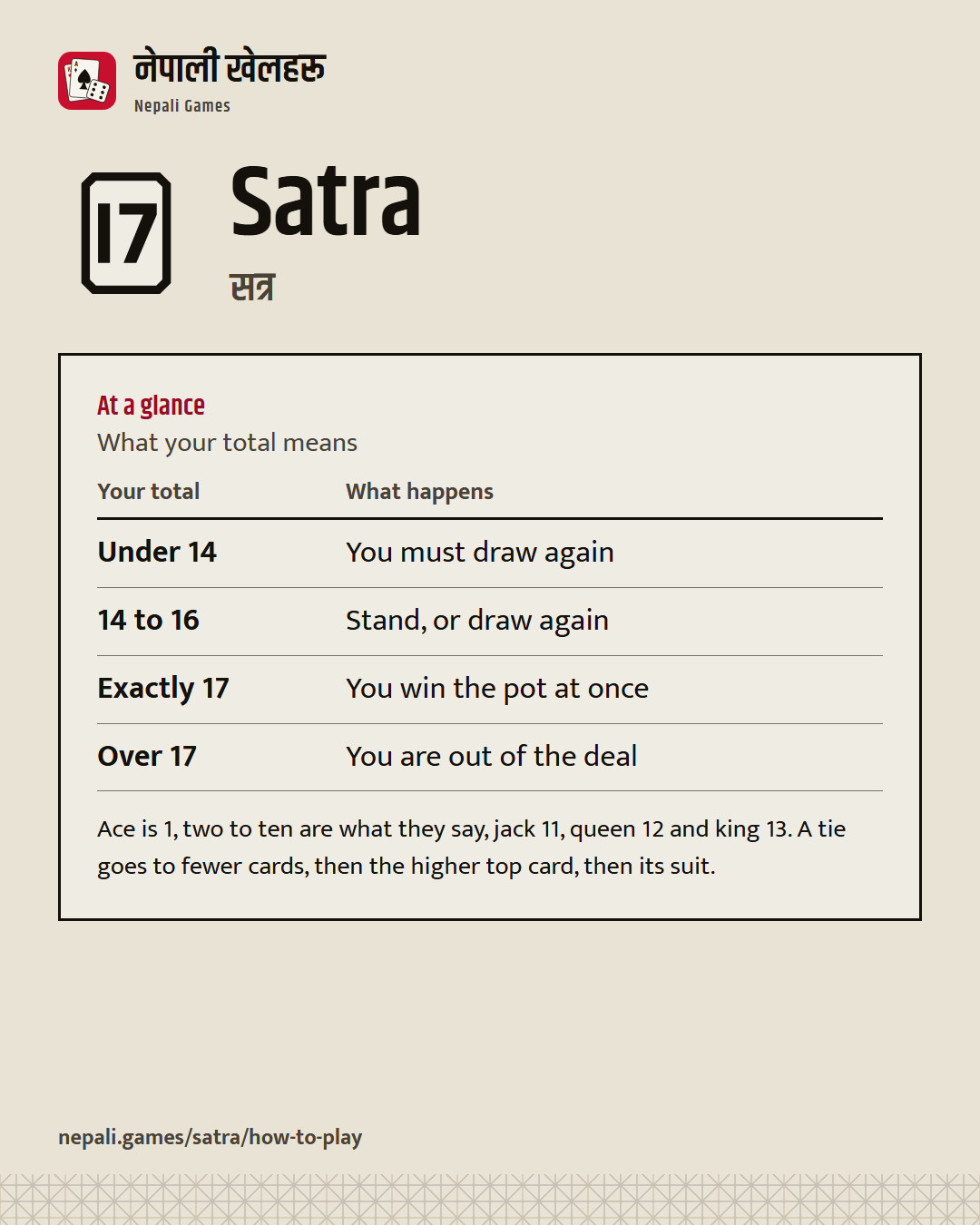 The same table on one card, to keep on your phone or send to the family group. Tap to open it.
Rules checked 11 November 2026. How these rules are written
What Satra is
Satra means seventeen, and that is the whole aim: build a hand that adds up to 17, or as close under it as you dare. One card more than you needed puts you out of the deal.
It is a game of nerve more than of skill. Every player draws on their own turn, nobody sees anybody else's cards, and the dealer plays last, knowing only how many players are still standing and how many cards each holds.
The pot and the deal
Everybody puts the boot into the middle to start a pot. The first dealer is chosen at random, and after that whoever wins a pot deals the next one.
The dealer gives everybody one card face down, one at a time, starting with the player after them and taking the last card themselves. You may look at your own card. Nobody else's is shown.
A turn
- The player after the dealer goes first, and the dealer goes last.
- Draw cards one at a time from the pack. Under 14 you may not stop, so you keep drawing.
- From 14 to 16 you choose: stand, or take another card. Exactly 17 wins the pot straight away, and nobody after you plays.
- Over 17 and you are out. Throw your cards in face up and the turn passes on.
What the cards count
An ace is 1. Two to ten count what they say. A jack is 11, a queen 12 and a king 13, so a single king and a four already make 17. In a tie the king is the highest card and the ace the lowest.
Winning the pot
The moment any player's cards add up to exactly 17, that player wins the whole pot. The deal ends there, even if others have not had their turn.
If nobody makes 17, the dealer's turn ends the deal and every hand still standing is shown. The highest total takes the pot.
Two hands on the same total? The one with fewer cards wins.
Same total and the same number of cards? Compare each hand's highest card. The higher card wins, with the king at the top and the ace at the bottom.
If those top cards are the same rank, the suit decides it. Spade beats heart, heart beats club, and club beats diamond. One pack has only one card of each, so this always settles it.
When everybody goes over
If every hand goes over 17, nobody takes the pot. It stays in the middle as it is, nobody puts more in, and the deal passes to the next player. The same players then play for the same pot until somebody wins it. Only then does everybody put in a new boot.
When to draw
On 14 the cards that keep you in are an ace, a two and a three, about one card in four, and the three is 17. On 15 only an ace or a two will do, about one in six. On 16 only an ace, about one in twelve, but that ace wins the pot.
Standing is safer, but a low hand standing early is easy to beat. Players still to come can draw past it, and the dealer will.
The dealer has the best seat. They know how many players are standing and on how many cards. A player standing on two cards often has 15 or 16, and if everybody else has gone over, the dealer only needs to reach 14.
The match
A match is a set number of deals, ten by default. Or it has no number at all, which is how a real table plays: it goes on until the people at it agree to stop, and whoever made the table ends it between deals.
A pot nobody has won by the end is shared out equally among the players in it, and the biggest pile wins. The chips belong to this table and are not your coins.
At this table
Your cards are face up to you and face down to everybody else. Under 14 they come to you by themselves, and from 14 the Draw and Stand buttons below the table light up, with your total in the status line. The dealer's cards turn face up when their turn begins. Each seat's label shows its chips, who is dealing, and whether it stood or went over. When several people share one phone, the phone is passed round behind a cover so nobody sees anybody else's cards.
Options
Every table here plays the rules above. These are what a table agrees before the first boot.
| Setting | Standard | What it changes |
|---|---|---|
| Players | 4 | Two to six round the pot. |
| Deals | 10 | How many deals a match lasts, or no limit, when the table plays on until it is ended between deals. |
| Chips each | 200 | The pile each seat starts with. |
| Boot | 10 | What each seat puts in to start a pot. Nothing more is paid until somebody wins it. |
| Suits in a tie | ♠ ♥ ♣ ♦ | The order of the suits when a tie comes down to the suit of the top card. Some tables use bridge's order, with the diamond above the club. |
| Difficulty | Medium | How carefully the computer decides between drawing and standing. The stronger levels think about who is still to play. |
The words
- Satra (सत्र)
- Seventeen in Nepali, and the name of the game.
- Going over (नाघ्नु)
- A hand that adds up to more than 17. It is out of the deal.
- Pot (भाँडो)
- The chips in the middle that the winner of a deal takes.
- Boot (बोट)
- What everybody puts into a new pot before it is dealt.
How other families play it
Every family plays it a little differently. These are the ways we know of. The ones with a button are house rules this table can play.
Bridge's order of the suits
When a tie comes down to the suit of the top card, some tables rank the suits spade, heart, diamond, club, as bridge does, rather than spade, heart, club, diamond. The suits setting plays it that way.
Maghe Satra, or Beg 17
A written version from abroad deals one card down and one up, ranks a tie by more cards rather than fewer, and plays for a point a hand rather than a pot. The table here plays Satra as a Nepali family table plays it.
Questions people ask
How do you play Satra (17)?
Everybody puts the boot into a pot and is dealt one card face down. Then each player draws one card at a time, the dealer last. Under 14 you must keep drawing, from 14 to 16 you may stand, over 17 you are out, and exactly 17 wins the pot at once. Otherwise the highest hand standing wins.
What are the cards worth in Satra?
An ace is 1, two to ten count what they say, a jack is 11, a queen 12 and a king 13. A king and a four make 17.
When can you stop drawing in Satra?
From 14. Under 14 you must take another card. From 14 to 16 you may stand or draw again, and at exactly 17 you have won.
Who wins a tie in Satra?
The hand with fewer cards. If both have the same number, the one whose highest card is higher, with the king at the top and the ace at the bottom. If those cards are the same rank, the suit decides: spade, then heart, then club, then diamond.
What happens if everybody goes over 17?
Nobody wins the pot. It stays as it is, nobody adds to it, and the deal passes to the next player. The same players play for it again until somebody takes it, and only then does everybody pay a new boot.
Who deals next in Satra?
Whoever won the last pot. The first dealer is chosen at random, and when everybody goes over, the deal passes to the next player.
Can you see the other players' cards in Satra?
No. Each player sees only their own until the end of the deal. The dealer's cards are the exception: they are turned up as the dealer plays, because nobody plays after the dealer.
Is Satra played for money here?
No. The chips belong to the table and are not coins, and nothing on this site is real money.
Every rule on this page is the one the app plays by. Change any of them on the game's own page before you start.