How to play Cricket
Written क्रिकेट in Nepali. The game here is the short form: a chase of one, two or five overs, closer to a T20 finish than a whole day, with a super over to settle a tie.
Cricket here is a short chase: you bat against the bot's bowling with two overs and three wickets to make 19 against the medium side. Swipe the way you want the ball to go as it reaches the bat, and time it. Pass the target before the balls or the wickets run out and you win.
You can also play a whole match with a toss, today's chase, the nets, a city league, turns on one phone, or a friend online.
Set the table up with your own house rules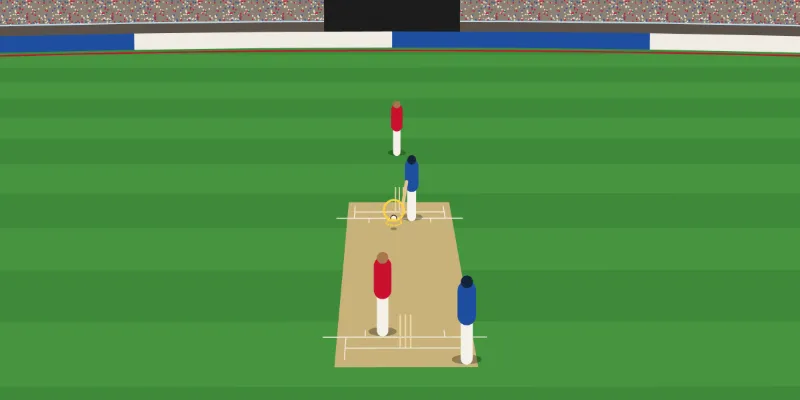
- Players
- 1, up to 4 taking turns on one phone, or 2 to 4 online
- What you need
- A bat, a ball, a ground and two sides
- How long
- About two minutes a chase, five for a whole match
At a glance
| Overs | Wickets | Target: easy, medium, hard |
|---|---|---|
| 1 | 2 | 8, 10, 11 |
| 2 | 3 | 16, 19, 21 |
| 5 | 5 | 38, 45, 50 |
Today's chase is always two overs against the medium side, with a target from 16 to 22 set by the day.
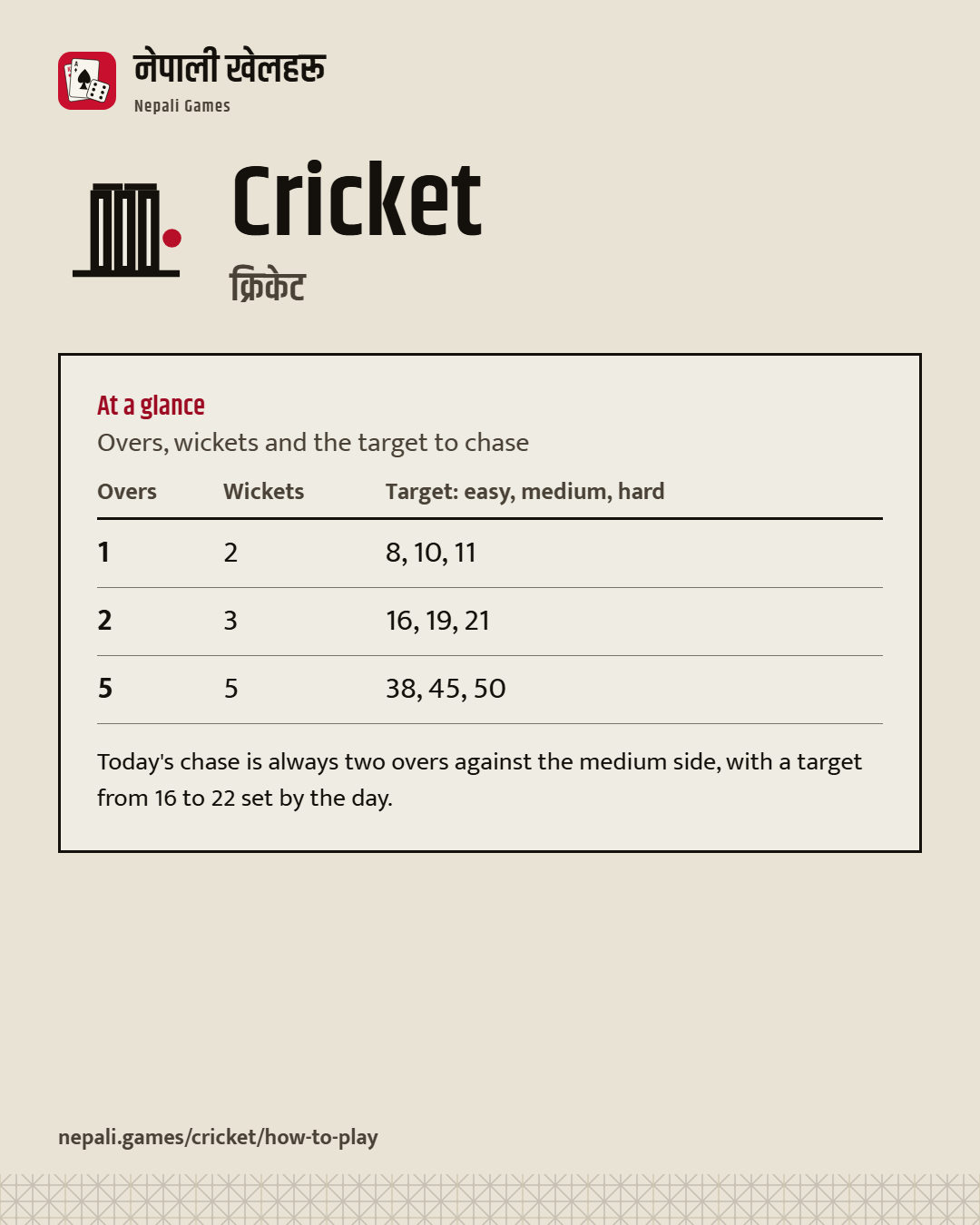 The same table on one card, to keep on your phone or send to the family group. Tap to open it.
Rules checked 20 October 2026. How these rules are written
What it is
A short cricket match, played ball by ball. In the usual game you have two overs and three wickets to chase the other side's target: twelve balls, about two minutes. You can also play a whole match with a toss, take today's chase, try a challenge, practise in the nets, play a season of the city league, take turns on one phone, or play a friend online.
The camera sits in the stand behind the bowler, as a television broadcast does, so you see the batter facing you and the field around them. Every ball is a flight the rules work out, and the ball goes where your swipe and your timing send it.
A ball
- The bowler runs in. With Help on, the screen names the bowler and the delivery.
- The ball pitches and comes on to the bat. With Help on, a dashed mark shows where it will pitch and a ring closes on it at the moment to swing.
- You swipe, or tap, as it reaches the bat. If you do nothing, the ball goes past and is left alone.
- The camera follows the ball over the field. A fielder catches it, stops it or watches it reach the rope, and the runs go into the over strip.
Where the swipe sends the ball
Swipe anywhere on the picture, in the direction you want the ball to go as you see the ground. The swipe is read through the camera, so the ball goes where your finger pointed.
- A short swipe keeps the ball along the ground. It cannot be caught, and fours come from finding the gaps between fielders.
- A long swipe lifts the ball. Struck well, it clears the rope for six. Struck badly, it hangs in the air for a fielder.
- A faster swipe hits harder. A harder hit asks for better timing.
- A tap defends. The ball dies near the bat and the stumps are safe.
Tap controls are the simpler way: tap the left, middle or right third of the screen as the ball arrives, in the upper part to lift it. Choose them in the settings.
Before the ball arrives you can move your feet: step down the pitch to meet a ball before it turns or bounces, or go back to give yourself more time against a short one. Stepping down takes a full ball on the half-volley, and leaves you stranded if you miss.
The length decides the stroke
Where a ball pitches decides how high it reaches the bat. A full ball suits a drive, which is a swipe down the screen. A short ball suits a cut or a pull, which is a swipe across it.
Playing the wrong stroke for the length costs contact. So does hitting across the line to a ball outside off stump, and lifting a yorker is hard. With Help on, the length is named as the ball is bowled.
Timing
The bat has to come through as the ball reaches it. Perfect timing sends the ball at its full speed. Early timing pulls the ball toward the leg side and late timing pushes it toward the off side, as a real bat does, and both cost speed.
With Help on, a swing made a little early waits for the ball and meets it nearly on time. The ball speed setting slows the whole flight down, which makes timing easier without changing where the ball goes.
Bowling
- At the start of each over pick the bowler. Nobody bowls two overs in a row, and nobody bowls more than a fifth of the overs. Then pick one of their three deliveries: outswing, inswing and a slower ball or a cutter for pace, off break, leg break or an arm ball for spin.
- Tap the pitch where the ball should land. With Help on, the pitch is marked in its lengths.
- A needle sweeps a meter. Tap again to stop it. Green lands the ball on your spot at full pace, further out it lands wider and slower. Picked the wrong spot? Move the spot, beside the meter, or Escape on a keyboard, takes it back so you can tap the pitch again.
Set the field for the over too. An attacking field brings fielders in close for catches, a defensive one spreads them out to save fours, and a balanced field is in between. The other side's captain moves fielders into the gaps you keep hitting.
The bot bats like a person: it cuts a short ball outside off, pulls one at the body, drives a full one, and lifts the ball more when it needs runs. Yorkers are hard to hit. Short balls are hit hard.
Runs and wickets
- Six: the ball clears the rope without touching the ground.
- Four: the ball reaches the rope along the ground.
- One, two or three: the batters run while a fielder gets to the ball and throws it in. A ball hit straight at a fielder is no run.
- A ball fielded on the ground gives the batters the runs that are safe. A Run button then offers one more: take it and the batters go for it, and the closer the throw, the likelier the run-out.
- Caught: a fielder takes the ball before it touches the ground. Fielders drop a hard chance now and then.
- Bowled: the ball hits the stumps. A ball left alone that would hit the stumps is out too.
- Leg before wicket: the ball hits the pad in line with the stumps and would have gone on to hit them.
- Stumped: you step down the pitch, miss, and the keeper breaks the stumps before you get back.
- Run out: the throw breaks the stumps before a batter reaches the crease.
- Edges: a bat that meets the ball badly sends it off an edge, behind the wicket for the keeper and slips, or high in the air off the top.
- Wide: a ball that passes too far from the batter. One run, and the ball is bowled again.
- No-ball: a ball over waist height on the full, or, with Help off, a bowl with the meter stopped in the red. One run, the ball again, and the next ball is a free hit you cannot be bowled, caught or given leg before off.
The kinds of match
Chase a target: you bat, the bot bowls, and you have the overs and the wickets to pass its target. The target is what the bot's own batters make at that level, plus one.
A whole match: a toss, then an innings each. The side batting second chases the first side's total. Whoever won the toss chooses to bat or bowl first, and a tie is settled by a super over.
Today's chase: two overs against the medium side, with a target set by the day. Everybody in Nepal gets the same balls, whatever they do with them.
On one phone: two to four people bat an innings each at the same balls, passing the phone between innings. The most runs wins.
Challenge a friend: after a chase, share a link that carries the same balls and your runs to beat. Nothing is sent anywhere until they open it.
Challenges: six short tasks, such as hitting three sixes in an over, surviving twelve yorkers or defending eight in the last over.
The nets: face whatever you ask for, any kind of bowler and any length, as often as you like. Nothing is scored.
The city league: your side plays Nepal's eight cricket cities a whole match each, the cities play each other as the season goes, and the top two meet in a final.
Online: race up to three friends at the same balls, all batting at once, most runs winning, or play a friend a whole match, a side each, bowling to each other ball by ball. Each ball is played on the batter's own phone, so a slow connection costs time and never a run.
Your squad: choose your eleven, their batting order, how each one bats and bowls, and your kit. Each style trades something for something, an anchor's safety for a hitter's power, and the styles are earned by playing, never bought.
How a match ends
A chase ends when the target is passed, the wickets are gone or the overs are bowled. Three wickets for two overs, two for one, five for five.
A whole match is won by runs when the side batting first defends its total, and by wickets when the chase gets there. A chase keeps how well you won it, balls to spare and then wickets in hand, and a whole match keeps your most runs.
Tactics
- Read the length before you choose the stroke. Most wickets come from driving a short ball or pulling a full one.
- Keep the ball on the ground until the rate climbs. Fours along the ground are safe runs.
- Lift a full ball that is on the stumps, not a short one outside off.
- When bowling, yorkers and a good length on off stump are hard to score from. Mix in a slower ball.
Options
Set on the game page before a match. The batting controls, the ball speed and Help change what you see and how a swipe is read, never what the rules decide.
| Setting | Standard | What it changes |
|---|---|---|
| Match | Chase a target | A chase, a whole match with a toss, or today's chase. |
| Overs | 2 overs | One, two or five overs an innings, with two, three or five wickets. |
| The other side | Medium | How well the other side bowls, bats and holds catches. |
| Batting | Swipe where the ball should go | Swipe in any direction, or tap a third of the screen. |
| Ball speed | Normal | Plays the ball slower or at real speed. The flight and the result are the same. |
| Help | On | The pitch mark, the ring, the length, the early swing that waits, and the bowling lengths. With Help off, a meter stopped in the red is a no-ball. |
Words
- Over (ओभर)
- Six balls from one bowler. Wides are bowled again and do not count.
- Wicket (विकेट)
- The three stumps, and a batter out.
- Length
- How far down the pitch a ball lands: yorker, full, good length, short.
- Yorker
- A ball that pitches at the batter's toes. Very hard to hit.
- Swing
- A pace bowler's ball moving sideways in the air before it pitches.
- Spin
- A slow bowler's ball turning off the pitch.
- Wide
- A ball that passes too far from the batter: a run, and bowled again.
- Target (लक्ष्य)
- The runs the side batting second has to make to win.
How other families play it
Every family plays it a little differently. These are the ways we know of. The ones with a button are house rules this table can play.
A whole match with a toss
A toss, then an innings each, with the side batting second chasing the first side's total. Whoever wins the toss chooses to bat or bowl, and a tie goes to a super over. It is a choice on the game's page.
Five overs a side
Five overs and five wickets, with a target of 45 against the medium side. Long enough to build an innings rather than swing from the first ball. It is a setting.
Questions people ask
How do you bat in this cricket game?
Swipe on the screen the way you want the ball to go, as it reaches the bat. A short swipe keeps it on the ground, a long one lifts it, and a tap defends. A setting gives tap controls instead: tap the left, middle or right third of the screen.
How do you hit a six?
Swipe long to lift the ball and time it well. A full ball on the stumps is the one to lift. Struck well, a lifted ball clears the rope for six, and struck badly it hangs in the air for a fielder.
How many overs is a match?
Two overs and three wickets, as the table comes. A setting makes it one over with two wickets, or five overs with five wickets.
What is the target in a two-over chase?
19 against the medium side, 16 against the easy side and 21 against the hard one. Today's chase sets a target from 16 to 22, the same for everybody that day.
Can you be out LBW in this game?
Yes. The batter is out leg before wicket when the ball hits the pad in line with the stumps and would have gone on to hit them. You can also be bowled, caught, stumped or run out.
What is a free hit?
The ball after a no-ball. You cannot be bowled, caught or given leg before off it.
How is a tie settled?
In a whole match, by a super over: six balls and two wickets a side, the side that batted second batting first. If the super over is level too, the match is tied.
Can I play cricket with a friend online?
Yes. Race up to three friends at the same balls, everybody batting at once and most runs winning, or play one friend a whole match, a side each, bowling to each other ball by ball.
Every rule on this page is the one the app plays by. Change any of them on the game's own page before you start.