How to play Bridge
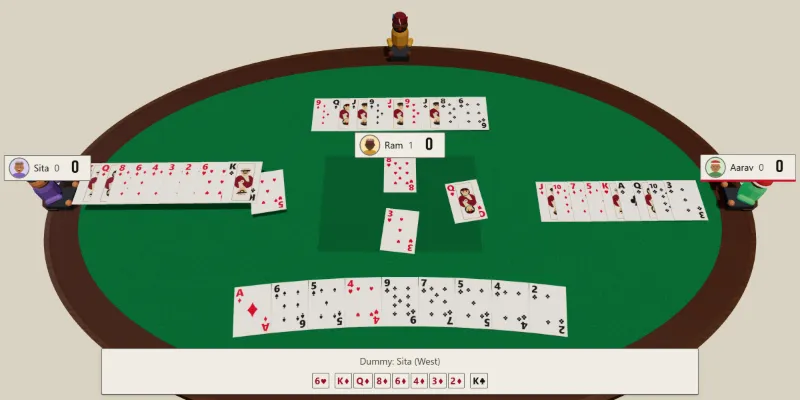
Bridge is the partnership card game played in clubs and tournaments all over the world, for four players in two sides with the full pack of 52. An auction decides the contract: how many tricks one side promises to take, and which suit is trumps. The declarer then plays both their own hand and their partner's, which lies face up on the table as dummy.
- Players
- Exactly 4, in two partnerships
- What you need
- A standard 52-card pack
- How long
- A Chicago of four deals, or eight or twelve
What it is
Four players sit at a square table, partners opposite. Bridge players name the seats by the compass: North and South are one side, East and West the other. In the app you always sit at South, with your partner across the table at North.
Every deal has two halves. In the auction the four players bid for the right to name trumps, each bid a promise to take a number of tricks. In the play the side that won the auction tries to keep its promise and the other side tries to stop it. The score depends on the contract, on how many tricks were taken, and on whether the side was vulnerable.
The deal
- All 52 cards are dealt, one at a time from the dealer's left, so everybody holds thirteen. Aces are high, then king, queen, jack and ten down to two.
- The dealer makes the first call of the auction, and the calls go round to the left.
- If all four players pass without a bid, nobody plays the deal. The same dealer shuffles and deals again.
The match is a Chicago of four deals, one dealt by each player. Being vulnerable raises the bonuses for making a game or a slam and the penalties for going down, so the same contract can be worth more or cost more on a different deal.
The auction
A bid is a level from one to seven and a strain: a trump suit or no trump. The level is the number of tricks over six you promise to take, so a bid of 4♠ promises ten tricks with spades as trumps.
Every bid must be higher than the one before. A higher level always beats a lower one, and at the same level the strains rank clubs, diamonds, hearts, spades and then no trump. After 2♥ the next player may bid 2♠, 2NT, or anything at the three level or above.
Instead of bidding you may pass. You may double the last bid if an opponent made it, which raises the score for both sides, and the side that was doubled may redouble. A new bid wipes out a double.
The auction ends when three players pass in a row after a bid. The last bid is the contract. The declarer is the player on the winning side who first named the contract's strain, and the declarer's partner is dummy.
The play
- The player on the declarer's left leads the first card.
- Then dummy lays all thirteen cards face up on the table, sorted by suit. From now on the declarer plays dummy's cards as well as their own, each in its turn.
- Everybody follows the suit led if they can. If you cannot, you may play a trump or throw any card.
- The highest trump wins the trick, or the highest card of the suit led if nobody trumped. The winner leads the next trick, from dummy if dummy won it.
In the app, when you are declarer, tap dummy's cards when it is dummy's turn, on the table or in the strip that shows dummy's hand. When your partner is declarer, your hand becomes dummy and your partner plays it.
Scoring
If the declarer's side takes at least the tricks it bid, it scores 20 for each trick bid over six in clubs or diamonds, 30 in hearts or spades, and in no trump 40 for the first and 30 for each after. Doubled that score is doubled, and redoubled it is four times as much.
A trick score of 100 or more is a game, worth a bonus of 300, or 500 vulnerable: 3NT, 4♥, 4♠, 5♣ and 5♦ are the cheapest games. Anything less is a part score and gets 50.
A small slam, six of anything, adds 500, or 750 vulnerable. A grand slam, all thirteen tricks bid, adds 1000, or 1500 vulnerable. Each trick over the contract counts at its trick value, or 100 if doubled, 200 if doubled and vulnerable, and twice those redoubled. Making a doubled contract adds 50, and a redoubled one 100.
If the declarer's side falls short, the defenders score for each trick it is down: 50 each, or 100 vulnerable. Doubled it is 100 for the first, 200 for the second and third and 300 for each after, or vulnerable 200 for the first and 300 for each after. Redoubled, twice that.
So 4♠ made exactly, not vulnerable, is 120 and 300, which is 420. 3NT with an overtrick, vulnerable, is 100, 500 and 30, which is 630. Scores add up over the Chicago, and the side with more at the end wins.
How the bots bid
Three of the four players are bots, so their bids are all you know about their hands. They bid a small natural system after Standard American, the one taught first in most clubs, and they read your bids the same way.
- Points: ace 4, king 3, queen 2, jack 1. An opening bid needs about 12, and 25 between two partners is enough for game.
- Opening: one of a major (1♥ or 1♠) with five or more cards in it, otherwise the longer minor. 1NT is 15 to 17 with no long or very short suit, 2NT is 20 or 21, 2♣ is 22 or more. 2♦, 2♥ and 2♠ are weak: a good six-card suit and 5 to 10 points.
- Responding to one of a suit: raise to two with support and 6 to 9, to three with 10 to 12, to game with 13 to 16. A new suit is forcing. 1NT is 6 to 10, 2NT 11 or 12, 3NT 13 to 15.
- Over 1NT: 2♣ asks for a four-card major (Stayman). 2♦ shows five hearts and 2♥ five spades, and the opener bids the suit shown (transfers). 2NT invites game and 3NT is game.
- Against an opening: an overcall is a good five-card suit and 8 to 16. A double of a suit bid at a low level is for takeout, asking partner to bid. A double of no trump, of a game, or late in the auction is for penalty.
- After that the bots add their points to what their partner has shown, look for a fit of eight trumps or more, and bid game or slam when the points are there.
You do not have to play the same system, but the bots will read your bids as if you did.
Playing it well
- Look for a fit in a major. Eight cards between you in hearts or spades usually plays a trick better than no trump.
- As declarer, count your sure tricks before you play to the first trick, and plan where the rest will come from.
- Draw the opponents' trumps early when you have most of them, so they cannot ruff your winners.
- As a defender, lead your partner's suit if they bid one, and return it when you get in.
Settings
There are no house rules: the scoring is the table every club uses. The settings change how long the match is and how strong the bots are.
| Setting | Standard | What it changes |
|---|---|---|
| Match length | 4 deals | Eight or twelve deals play two or three Chicagos in a row, with the vulnerability starting again at each. |
| Difficulty | Medium | Easy miscounts its points and never doubles for penalty. Hard plays out many guesses at the hidden hands before each card. |
The words
- Contract
- The final bid: how many tricks over six the declarer's side must take, and the trump suit or no trump.
- Declarer
- The player who plays the contract, both their own hand and dummy's.
- Dummy
- The declarer's partner, whose hand lies face up and is played by the declarer.
- Vulnerable
- A side that gets bigger bonuses for game and slam and bigger penalties for going down, set by the deal in a Chicago.
- Game
- A contract worth 100 or more in trick score: 3NT, 4♥, 4♠, 5♣ or 5♦ and anything higher.
- Slam
- A contract for twelve tricks (small slam, six) or all thirteen (grand slam, seven).
- Points
- High-card points, the count bidding starts from: ace 4, king 3, queen 2, jack 1, forty in the pack.
- Stayman and transfers
- Bids over partner's 1NT that do not mean what they say: 2♣ asks for a major, 2♦ and 2♥ show the next suit up.
Every rule on this page is the one the app plays by. Change any of them on the game's own page before you start.