How to play Sho
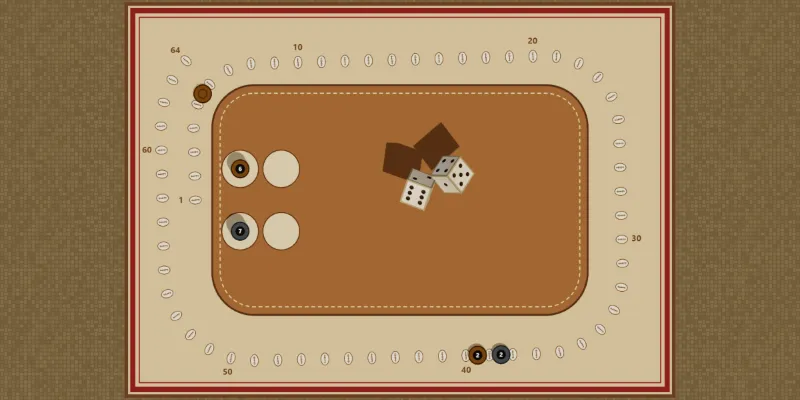
Sho is the dice game Tibetans and Sherpas throw at Losar: two or three players, nine coins each, and a spiral of sixty-four cowries round a leather pad. The dice are slammed down from a wooden cup, coins stack as they land together, and the first to take all nine past the last shell wins.
- Players
- 2-3
- What you need
- 64 cowries, a leather pad, two dice, nine coins each
- How long
- Ten to twenty minutes a game
What the game is
Sho (ཤོ) is played across Tibet, and in Nepal by Sherpas in Solukhumbu and by the Tibetan families of Boudha and Jawalakhel. It is a men’s game and a gambling game, played for days at a time over Losar, the Tibetan new year, with the stakes tucked under the pad.
It is a race, as Ludo is, but the pieces are stacks. Coins of one player that land together stay together and move together, a stack sends home any stack of another player no bigger than itself, and a bigger one blocks it. So the game is about building stacks and choosing when to run them.
The rules here are the ones players in Lhasa gave the anthropologist Daisuke Murakami (Revue d’Etudes Tibétaines, 2014), with the points other accounts disagree on as settings. Christoph von Fürer-Haimendorf photographed a Sherpa playing it in 1957, and the sets sold in Kathmandu for Losar are the same game.
The pad and the spiral
The dice are thrown onto a round pad of yak leather stuffed with wool. Round it, sixty-four cowrie shells are laid in a spiral that turns clockwise, a little over once, so its end lies just outside its start.
Coins stand in the gaps between shells, not on them. A throw of 7 puts a coin in the gap after the seventh shell. Past the sixty-fourth shell is home.
Each player has nine coins, usually old coins of whatever kind is to hand. Here they are brass, steel with a square hole and copper with a round one.
A turn
- Throw the two dice. At Losar they are shaken in a wooden cup and slammed face down on the pad.
- Add them up. Only the total counts, never the two dice on their own.
- Move one of your stacks that many gaps round the spiral, or bring one coin in from your hand to that gap.
If nothing you have can use the throw, it is lost and the dice pass on. Play goes round the pad in turn.
The opening throw
Your first throw brings two coins in at once, as one stack, as many gaps along as the dice show. A total of 3, or a 1 and 1, brings in three instead.
If your first throw lands on another player’s opening stack, it kills it, and you put three coins down there instead of two and throw again. A bigger stack there refuses you, and you try again next turn.
Moving, and stacks
A stack moves as one, the whole total, and passes over anything on the way. Only the gap it lands in matters.
Land in an empty gap and your turn is over. Land on a stack of your own and the two become one, and you throw again.
A stack never splits. A tall stack is hard to kill and kills everything smaller, but every coin in it is lost at once if it is killed.
Killing, and blocking
Land on another player’s stack that is the same size as yours or smaller, and you kill it: its coins go back to its owner’s hand, to come in again one at a time. You take the gap, and you throw again.
A stack bigger than yours cannot be landed on. If that is your only move, the throw is lost.
Pa ra
A 1 and a 1 is pa ra. Nothing moves yet: the 2 waits, and you throw again at once.
Then you may move 2 and the new total separately, with one stack or two, or both together with one stack. If one of those moves kills or joins a stack, you throw again with the other still waiting, and the two can be added to the new throw. That is how a stack can travel more than twelve gaps in a turn.
The six-three
If every one of your coins has been killed back to your hand, a 6 and a 3 can bring all nine in at once, as one stack in the ninth gap, if nobody stands there. Not every account has this rule, so it is a setting.
How a game is won
A stack that moves past the sixty-fourth shell goes home. Any throw that passes it will do, unless the house plays that it must land exactly. The first player to take all nine coins home wins.
A game here also stops after 2,000 throws, which a real game never reaches, and then whoever has most coins home wins. Most games take a hundred to two hundred throws.
Tactics
- Join your coins into stacks. A stack of three can only be killed by three or more, and it kills every single coin it lands on.
- Before you leave a stack somewhere, look behind it. Another player’s stack six to eight gaps back, at least as big as yours, has the best odds of reaching it.
- A single coin brought in near the start is cheap to lose. A tall stack near the end is the whole game, so move it when it is safe.
- After a pa ra, look for a move with one value that kills or joins. It throws again, and the other value grows.
Settings
Players in Lhasa, the Wikipedia account and the rule sheets agree on most of Sho and differ on a few points. Those points are the settings.
| Setting | Standard | What it changes |
|---|---|---|
| Difficulty | Medium | Easy kills or joins a stack when it can and otherwise runs furthest. Medium weighs what each kill is worth. Hard also reads every stack behind its own and builds stacks tall. |
| Going home | Any throw that passes it | Whether a stack goes home on any throw that passes the last shell, or only on one that lands just past it. |
| Six-three brings all nine in | On | Whether a 6 and a 3 brings all nine coins back in for a player who has nothing out. |
| Three pa ras in a row | Off | Whether three pa ras in a row win the game on the spot. |
Words
- Sho (ཤོ)
- Dice, and the game played with them. It is also called sho para.
- Pa ra (པ་ར)
- A 1 and a 1. You throw again before moving, and the 2 waits to be spent with the next throw.
- The pad
- The round of yak leather stuffed with wool that the dice are slammed onto, with the stakes underneath.
- The cowries
- The sixty-four shells laid in a spiral round the pad. Coins stand in the gaps between them.
- A stack
- Coins of one player in one gap. They move together and never split.
- A kill
- Landing on another player’s stack no bigger than yours, which sends its coins back to their hand.
- Losar (ल्होसार)
- The Tibetan and Sherpa new year, when Sho is played most.
Every rule on this page is the one the app plays by. Change any of them on the game's own page before you start.