How to play Blackjack
Also called twenty-one (एक्काइस), and written ब्ल्याकज्याक in Nepali. Pontoon and Vingt-et-un are its relatives played at home.
Blackjack is a card game where every player plays their own hand against the dealer, trying to get closer to 21 than the dealer without going over. On your turn you hit for another card, stand, double your bet for exactly one more card, or split a pair into two hands. Over 21 loses at once, the dealer draws to 17, and a hand that beats the dealer's wins as much as it bet, or three to two for a blackjack.
A blackjack is an ace and a ten-card as your first two. The chips here belong to the table and are not money.
Set the table up with your own house rules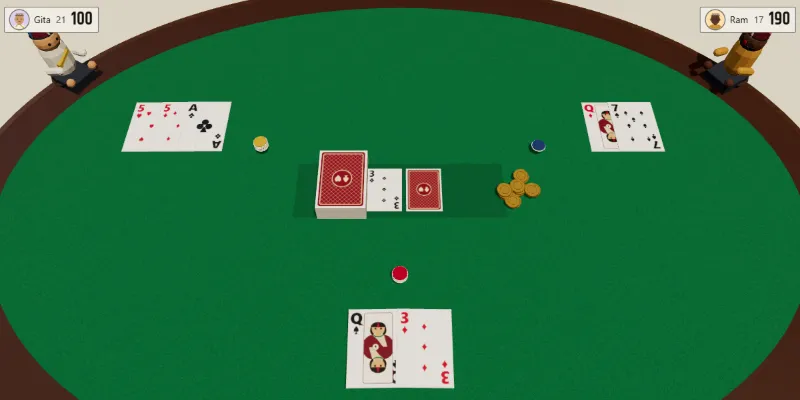
- Players
- 2 to 6, and the dealer
- What you need
- One pack of 52 cards and a pile of chips
- How long
- Ten rounds, or until the table stops
At a glance
| What | Counts or pays |
|---|---|
| Two to ten | Its number |
| Jack, queen, king | 10 |
| Ace | 11, or 1 if 11 would go over 21 |
| The dealer | Draws to 17, stands on soft 17 |
| Beat the dealer | Your bet again, one to one |
| Blackjack | Three to two |
| Same count as the dealer | A push: your bet back |
| Over 21 | Bust: the bet is lost |
A blackjack is an ace and a ten-card as the first two cards, and it pays rounded down to a whole chip. A house rule has the dealer take a card on soft 17.
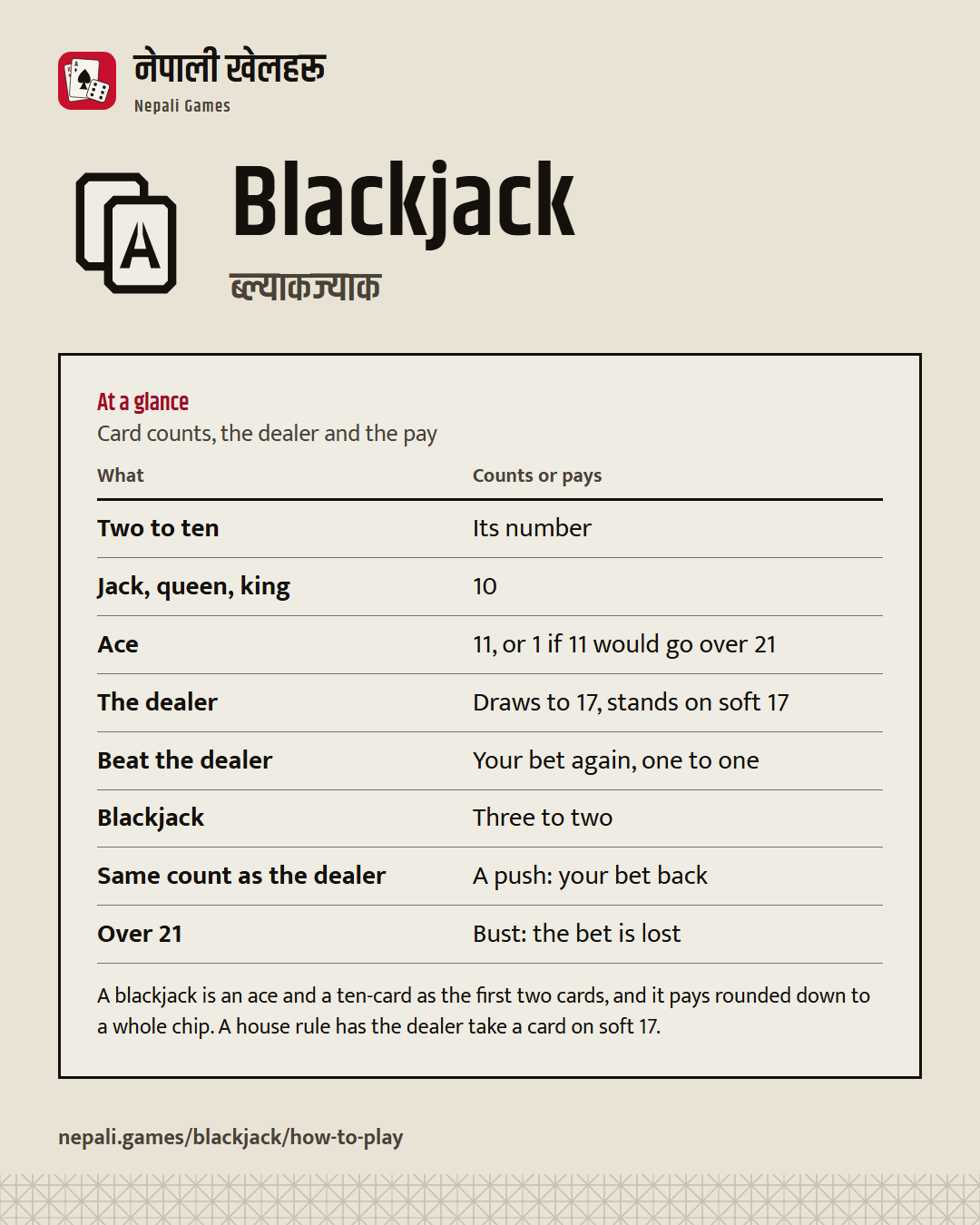 The same table on one card, to keep on your phone or send to the family group. Tap to open it.
Rules checked 20 October 2026. How these rules are written
What Blackjack is
Blackjack is twenty-one, the staple card game found at every casino table, and often played at home as Pontoon or Vingt-et-un. In Nepal, it is well-known from the casinos in Kathmandu and popular films.
Players do not compete against each other. Instead, everyone plays against the dealer, who represents the house and follows strict, fixed rules. This makes the table cooperative in a way that pot games are not. When the dealer goes bust, everyone still standing wins together.
What the cards count
A card from two to ten counts its number. A jack, a queen or a king counts ten. An ace counts eleven, or one when eleven would take the hand over 21. A hand counts the sum of its cards.
A hand with an ace counted as eleven is soft: it cannot go bust on the next card, because the ace can drop to one. Without one it is hard.
A round
- A fresh pack is shuffled. Seat by seat, everybody puts out a bet from the table's sizes.
- Two cards go to every seat face up, and two to the dealer: the first face up, the second face down. That one is the hole card.
- If the dealer's up card is an ace or worth ten, the dealer looks under it. A dealer with blackjack turns it over at once, and the round is settled there.
- Otherwise each seat plays its hand in turn: hit, stand, double or split.
- Last the dealer turns the hole card over, draws by the rule, and every hand still standing is paid or taken.
Your four moves
Hit: take another card. Take as many as you like, one at a time. At 21 you stop by yourself, because another card could only lose.
Stand: keep what you have, and the turn passes.
Double: put out as much again as your bet, and take exactly one more card. Allowed on any first two cards. It is the move for a hand that one good card will make.
Split: two cards of the same value can be split into two hands, with a bet on each, and each is dealt a second card. A king splits with a queen. Each hand is then played on its own, and either may double. Split aces take one card each and stop, and 21 on a split hand counts as 21, not blackjack. A seat splits once.
The dealer
The dealer decides nothing. After every seat has played, the dealer turns the hole card over and takes cards until the hand counts 17 or more.
On a soft 17 the dealer stands, unless the table has agreed the dealer takes a card, which is the rule at many casinos and slightly worse for the players.
If every hand is bust or a blackjack, there is nothing to beat, and the dealer only turns the hole card over.
What each hand pays
Closer to 21 than the dealer, or still standing when the dealer goes bust: you win as much as you bet.
The same count as the dealer: a push, and your bet comes back.
Blackjack, an ace and a ten-card as your first two: you win three for every two you bet, rounded down to a whole chip. It ties a dealer's blackjack, which beats every other hand.
Over 21: bust, and the bet is lost straight away, even if the dealer goes bust after you.
Playing a hand well
The dealer's up card is half the decision. Against a two to six the dealer is likely to go bust, so stand on 12 or more against a four, five or six, and on 13 or more against a two or three. Against a seven or more, hit until you have 17.
Double on 11 against anything but an ace, on 10 against a nine or less, and on 9 against a three to six. Always split aces and eights. Never split tens or fives: twenty is a good hand, and two fives are a ten to double on.
That chart is called basic strategy, and played exactly it leaves the house less than a chip in every hundred. The computer's best players use all of it, and size their bets by where they stand in the match.
The match
A match is a set number of rounds, the first seat to bet moving on one each round. Or it has no number at all, and whoever made the table ends it between rounds. It ends early when fewer than two seats have chips left.
The biggest pile at the end wins. A shared top pile is a draw. The house pays from a bank with no bottom, so a whole table can finish up. The chips belong to this table and are not your coins.
At this table
The dealer's cards lie across the middle, beside the house's heap of gold. Every seat's cards lie in front of it face up, with its count in its label and its bet as a stack of chips. On your turn the status line says what you have against the dealer's up card. While the table bets, the buttons below are the table's sizes. While it plays, they are Hit, Stand, Double and Split, and only what you may do can be pressed. Several people can share one phone: everybody's cards are face up anyway, so there is nothing to hide.
Options
Every table here plays the rules above. These are what a table agrees before the first bet.
| Setting | Standard | What it changes |
|---|---|---|
| Players | 3 | Two to six seats against the dealer. |
| Rounds | 10 | How many rounds a match lasts, or no limit, when the table plays on until it is ended between rounds. |
| Chips each | 200 | The pile each seat starts with. |
| Least bet | 10 | The smallest bet. The table's sizes are it, twice it, five times and ten times. |
| On a soft 17 the dealer | Stands | Whether the dealer stops on a soft 17 or takes another card. |
| Difficulty | Medium | How well the computer plays: from drawing to 17 like the dealer, to the whole of basic strategy with its bets sized by the match. |
The words
- Blackjack
- The game, and the hand that names it: an ace and a ten-card as the first two. Also twenty-one.
- Hit
- Take another card.
- Stand
- Take no more cards.
- Bust
- Over 21, which loses.
- Soft
- A hand with an ace counted as eleven.
- Push
- A tie with the dealer. The bet comes back.
- Hole card
- The dealer's face-down card, turned over when the seats have played.
How other families play it
Every family plays it a little differently. These are the ways we know of. The ones with a button are house rules this table can play.
The dealer hits soft 17
Many casinos print this rule on their felt: the dealer takes another card on a soft 17. It is slightly worse for the players. The table here stands on soft 17 by default, and the setting makes the dealer hit.
Insurance
At a casino, when the dealer shows an ace, players may make a side bet that the dealer has blackjack. A player who knows the odds never takes it, and the table here does not offer it.
Surrender
Some casinos let a player give up a hand at the start for part of the bet back. Basic strategy answers that the same way almost every time, so the table here leaves it out.
A shoe of several packs
Casinos deal from a shoe of several packs down to a cut card, which makes counting cards harder. The table here shuffles one fresh pack every round.
Questions people ask
How do you play Blackjack?
Everybody bets, then gets two cards face up, and the dealer gets one up and one face down. Each player in turn hits, stands, doubles or splits, trying to get closer to 21 than the dealer without going over. Then the dealer draws to 17, and every hand still standing is paid or taken.
What is an ace worth in Blackjack?
Eleven, or one when eleven would take the hand over 21. A hand with an ace counted as eleven is soft, and it cannot go bust on the next card.
When does the dealer stand in Blackjack?
On 17 or more. By default the dealer also stands on a soft 17, such as an ace and a six. A house rule makes the dealer take a card on soft 17, as many casinos do, which is slightly worse for the players.
What does a blackjack pay?
Three to two: a bet of 10 wins 15, rounded down to a whole chip. It ties a dealer's blackjack, which beats every other hand.
Can you split any pair in Blackjack?
Any two cards of the same value, so a king splits with a queen. Each hand gets its own bet and a second card and is played on its own. A seat splits once, split aces take one card each, and 21 on a split hand is not a blackjack.
When can you double down in Blackjack?
On any first two cards, including a hand made by a split. You put out as much again as your bet and take exactly one more card. You need the chips to match the bet.
Is there insurance or surrender at this Blackjack table?
No. Insurance is a side bet a player who knows the odds never takes, and surrender is a choice basic strategy answers the same way almost every time, so the table leaves both out.
How many packs are used here?
One, shuffled fresh every round. Casinos deal from a shoe of several packs to make counting cards harder, which buys nothing here.
Every rule on this page is the one the app plays by. Change any of them on the game's own page before you start.