How to play In Between
Also written inbetween and in-between, and इन बिट्विन in Nepali. Elsewhere the same game is called Acey Deucey (एसी ड्युसी) or Red Dog.
In Between is a betting card game for two to six players round a pot. On your turn your two cards are turned up as posts, and you bet, from the boot up to the pot, that the next card off the pack falls between them, or you pass. Between wins your bet out of the pot, outside or on a post loses it, and after the last round the biggest pile wins.
Onlinekhabar lists it among the card games of Dashain, and elsewhere it goes by Acey Deucey or Red Dog. The chips here belong to the table and are not money.
Set the table up with your own house rules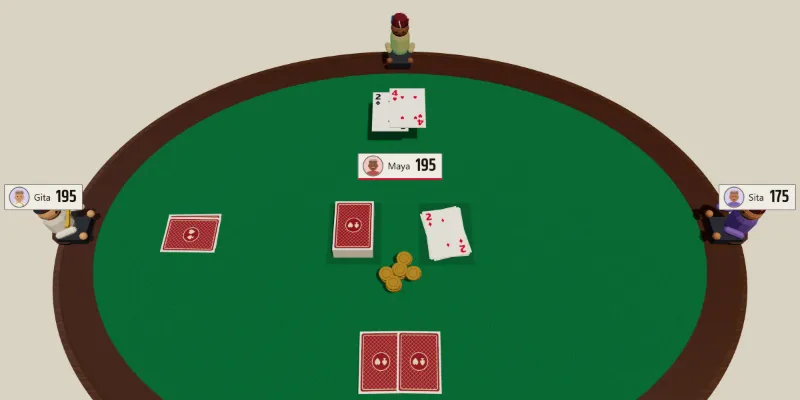
- Players
- 2 to 6
- What you need
- One pack of 52 cards and a pile of chips
- How long
- Five rounds of one turn each, or until the table stops
At a glance
| The third card | Your bet |
|---|---|
| Between the posts | Won: take it out of the pot |
| Outside the posts | Lost: put it in the pot |
| The same value as a post | Lost, or twice the bet with the house rule |
| Posts a pair, or next to each other | No bet: the turn passes |
Aces are high. You bet from the boot up to the pot, or up to what you hold if that is less. When a bet empties the pot, everybody puts the boot in again.
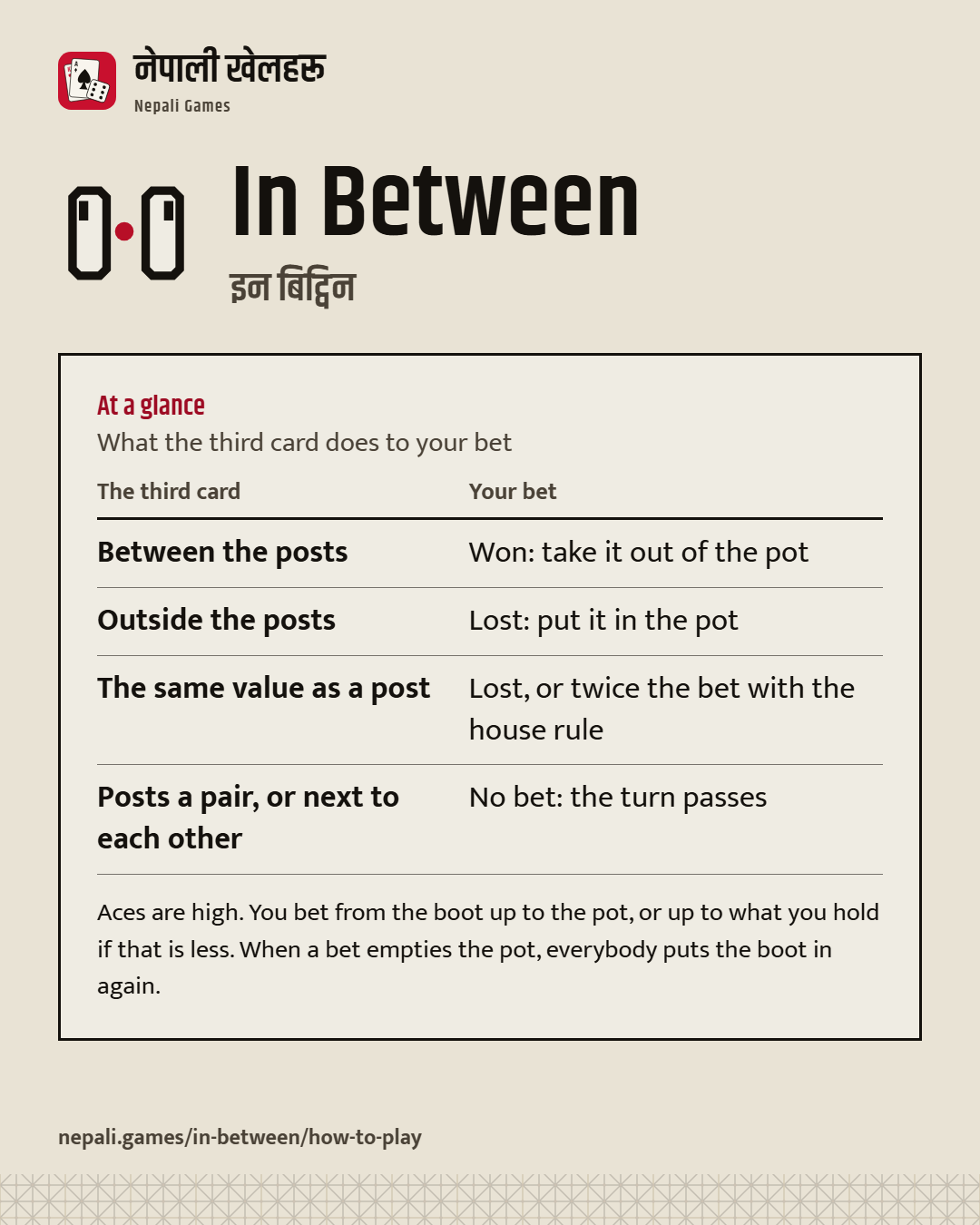 The same table on one card, to keep on your phone or send to the family group. Tap to open it.
Rules checked 20 October 2026. How these rules are written
What In Between is
In Between is heavily featured on lists of popular Dashain card games. It is purely a betting game, known elsewhere as Acey Deucey or Red Dog.
Players don't hold a traditional hand. Your two cards merely act as goalposts, and every turn revolves around calculating the odds of the third card landing between them and deciding how much of the pot you dare to risk.
The pot
At the start everybody puts the boot into the middle. That is the pot, and every bet is made against it: a winning bet comes out of it and a losing one goes into it.
Nobody may bet less than the boot or more than the pot holds. When a bet empties the pot, everybody puts the boot in again at once, so there is always something to play for. That is the only time it is paid again.
A turn
- A fresh pack is shuffled at the start of each round and dealt round the table one card at a time until everybody holds two, face down. You may look at your own.
- When your turn comes your two are turned over for everybody to see. These are the posts.
- Bet from the boot up to the pot that the next card off the pack will fall strictly between them, or pass. The card is turned, and the bet is settled.
- The turn passes to the next player, whose two are turned over in their turn.
Where the third card lands
Between the posts, and you win: take your bet out of the pot.
Outside them, and you lose: put your bet into the pot.
The same value as either post, and you have hit the post. You lose the bet, and at tables that play it hard, twice the bet.
Nothing between
Two posts of the same value, or two next to each other, leave no value between. They are turned over so everybody sees them, and since there is nothing to bet on, the turn passes by itself.
Judging a spread
Count the values between the posts. A three and a queen have eight between them, four to jack, which is thirty two of the fifty cards still to come: a better than even chance. A five and a nine have three between them, and the odds are well against you.
Every card turned is face up, so a player who remembers them knows what has gone. The pack is fresh every round, so the count starts again each time, and a wide spread late in a round of six is worth a little less than it looks.
The computer’s best players bet the most they may whenever the odds are on their side, and pass otherwise. Played against each other, betting big on good spreads won more matches than betting a share of the pile.
The match
A match is a set number of rounds, each one turn for everybody, the first turn moving on a seat each round. Or it has no number at all, which is how the game is played at a real table: it goes on until the people at it agree to stop, and then whoever made the table ends it between rounds.
At the end, whatever is left in the pot is shared out equally, and the biggest pile wins. A shared top pile is a draw. The chips belong to this table and are not your coins.
At this table
Your two cards are dealt in front of you, face up to you and face down to everybody else. On your turn they are printed in the status line with how many values lie between them. The buttons below are your bets: Pass, the table’s sizes from the boot up, and the most you may, which is the pot or everything you have. The third card lands among your posts in order of value, so you can see at once whether it fell between. When several people share one phone, nobody’s cards are shown before their turn.
Options
Every table here plays the rules above. These are what a table agrees before the first boot.
| Setting | Standard | What it changes |
|---|---|---|
| Players | 4 | Two to six round the pot. |
| Rounds | 5 | How many rounds a match lasts, or no limit, when the table plays on until it is ended between rounds. |
| Chips each | 200 | The pile each seat starts with. |
| Boot | 5 | What each seat puts in at the start, and again whenever the pot empties. It is also the smallest bet. |
| Hitting a post costs | The bet | The bet once, as Onlinekhabar describes the game, or twice, the rule many tables play. |
| Difficulty | Medium | How well the computer reads a spread: the stronger levels count the cards and pass the bad ones. |
The words
- In Between
- The game, called by its English name in Nepal too. Also Acey Deucey.
- Posts
- The two cards dealt face up that the third has to fall between.
- Pot
- The chips in the middle that every bet is made against.
- Boot (बोट)
- What everybody puts into the pot at the start, and again whenever it runs dry. Also called the ante.
How other families play it
Every family plays it a little differently. These are the ways we know of. The ones with a button are house rules this table can play.
Twice the bet on a post
Many tables make a player who hits a post pay twice the bet, which makes a narrow spread a worse risk. Onlinekhabar's account of the Dashain game has the bet paid once, which is this table's default, and the post setting plays it twice.
Calling an ace low
Some tables let a player whose first post is an ace call it low, so an ace and a king are the widest spread. The table here always plays aces high.
Higher or lower on a pair
Some tables let a player whose posts are a pair bet that the next card is higher or lower instead. Here a pair, like two cards in a row, is shown and the turn passes.
Questions people ask
How do you play In Between?
Everybody puts the boot into a pot and is dealt two cards face down. On your turn your two are turned up as posts, and you bet from the boot up to the pot that the next card falls strictly between them, or pass. Between, you take your bet out of the pot. Outside or on a post, you put it in.
What happens if you hit the post in In Between?
You lose your bet into the pot. That is this table's default, as Onlinekhabar describes the game. Many tables make a post cost twice the bet, and the settings offer that too.
Are aces high or low in In Between?
High, always. An ace is above the king, so an ace and a two are the widest posts there are, with eleven values between them. Some tables let a player call the first ace low, and this one does not.
What happens if both cards are the same in In Between?
Nothing can fall between them, so there is no bet and the turn passes. The same goes for two cards next to each other, such as a seven and an eight.
How much can you bet in In Between?
Anything from the boot up to the pot, or up to what you hold if that is less, or you may pass. Betting the whole pot is the big shout of the game. When a bet empties the pot, everybody puts the boot in again.
What are the odds of winning in In Between?
Count the values between the posts and multiply by four: that is how many of the 50 cards you cannot see will win. A three and a queen leave eight values, 32 cards, a better than even chance. A five and a nine leave three values, 12 cards, about one in four.
Is In Between the same as Acey Deucey?
Yes, near enough. In Between is what Nepali tables call it, and elsewhere the same bet on the gap is called Acey Deucey or Red Dog. Tables differ on what a post costs and how aces count, which is why the post is a setting here.
Is In Between played for money here?
No. The chips belong to the table and are not coins, and nothing on this site is real money.
Every rule on this page is the one the app plays by. Change any of them on the game's own page before you start.