How to play Four in a Row
Called lagatar char (लगातार चार) in Nepali, four one after another. Also typed 4 in a row and four in a line, and called char line (चार लाइन).
Four in a Row is a game for two on an upright board of seven columns and six rows. Take turns dropping a disc into a column, where it falls to the lowest empty pit, and the first to line up four of their own across, up and down or on a slant wins. A full board with no line is a draw.
Moving first is an edge here: with perfect play the first player wins. So a match is several games, and the first move goes back and forth between you.
Set the table up with your own house rules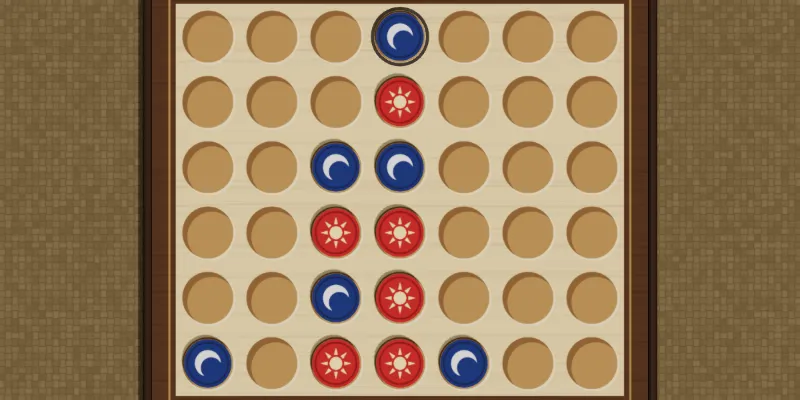
- Players
- 2
- What you need
- Seven columns of six pits, and 21 discs each
- How long
- A game takes two or three minutes
Rules checked 20 October 2026. How these rules are written
What four in a row is
Four in a row is a game for two on a board that stands upright, seven columns wide and six pits deep. One player drops sun discs and the other moon discs, one a turn, until somebody has four of their own in a straight line.
A line can run across, up and down, or on a slant either way. If every pit fills and nobody has a line, the game is a draw.
The board
- A real board stands on its edge between the two players. Here it lies flat, with the top of the board at the far side of the screen, so a disc falls towards you.
- One player plays the sun and the other the moon. Each disc carries its emblem as well as its colour, so you can tell them apart without the colours. You choose on the game page and keep your discs for the whole match.
- The sun makes the first move of the first game. After that, the first move goes back and forth between you.
Taking a turn
On your turn, drop one disc into any column that is not full. It falls to the lowest empty pit in that column. That is the whole move. A disc never moves once it lands, and nothing is ever taken off the board.
Before you drop, look for two things. Can you finish a line of your own? Then do it, because that wins. Does your opponent have three in a line with the fourth pit ready to take? Then drop there yourself, or they win on their next turn.
On the screen, the column under your finger is lit, with a faint disc in the pit it would land in. Lift your finger over the column you want and your disc drops in. The disc your opponent dropped last is ringed, so you can see what they did.
The pit under a threat
A threat cannot always be taken at once. Three in a line with an empty pit at the end is only a win when there is a disc under that pit, because a disc falls to the bottom of its column.
So the pit under your opponent's threat is poison. Drop into it and you build them the step they were waiting for, and they win on the next turn. Leave that column alone and make them fill it.
This is what good players play for: a threat high in the board that neither player can afford to drop under. As the other columns fill, somebody runs out of safe places to drop, and whoever made the threat wins.
How a game ends
A game ends the moment somebody makes a line of four. A disc can finish a line of five, or two lines at once, and every line it made is struck through so both players can see it.
If the last of the forty-two pits fills and nobody has a line, the game is a draw. Between two careful players that happens, but far less often than at tic-tac-toe.
A match
A match is one, three or five games, chosen on the game page. Three is the usual setting: a game takes two or three minutes, and three is a sitting.
Each player keeps their discs for the whole match while the first move goes back and forth. The sun opens the first game, the moon the second, the sun the third. Moving first is a real edge in this game, and this shares it out.
Every game of the match is played, and whoever wins more of them wins the match. A drawn game counts for nobody, and a match that ends level is a draw. Some tables give the first move to whoever lost the last game instead, and that is a setting on the game page.
Playing better
- Start in the middle column. It sits on more lines than any other, and a disc there helps four lines across and both slants.
- Look for a move that makes two threats at once. Your opponent can block only one of them.
- Count from the bottom. If you moved first in the game, a threat on an odd row (the first, third or fifth from the bottom) is the one that wins as the board fills. If you moved second, an even row.
- Before every drop, check the pit above where your disc will land. If your opponent wins there, your drop has just given it to them.
Settings
Everything on the game page, before you press Play.
| Setting | Standard | What it changes |
|---|---|---|
| Who is playing | With bots | With bots sets you against a bot. On this phone seats two people, who pass the phone between turns or leave it lying flat between them. Friends online plays over a link. Watch the bots, the link under the button, sets two bots against each other. |
| Your discs | Sun | The discs you play for the whole match. The sun opens the first game. On this phone they are the first player's. |
| Games | 3 | One, three or five games. Every game of the match is played, even once one player can no longer be caught. |
| Difficulty | Medium | Easy takes a win when it sees one but misses a block about half the time. Medium always blocks, never drops under your threat, and looks four drops ahead. Hard looks eight or more drops ahead and plays for threats on the right rows. |
| Who opens the next game | Each in turn | Each in turn shares the first move out over the match. Whoever lost gives the first move of the next game to the player who lost the last one, and after a draw the turn goes on as usual. |
The words
- Lagatar char (लगातार चार)
- Four in a row in Nepali: four one after another.
- Sun (घाम)
- One set of discs, each with a rayed sun on it. It opens the first game of a match.
- Moon (जून)
- The other set, each with a crescent moon on it. It opens the second game.
- Column
- One of the seven upright lanes a disc is dropped into. It holds six.
- Threat
- Three of one player's discs in a line with the fourth pit empty. Taken at once if there is a disc under it, waiting if there is not.
- Draw (बराबरी)
- A full board with no line of four.
How other families play it
Every family plays it a little differently. These are the ways we know of. The ones with a button are house rules this table can play.
Whoever lost goes first
Some tables give the first move of each game to whoever lost the last one, so the edge of going first goes to whoever needs it. After a draw the first move goes on taking turns. It is a setting here.
Pop out
On your turn you may take one of your own discs out of the bottom row instead of dropping one, and everything above it falls a pit. The table here does not have it.
Questions people ask
How do you play four in a row?
Take turns dropping a disc into one of seven columns, where it falls to the lowest empty pit. The first to line up four of their own across, up and down or on a slant wins. If all 42 pits fill with no line, the game is a draw.
Who wins four in a row with perfect play?
The player who moves first. That is why a match here is several games and the first move goes back and forth between you.
Where is the best first move in four in a row?
The middle column. It sits on more of the lines that can win than any other column.
Does four on a diagonal win?
Yes. Four on a slant in either direction wins, the same as four across or four up and down.
How many discs does each player get?
21, half of the 42 pits on a board of seven columns by six rows.
Who goes first in four in a row?
The sun opens the first game here, and the first move then goes back and forth, sun, moon, sun. On the game page you can give it instead to whoever lost the last game.
What is four in a row called in Nepali?
Here it is लगातार चार, lagatar char, four one after another. The game has no older Nepali name that everybody uses.
Every rule on this page is the one the app plays by. Change any of them on the game's own page before you start.