How to play Kasimala
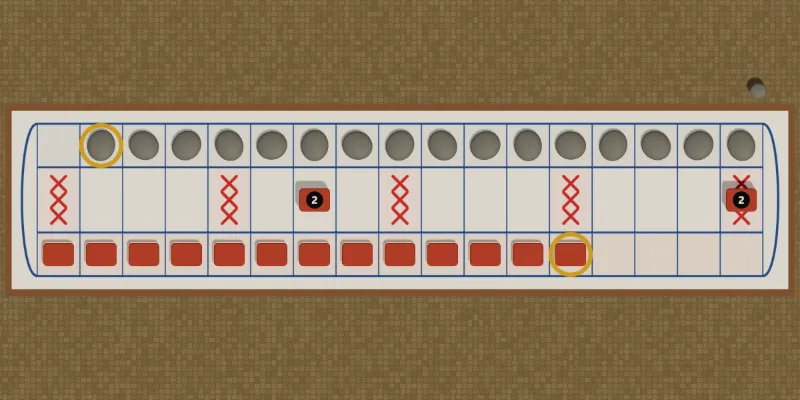
Kasimala is a game for two from Bhaktapur, played on a board of three rows with four strips of bamboo for a die. Each side starts with its pieces filling its own row, and the side that captures every piece the other side has wins. The elders who keep it say it is played nowhere else.
- Players
- 2
- What you need
- A board of three rows, 17 pieces a side, four bamboo strips
- How long
- Twenty minutes to an hour
What the game is
Kasimala Paay (कसिमला पाँय्) is a Newar game of Bhaktapur. It was close to being lost until the municipality put it in the class 6 local curriculum, and since 2075 BS it has been part of the city’s inter-school sports. Elders still play it at pauwas in Taulachhen, Chochhen and Siddha Pokhari.
It looks like Ludo at first: a throw, then a choice of which piece to move. But nothing ever gets home. A piece that has started goes round the middle of the board and the other side’s row until it is captured, so the game is a running fight, and it ends when one side has taken every piece the other side had.
The rules here come from what Bhaktapur has written down about the game (the elders quoted on bhaktapur.com and in Nagarik News), from the board the municipality prints for its schools, and from an app by Ramesh Prajapati that recorded the same rules before it left the Play Store.
The board
Three rows of cells, usually seventeen along each. The two outer rows are narrow, and each belongs to one side: its pieces start there, one to a cell. The middle row is wider. It is called the mala, the alley, because it is where the two sides meet.
In the mala, the first cell and every fourth one after it is marked with crosses. Those cells are laigas (also called bhong), and they are safe. On a board of seventeen there are five of them, at both ends of the mala and three between.
Each side walks its own row towards the end nearest the mala, turns into the mala and walks it the other way, and then turns into the other side’s row. After that a piece goes round the mala and that row for good. The two sides go round in opposite directions, so they meet head on in the mala, and each side’s loop runs straight through the other side’s waiting pieces.
The throw
- Throw the four strips of split bamboo, the paay. Each lands round side up or hollow side up.
- Count the hollow sides showing: one is a kasi (1), two a dwadi (2), three a sudi (3) and four a chya (4). If none shows, with all four round sides up, it is a ngha (5).
A chya or a ngha gives you another throw after your move. Nothing else does: not a kasi, and not a capture.
With real strips a dwadi is the commonest throw, six falls in sixteen. A kasi or a sudi comes four times in sixteen, and a chya or a ngha once each. The game throws four strips the same way, so the odds are the real ones.
Starting a piece
No piece moves until its side throws a kasi. Each kasi starts one piece, and moves that piece a single cell forward along its path.
Pieces start in order from your right, which is the piece next to the mala. So your first kasi puts your first piece on the laiga at the mouth of the mala, and the next kasi brings out the piece beside where it stood.
While one of your pieces is still waiting, a kasi has to start it. Only once every piece is out, or taken, can a kasi move a piece one cell like any other throw.
Moving
Choose a piece that has started and move it the whole throw along its path. It may pass over anything: your own pieces, the other side’s, and a laiga the other side holds. Only the cell it lands on matters.
Your pieces may share a cell, as many as you like. A stack moves one piece at a time.
If no piece can use the throw, the throw is lost. Early in the game that is most throws, because nothing moves until a kasi.
Capturing, and the laigas
Land on a cell where the other side has pieces and every one of them is captured and goes off the board for good. A stack is taken whole.
That includes pieces still waiting in their own row. Once your pieces reach the other side’s row, its waiting pieces are in the way of every throw.
A laiga is the exception. A piece on a laiga is safe, and the other side cannot land there at all while you hold it. Your own pieces can join it.
How a game is won
The side that captures every piece the other side has wins.
Winning without losing a single piece of your own is a gulmasi. Bhaktapur scores it double, and the end of the game here says so when it happens.
A game here also stops after 3,000 throws, which a real game never reaches, and then the side with more pieces left wins. Most games take a few hundred throws: twenty minutes to an hour across a pauwa.
Tactics
- A piece on a laiga cannot be taken, and nobody can land on it. Move from laiga to laiga when you can: they are four cells apart, which is a chya.
- Before you leave a piece in the open, count back along the other side’s path. A piece one, two or three cells ahead of an enemy is in reach of the commonest throws.
- Get to the other side’s row early. Its waiting pieces cannot run, and every throw that lands on one of them takes it.
- If the other side has not started anything yet, sit on the laiga its first piece starts onto. Until you move, a kasi does it no good.
Settings
The game is played the way the elders play it. The one choice is how long the board is, because some boards in Bhaktapur run longer than seventeen.
| Setting | Standard | What it changes |
|---|---|---|
| Difficulty | Medium | Easy plays the way the app that kept these rules did: a capture if it sees one, otherwise a laiga. Medium and hard count what each move leaves open to the other side’s next throw. |
| Board length | 17 | 17, 21 or 25 cells along each row. Each side has as many pieces as its row has cells, and a longer board has more laigas, up to seven. |
Words
- Paay (पाँय्)
- The four strips of split bamboo or reed thrown for each turn, and the Newar word in the game’s name.
- Kasi (कसि)
- One hollow side up: a throw of 1, and the only throw that starts a piece.
- Dwadi (द्वादी), or dwak
- Two hollow sides up: a throw of 2.
- Sudi (सुदी)
- Three hollow sides up: a throw of 3.
- Chya (च्या), or pi
- Four hollow sides up: a throw of 4, and another throw.
- Ngha (ङा)
- All four round sides up: a throw of 5, and another throw.
- Mala (माला)
- The wide middle row of the board, where the two sides meet. The word means an alley.
- Laiga (लायग), or bhong
- A safe cell of the mala, marked with crosses: the first and every fourth after it.
- Goti (गोटी)
- A piece. In the street one side plays with bits of brick and the other with stones.
- Gulmasi (गुलमसी)
- Taking every piece the other side has without losing one of your own. It scores double.
Every rule on this page is the one the app plays by. Change any of them on the game's own page before you start.