The history of Kasimala
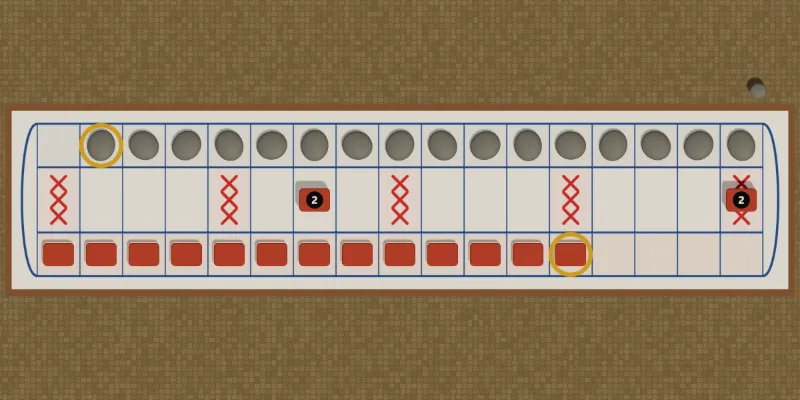
Kasimala is a Newar game of two armies, seventeen pieces a side, thrown with four strips of bamboo. Elders in Bhaktapur say it is played nowhere else.
It came close to dying out, and its rules were hard to find written down anywhere. This site's rules page was put together from the people and pages below.
- Also called
- कसिमला पाँय् (Kasimala paay), कसिपाँय् for short. Kassi-Pyacha
- Played
- Bhaktapur: Bakupati Narayan in Taulachhen, Chochhen Chhumaganesh and Siddha Pokhari
- Earliest record
- Kathmandu Post, 2018, on a talk at SOAS in London that called it endangered
The names
कसि (kasi) is the throw of one, the throw that lets a piece start. माला (mala) is the middle row of the board, which the Nepali write-ups gloss as an alley. पाँय् (paay) are the four strips of split bamboo that are thrown for a move. A safe cell is a लायग or भोङ्ग, and a win without losing a single piece is a गुलमसी, worth double.
The pieces are bricks on one side and stones on the other, Nagarik News reported, and a game takes from twenty minutes to an hour. The cultural expert Om Dhaubhadel told the paper it is a game of armies, which teaches how to survive and how to kill the enemy's soldiers.
Nearly lost
Nobody knows when the game began, and the people who play it say so. The bhaktapur.com write-up, made from the elders at Bakupati Narayan, Chochhen Chhumaganesh and Siddha Pokhari, says it was close to dying out.
In 2018 Sushil Prajapati of Taulachhen, president of Pasa Puchah Guthi UK, showed it at a Newa language and culture workshop at SOAS in London, as an endangered game still played among the elderly in Bhaktapur. Bhaktapur municipality has since put it into the class 6 local curriculum, in its own textbook Khwopa ko Pahichan, and from 2075 BS into its inter-school sports. In 2079 the Guru Ganesh cooperative held an open tournament for 37 players aged 14 to 73. In 2024 and 2025 the Heritage as Placemaking project trained teachers in it, with Baghchal, and made a handbook and kits.
Its likely relatives
Two armies that each fill their own outer row, a middle row where they meet, pieces released one at a time by the throw of one, and a game won by killing every enemy piece: that is the shape of the running-fight games, found from West Africa to India. The best known is Tâb, of Egypt and the Levant, thrown with four sticks, where a tâb (one) is needed to start each piece and a player who loses every piece loses.
No source links Kasimala to Tâb. The likeness is this site's reading, set out so that somebody who knows better can say so. What the Newar game has that Tâb does not is its stars, the safe cells of the middle row, and a board that grows from seventeen columns to twenty-five.
Sources
Every fact above comes from one of these. Where a page could only be read in a search summary, or a claim has no source at all, the text says so.
- परम्परागत स्थानीय खेल : कसिमला पाँय्, Roshanraj Tuitui, bhaktapur.com (in Nepali)
- भक्तपुरको मौलिक खेल कसिमला पाँय्ले पुनर्जीवन पाउँदै, Krishna Kisi, Nagarik News, 27 Poush 2079 (in Nepali)
- रैथाने खेल : नयाँ पुस्ताका लागि इतिहासमा सीमित हुँदै, Sudarshan Aryal, Onlinekhabar, 14 Falgun 2078 (in Nepali)
- Home away from home, The Kathmandu Post, 13 June 2018
- Reviving Play: Documenting and Reviving Traditional Games of Bhaktapur, Heritage as Placemaking, 2025
- Running-fight game, Wikipedia
- Tâb, Wikipedia