The history of Sholo Guti
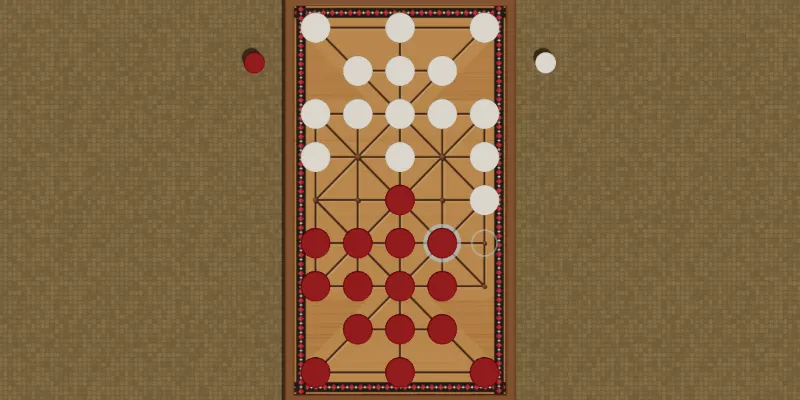
Sholo Guti means sixteen pieces. It is a game of captures on a board scratched into the ground, played with stones, across the plains from Bangladesh to the Terai.
Its history is written in Sri Lanka and in Bengal. In Nepal nobody has written it down at all, which is what this page says first.
- Also called
- सोह्र गोटी, ষোল গুটি (sholo guti), Sixteen Soldiers. Solah Guttiya in Bengal in 1909
- Played
- Bangladesh, West Bengal and Bihar, and the Terai. Sri Lanka under other names
- Earliest record
- Henry Parker, Ancient Ceylon, 1909
What the record shows
The oldest written rules found are in Henry Parker's Ancient Ceylon of 1909. He describes Hewakam Keliya, "the war game": sixteen pieces a side called soldiers, small stones or pieces of broken pot, which capture "exactly like kings at draughts" and may take as many as they can in one move. The player may refuse a capture. Parker adds that the game is known in India, "and in Bengal is termed Solah Guttiya, Sixteen Balls".
Sri Lanka also had larger cousins on the same kind of board: Perali Kotuwa, with twenty-three soldiers a side, and Kotu Ellima with twenty-four. In 1906 a board of the same shape with eighteen pieces a side was recorded at Karwi, in what is now Uttar Pradesh.
The board it grew from
The middle of the board is the alquerque square, five points by five, the same lattice Baghchal is played on. Sholo Guti adds a triangle at each end, which gives each side room for its sixteen soldiers. Alquerque itself is old: a game called qirkat is named in the tenth century Book of Songs in Baghdad, and its rules are written out in the book of games made for Alfonso X of Castile in 1283.
In the villages of Bangladesh the board is drawn on the ground and the soldiers are stones, and Rashid Haider's Sports of Bangladesh, published by the Bangla Academy, counts it among the country's own games.
What nobody has written in Nepal
Sholo Guti is played in the Terai, and families there will say so. But no Nepali source in print or online could be found that names it, in Nepali, Maithili, Bhojpuri or Tharu. The app stores say it is popular in Nepal, and they say that about everything.
That makes this a page with a gap in the middle, and the gap is the useful part. If you play it, or your grandparents did, the name you call it, the board you draw and whether a capture is compulsory at your table are worth more than anything above.
Sources
Every fact above comes from one of these. Where a page could only be read in a search summary, or a claim has no source at all, the text says so.
- Ancient Ceylon, Henry Parker, 1909, page 583
- Sixteen Soldiers, Ludii Portal
- Sixteen Soldiers, Wikipedia
- Peralikatuma, Wikipedia
- Alquerque, Wikipedia