The history of Kauda
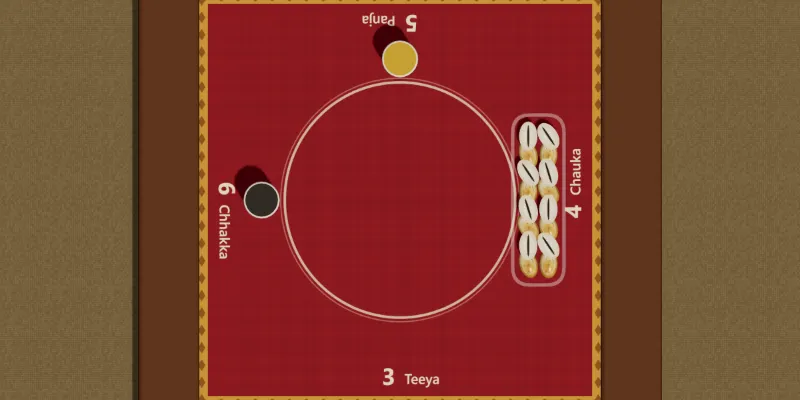
Kauda is sixteen cowrie shells thrown on a mat, four players named for numbers, and the whole courtyard watching. It is the Tihar game.
The belief that gambling is allowed at Tihar is not a myth that came from nowhere. For about a hundred years it was the law. This page is about the shells, the words and that law.
- Also called
- कौडा, कौडो. The seats are तिया, चौका, पन्जा and छक्का
- Played
- Courtyards across the hills and the valley, at Tihar
- Earliest record
- The Muluki Ain of 1854, which allowed gambling for the five days of Tihar
Shells that were money
A cowrie is a small sea shell, and for centuries it was small change across South Asia, shipped from the Maldives. The Nepal Academy dictionary keeps both lives of the word: कौडो is the game, and also a thing that was once used to buy and sell.
The dictionary records the game as Nepal plays it. Sixteen cowries, four daus called teeya, chauka, panja and chhakka, played for stakes and, in its own word, illegal. It defines teeya as three, seven, eleven or fifteen shells landing mouth up, which is the count read by fours that this site deals. It also keeps the table's words: खाल is where the shells are thrown, चौपट is four mouths up, a खिपाहा is a man skilled at fixing a throw, and दोदन्त is two shells up, a throw that belongs to chhakka.
When Tihar was legal
Prithvi Narayan Shah banned gambling outright. His grandson Rana Bahadur Shah allowed it again at Tij and Tihar. The Muluki Ain of 1854, Jang Bahadur's code, wrote the exception into law: gambling was allowed on the five days of Yamapanchaka, from the thirteenth of the dark half of Kartik to the second of the bright half. That is Kag Tihar to Bhai Tika.
Visitors saw it. Daniel Wright, surgeon at the British Residency, wrote in 1877 that public gambling, illegal at other times, was allowed for three days and nights, and that the town streets were almost impassable for groups of gamblers. Percy Brown wrote in 1912 that the start was signalled by a gun, that the streets were strewn with tables of coins and cowries, and that the government was trying to cut the number of days. The Rana prime ministers declared open gambling at Dashain and Tihar and for royal births and coronations, and that ended with their rule in 1951.
What the law says now
The Gambling Act of 1963 made it a crime all year, and Section 125 of the Penal Code of 2017 took that over: up to three months' prison or Rs 30,000 for a first offence. The only exception is a game the government approves for a festival or fair, played for small sums, and there is no way to apply. The police arrested 459 people for gambling over Tihar in 2076 alone.
What survives of the old law is the feeling that Tihar is different. Jhalak Subedi, writing in 2082 about the village he grew up in, remembered that the card games were played for cigarettes and kauda for real money. On this site the stakes are chips with no money value.
Fifteen shells or sixteen
Percy Brown described a cowrie game at Tihar in 1912 under the name "Tommy dod": fifteen cowries shaken in the hand and thrown on a board, with the company betting on whether more landed split side or smooth side up. That is not kauda's four daus, and whether it was a different game, a different town's way of playing, or a visitor's misreading, nobody can now say. It is the oldest description of a Nepali cowrie game found.
Sources
Every fact above comes from one of these. Where a page could only be read in a search summary, or a claim has no source at all, the text says so.
- कौडो, तिया, चौका, दोदन्त: नेपाली बृहत् शब्दकोश, Nepal Academy (in Nepali)
- A declaration of the Mulukī Aḍḍā on the tender for the gambling license for the Annapūrṇā Guṭhī in Asana (VS 1961), with commentary, Simon Cubelic and Rajan Khatiwoda, Documenta Nepalica, Heidelberg Academy of Sciences
- History of Nepal, Daniel Wright (ed.), 1877
- Picturesque Nepal, Percy Brown, 1912, pages 192 to 195
- State of the Gamblers for the Gamblers, Hemant Dabadi, b360nepal, 14 July 2017
- सांस्कृतिक पर्व तिहार, Aamodbardhan Kaudinyayan, Gorkhapatra, 10 Kartik 2081 (in Nepali)
- National Penal (Code) Act 2017, Section 125: prohibition of gambling or betting, Nepal Laws
- Don't bet on it, Akshya Aryal, The Kathmandu Post, 6 November 2019
- तिहारमा साढे ४ सय जुवाडे समातिए, मापसे गर्ने ७ सय कारबाहीमा, Onlinekhabar, 13 Kartik 2076 (in Nepali)
- तिहारका झिलिमिली सम्झना, Jhalak Subedi, Onlinekhabar, 6 Kartik 2082 (in Nepali)