The history of Langur Burja
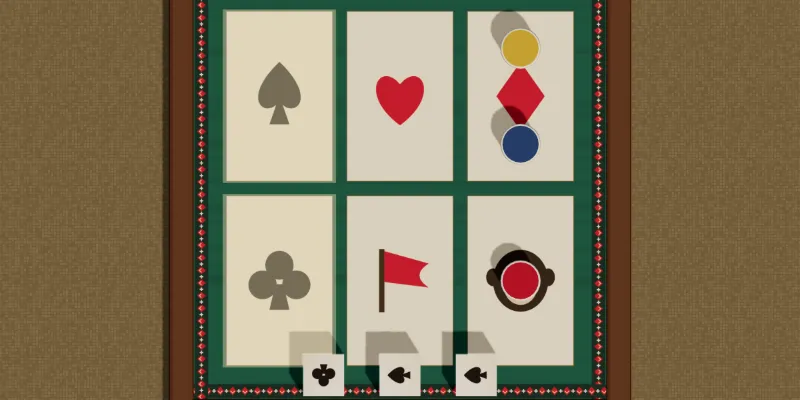
Langur Burja looks like the most Nepali thing in the world: a painted cloth on a courtyard floor at Tihar, three dice, and a crowd. Its name says where it came from.
In the Nepali of a century ago, langur meant an anchor and burja a dome. The game is Crown and Anchor, the dice game of British fairs and ships, under a translation of its English name.
- Also called
- लंगुर बुर्जा. Crown and Anchor in English, Jhandi Munda in India
- Played
- Courtyards and street corners at Dashain and Tihar
- Earliest record
- Anchors, stars and the four suits at a London fair in 1821. Jhandi Munda in the Bombay and Poona courts by 1905
Anchor and dome
R. L. Turner's Nepali dictionary of 1931 gives laṅgar, "or laṅgur", as an anchor, a word Nepali took from Hindi and Hindi from Persian. It gives burjā as a cupola or dome, from the Arabic burj. So लंगुर बुर्जा is "anchor and dome", and the dome is the crown. The monkey, the langur, is a different word that happens to sound the same.
On a Nepali cloth the anchor has become a flag, the jhanda, and the four card suits keep their Nepali names. A Himalayan Times piece in 2007 listed them as pan (hearts), surat (spades), eet (diamonds, the brick) and chidi (clubs), with burja the crown and langur or jhanda the flag.
Crown and Anchor
The earliest description found is from the fair in Hyde Park for George IV's coronation in 1821, where men played with "anchors, stars, clubs, spades, hearts, and diamonds". The name "crown and anchor game" first appears in print in Melbourne in 1882. It is called a sailors' game, played in the Royal Navy, though the claim that it goes back to the eighteenth century has no source behind it.
In India the same game was in the courts of Bombay and Poona by 1905 and is known as Jhandi Munda, played at Diwali. Its faces are a flag, a crown and the four suits, which is the Nepali cloth exactly. How it crossed into Nepal nobody has written. Soldiers who served in British and Indian regiments are the obvious guess, and a guess is all it is.
The festival and the law
Langur Burja is played for money, and gambling is against the law in Nepal all year. Section 125 of the Penal Code of 2017 forbids it, with up to three months' prison or a fine of Rs 30,000 for a first offence, and the money on the cloth forfeit. The code allows a game approved by the government to be played for small stakes at a festival or fair, and no way of getting that approval exists.
The belief that the five days of Tihar are exempt is a belief. The police raid courtyards every festival, and in Asoj 2083 a paper reported four people held in Jhapa for playing लंगुरबुर्जा. On this site the chips have no money value, which is the only way the game can be played here at all.
Sources
Every fact above comes from one of these. Where a page could only be read in a search summary, or a claim has no source at all, the text says so.
- A Comparative and Etymological Dictionary of the Nepali Language: laṅgar, burjā, R. L. Turner, 1931, pages 454 and 545
- Crown and Anchor, games.porg.es
- Crown and anchor, Wikipedia
- School Times: Roll of dice, Rishi Singh, The Himalayan Times, 24 October 2007
- National Penal (Code) Act 2017, Section 125: prohibition of gambling or betting, Nepal Laws
- Don't bet on it, Akshya Aryal, The Kathmandu Post, 6 November 2019
- तास र लंगुरबुर्जा खेल्ने/खेलाउने ११ जना पक्राउ, Annapurna Post, Asoj 2083 (in Nepali)