The history of Baghchal
Baghchal is the game most Nepalis would name as their own: four tigers against twenty goats on a board of lines that can be scratched into the ground with a stone. It is printed on a stamp and sold in brass to every tourist in Basantapur.
It also has almost no written history. This page sets out what can be shown, what is only repeated, and where the record stops.
- Also called
- बाघचाल (Baghchal, Bagh-chal), "the tigers' move". A note of 1933 gives Bhagchal, Bhagchakar and Chakrachal
- Played
- The hills and the Kathmandu valley, by elders in paatis and sattals, on boards drawn on the ground
- Earliest record
- 1933, a note by S. L. Hora in the journal of the Asiatic Society of Bengal
A hunt game on a lattice of lines
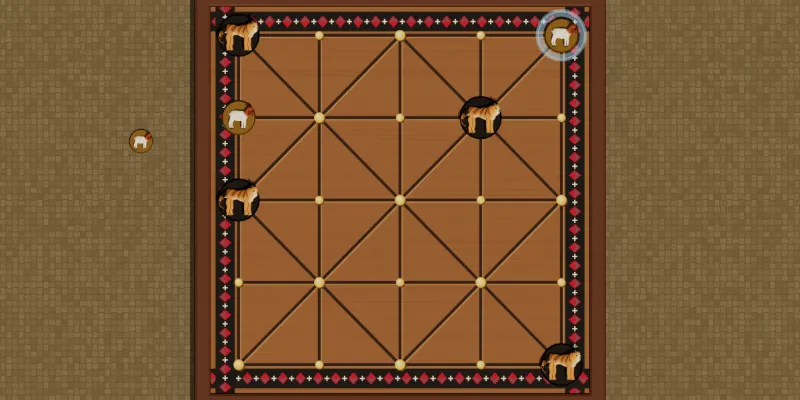
The board is five points by five, joined by lines across, down and, from every other point, on the diagonal. The four tigers start on the corners. The goats come on one at a time, and a goat cannot move until all twenty are on the board. A tiger takes a goat by jumping it along a line. The tigers win by taking goats, which in most tables means five, and the goats win by leaving no tiger a move.
Games like this are called hunt games: a few strong pieces against many weak ones. South Asia has a whole family of them. Bengal plays Bagh bandi with two tigers and twenty goats stacked on four points. Punjab has Sher-bakar. The south plays Aadu puli aatam, Pulijudam and Huli katti, with three tigers and fifteen goats on a triangle. The lattice itself is the alquerque board, which has been played on from Spain to India.
What the record shows
The oldest written description that could be found is in "Sedentary games of India", a note by S. L. Hora in the Journal and Proceedings of the Asiatic Society of Bengal in 1933. It describes four tigers and twenty goats brought on one at a time, the goats unable to move until all are down, and a game that ends when the goats are all taken or the tigers are all shut in. Hora recorded it in the Teesta valley, east of Nepal, under the names Bhagchal, Bhagchakar and Chakrachal. H. J. R. Murray listed it in his History of Board-Games other than Chess in 1952.
The Europeans who wrote at length about the Kathmandu valley before that do not mention it. The texts of Francis Hamilton (1819), Henry Oldfield (1880), Percy Brown (1912) and Perceval Landon (1928) were searched for it, and Oldfield describes the swings, the kites and the gambling of Tihar but no board game.
After that the record fills in. In 1974 Nepal put Baghchal on a stamp, beside football. In 1976 David Parlett wrote that it was the nearest thing to an intellectual game he met in the Himalaya, and that Buddhist monks played it with pebbles on a pattern scratched in the ground. The chess historian Yuri Averbakh visited in 1986 and called it no less popular in Nepal than chess.
What is said, and cannot be shown
"A thousand years old" is the line every article and every shop repeats. None of them gives a source for it, and none could be found. Nor is there one for the stories that shepherds once trapped tigers with goats, or that the Buddha played it. The Nepali Times, which told the second one in 2003, called it a legend.
The retired Tribhuvan University historian Tri Ratna Manandhar told the Kathmandu Post in 2021 that he had never seen it mentioned in a history text. He saw it played widely in Gorkha, Lamjung and Nuwakot, and suspects it began in Gorkha, which he said himself he cannot prove.
It is often said that old boards are carved into the stone of temple steps in the Durbar Squares. No source shows one. The one carved board found in print is on the floor of a sattal in Kirtipur, photographed in 2021, and nothing dates it. South India's relatives of the game are cut into temple stone, at Mysore and across Tamil Nadu, and there too nobody knows who cut them or when. Whether the Nepali game is older than the Indian ones, or younger, nobody has argued with evidence.
Solved, in 2009
Two computer scientists at ETH Zurich, Lim Yew Jin and Jürg Nievergelt, set out to find who wins Baghchal when both sides play perfectly. Their first paper, in 2004, found that the tigers have the better of the opening and that the goats might catch up. Their second, in 2009, settled it: "Tigers and Goats is a draw if played optimally."
The part of the game after all twenty goats are down has 88,260,972 positions, counting a position and its mirror images once, and they worked out every one. The placing of the goats, thirty-nine moves deep, they searched. They played by the rules this site deals by default: the goats move first and the tigers win on the fifth goat taken. A table that loses is therefore a table where somebody went wrong.
Who plays it now
The Kathmandu Post found it in 2021 where it has always been: among older men in paatis and sattals, on a board drawn on the ground with stones for pieces. Nirmala Mani Adhikari of Kathmandu University's School of Arts told the paper the game lost its place for twenty years after the 1990s and has started to come back. The souvenir boards are a different trade. "No Nepali buys the Bagh Chal board," a Basantapur stallholder said. "Only foreigners buy it." The Horniman Museum in London holds one of those brass sets, four tigers and twenty goats.
The competitions are recent. A youth group, Pragatibadi Yuba Samaj Nepal, held the first national Baghchal competition in Kathmandu in Saun 2075 (July 2018) and Sagar Maharjan, aged 61, won its 2019 edition. Bhaktapur held a citywide tournament in 2022. In Asar 2083 (June 2026) Baghchal was one of six games at the first contest of traditional games in Kathmandu, with dandi biyo, ghaito phutai and tug of war. The state does not recognise it as a sport.
Sources
Every fact above comes from one of these. Where a page could only be read in a search summary, or a claim has no source at all, the text says so.
- Baghchal, with the texts of Hora (1933), Parlett (1976) and Averbakh (1995), Ludii Portal, Digital Ludeme Project
- Tigers and Goats is a draw, Lim Yew Jin and Jürg Nievergelt, Games of No Chance 3, MSRI Publications 56, 2009
- Computing Tigers and Goats, Lim Yew Jin and Jürg Nievergelt, ICGA Journal 27(3), 2004
- Bagh Chal: A native board game on the brink of extinction, Shranup Tandukar, The Kathmandu Post, 9 September 2021
- Bagchal in the Alps, Shraddha Basnyat, Nepali Times, 17 January 2003
- बाघचाल प्रतियोगिता हुँदै, Annapurna Post, 19 Asar 2075 (in Nepali)
- रिसनलाई चेस तथा जेन्जीलाई टग अफ वारको उपाधि, Gorkhapatra, 13 Asar 2083 (in Nepali)
- Bagh Chal game containing 1 brass board, 4 x brass tigers and 20 brass goats, Horniman Museum, London, HC.1999.625
- Nepal, 1974: Bagh Chal and football, iStampGallery
- Lambs and tigers, and the hunt games of South India, Wikipedia
- Aadu Puli Aatam: The 'tiger and goat' game in Tamil Nadu's temples, The Bridge, 26 July 2022