The history of Pasa
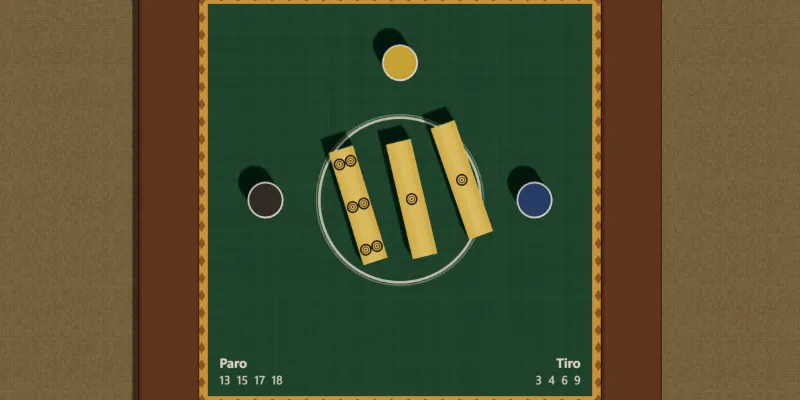
A pasa is a long die, a bar with four faces marked one, two, five and six. Three are thrown together, and at Dashain and Tihar families bet on the total.
The dice are among the oldest gaming things in South Asia. The village game played with them has one written account. This page puts the two side by side.
- Also called
- पासा. Three together, त्रिपासा. In Sanskrit, पाशक
- Played
- Villages in the hills, among family and friends at Dashain and Tihar
- Earliest record
- The Nepal Academy dictionary's पासा, and Bhupal Sapkota's account of the village game, 2020
The long die
Long dice with four marked faces are the dice of South Asia. Dot-and-ring dice come out of the Indus cities, and the long dice used for chaupar today are marked 1, 2, 5 and 6, as Nepal's are, or 1, 3, 4 and 6. The Nepal Academy dictionary describes the pasa as an oblong, four-sided piece marked six, five, two and one, thrown in place of cowries in games like pachisi. Its entry for त्रिपासा, three dice, says they were made of ivory.
It is often said that pasa is the dice of the Mahabharata, where Yudhishthira gambles away his kingdom. The epic's word for those dice is akṣa, and no source ties the Nepali pasa to them.
The king and the goddess
The best known pasa story in Nepal is the Kumari's. The goddess Taleju, the story goes, came every night to play tripasa with the Malla king, on condition that nobody else saw her. When the king's wife followed him and saw, the goddess left, and came back only in the body of a young girl, the Kumari. The story is told of Jayaprakash Malla. Daniel Wright, in his History of Nepal of 1877, tells it of Jagatjyoti Malla playing at dice with Taleju.
The dictionary keeps a quieter use. Its entry for दुहिता records a cloth held over the bride and groom while they play pasa at the wedding.
The village game
Nobody wrote down the betting game until 2020, when Bhupal Sapkota put a list online of how the totals are called: परो (paro) wins for the thrower, तिरो (tiro) pays out, and the rest are बच्यो (bachyo). Two throws have names, हल्हले, three twos, and टिके तेह्र, six, six and one. The owner of the dice takes a cut, the बोट, on a fifteen. Gorkhapatra, writing about Yamapanchaka in 2081, gives the old belief that these days are to be enjoyed playing pasa.
Sapkota's page has since grown a section on how to play, and it differs from the way this site deals the game in two places: the dice pass to the next player on a bachyo, and the stake doubles on each paro in a row. Neither is settled. If your village plays a third way, that is worth telling us.
Sources
Every fact above comes from one of these. Where a page could only be read in a search summary, or a claim has no source at all, the text says so.
- पासा, Bhupal Sapkota, 17 November 2020 (in Nepali)
- पासा, त्रिपासा, दुहिता: नेपाली बृहत् शब्दकोश, Nepal Academy (in Nepali)
- Long dice, Wikipedia
- Kumari, Wikipedia
- History of Nepal, Daniel Wright (ed.), 1877
- सांस्कृतिक पर्व तिहार, Aamodbardhan Kaudinyayan, Gorkhapatra, 10 Kartik 2081 (in Nepali)