The history of Snakes & Ladders
Before it was a children's game, Snakes and Ladders was a lesson. On the old boards a ladder rose from a virtue and a snake fell from a vice, and the square at the top was heaven.
Nepal had its own boards of that kind, in Nepali and in Newar, and one of them hangs in an American museum. This page is about them.
- Also called
- Gyan chaupar, the game of knowledge. In Nepali वैकुन्ठे (Vaikunthe). In Newar, Chiba kasa
- Played
- Snakes and Ladders everywhere. The karma boards in temples and homes, now mostly in museums
- Earliest record
- A Nepali cloth board of the nineteenth century, now in the Nelson-Atkins Museum
A board of virtues and vices
The game behind Snakes and Ladders is called gyan chaupar, the game of knowledge. Its boards are grids of squares, most often 72 in the Vaishnava boards and 84 in the Jain ones, and each square is a state of the soul. A ladder rises from a good act to where it leads, a snake falls from a bad one, and the top of the board is liberation. The oldest boards known are from the late eighteenth century.
It is often said that the poet saint Dnyaneshwar invented it in the thirteenth century. Nothing written by him or near his time says so.
The Nepali boards
The Nelson-Atkins Museum in Kansas City holds a Nepali board of the nineteenth century, painted on cloth, 65 by 64 centimetres. It has 72 squares, with inscriptions in Nepali, in Devanagari, naming the deity of each, and its snakes are dark grey, red and tan.
The Nepal Academy's dictionary has the Nepali name for such a game. Its entry for वैकुन्ठे (Vaikunthe) reads: a game played on a cloth drawn with two snakes, one white and one black, thrown with four cowries or one long die. Vaikuntha is Vishnu's heaven, and in Telugu the same game is called Vaikunthapali. A museum record in Cambridge notes that the Nepali boards were called nagapasha, the snake noose, with red snakes and black, the red leading up. The art historian Deepak Shimkhada studied these boards across India, Nepal and Tibet in "A Preliminary Study of the Game of Karma" in 1983.
Chiba kasa, a Newar heaven and hell
The British Library's Endangered Archives Programme has photographed a manuscript from the Nir Harsha Bajracharya collection in Banepa, dated to the eighteenth century and called Chiba kasa, the chaitya game. Its catalogue describes a drawing of the Swayambhu chaitya with the stages of heaven and hell under the dome, for a game in which a player's actions decide where they go. The record adds that most Newars today do not know such a game was ever played.
Tibet has a game of the same idea, the game of rebirth, on a board of 104 squares, which tradition credits to the scholar Sakya Pandita in the thirteenth century. That is tradition, not record.
How it became Snakes and Ladders
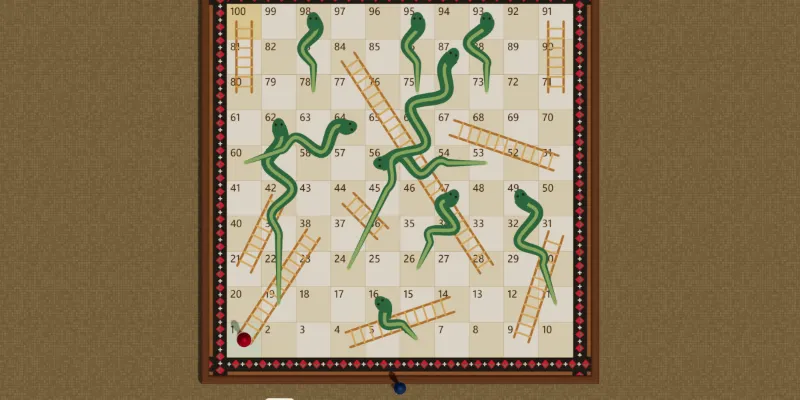
An English version was registered by F. H. Ayres of London in 1892. It kept the snakes and the ladders and dropped the virtues and the vices, and in 1943 Milton Bradley sold it in America as Chutes and Ladders. The game on this site is that one, a hundred squares and a die, with the house rules families argue about.
The karma boards are not lost. They are in museums, and in the dictionary, waiting for somebody who remembers the rules.
Sources
Every fact above comes from one of these. Where a page could only be read in a search summary, or a claim has no source at all, the text says so.
- Snakes and Ladders, Nepalese, 19th century, The Nelson-Atkins Museum of Art, 2011.44
- वैकुन्ठे: नेपाली बृहत् शब्दकोश, Nepal Academy (in Nepali)
- A Preliminary Study of the Game of Karma in India, Nepal, and Tibet, Deepak Shimkhada, Artibus Asiae 44(4), 1983
- Chiba Kasa, British Library, Endangered Archives Programme, EAP790
- Snakes and Ladders game board made of wood inlaid with mother of pearl, Museum of Archaeology and Anthropology, Cambridge
- Gyan caupar, the precursor of Snakes and Ladders, Jacob Schmidt-Madsen, INDOLOGY list, 30 October 2012
- Snakes and ladders, Wikipedia