The history of Sho
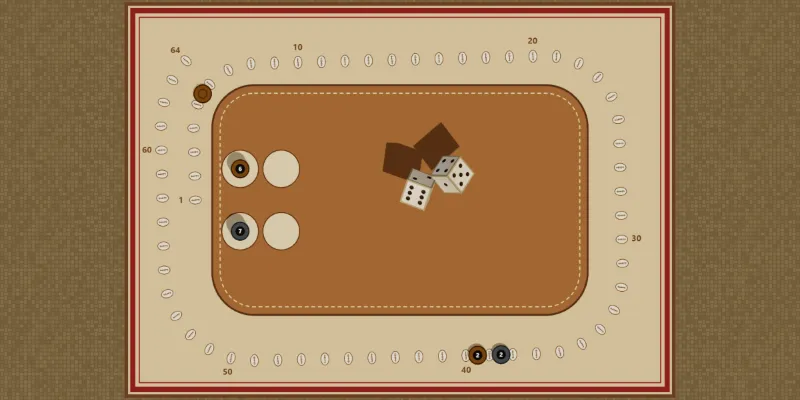
Sho is the dice game of Tibet, and of the Sherpas and Tibetans in Nepal: nine coins each, a spiral of shells round a leather pad, and two dice slammed down from a wooden cup with a shout.
The best account of it is one anthropologist's fieldwork in Lhasa. This page is built on that, and on the few photographs that place the game in Nepal.
- Also called
- ཤོ (sho), "dice". Formally sho rtsed, the dice game
- Played
- Tibet, and in Nepal among Sherpas and the Tibetan families of the Kathmandu valley
- Earliest record
- Charles Bell, 1924: "the national gambling game, played by all Tibetans, high and low"
The pad, the cup and the shells
The word sho just means dice. The kit is two dice, a round pad of yak leather stuffed with wool (sho gdan), a wooden cup about the size of a tea bowl (sho phor), sixty-four counters laid in a spiral round the pad, and nine coins for each player. The counters were pebbles once and are cowrie shells now. Daisuke Murakami, who studied the game in Lhasa, notes that the coins can be Nepali or Indian ones, or copies of old Chinese coins.
Players stake money under the pad. Two dice landing one on top of the other (sho rtseg) wins the whole kit for the thrower, who has to recite the rhyme for it.
What the record shows
Charles Bell, the British political officer for Tibet, wrote in 1924 that sho was "the national gambling game, played by all Tibetans, high and low, the peasantry included". The Japanese monk Ekai Kawaguchi, who was in Tibet in 1900, disapproved of monks playing it. A mural in the Potala shows three men at sho, but the murals were repainted many times, so Murakami will only say that sho was played in or before the nineteenth century.
Older claims rest on stories. Milarepa's grandfather is said to have lost his fortune at sho, which would put the game in the tenth or eleventh century, but that life of Milarepa was written in the fifteenth, and Murakami calls the dating unconvincing. In the Gesar epic, Gesar wins at sho with a throw of thirteen on two dice. The dice of the Tibetan empire, around 600 to 850, were oblong and used for law and divination, and whether anybody gambled on them is, in Murakami's word, speculative.
A prayer on every throw
What an onlooker remembers is the noise. Before each throw the player calls the number they want and shouts a verse, a sho bshad, a dice prayer. For pa ra, the throw of one and one, the call begins "Pa ra, the auspicious splendour, come!" and goes on to summon it from the realms of the gods and the nagas. The folklorist Dechen Drokar collected these verses in 2003.
Luck at sho belongs to a spirit, the the'u rang, and divination with dice belongs to the protector Palden Lhamo. It is a gambling game, and in Lhasa a men's game: Murakami heard that a woman playing it is improper, and also that when women play, they always win.
In Nepal
The Nepal evidence is thin, and real. The anthropologist Christoph von Fürer-Haimendorf photographed a Sherpa man playing sho in 1957, and another photograph in the same collection at SOAS shows a man playing it at Dumje, the Sherpa festival of Khumbu. In exile the game has been played most by people newly arrived from Tibet.
It is often called the game of Losar, the new year. Murakami found the opposite on the day itself: in Lhasa, playing sho on New Year's Day is thought very unlucky, because bringing the cup down upside down recalls the way a dead person's tea bowl is turned over. Many people also avoid it on holy days such as Saga Dawa. When in the season it is thrown in Solukhumbu, Boudha or Jawalakhel, nobody has written down.
Sources
Every fact above comes from one of these. Where a page could only be read in a search summary, or a claim has no source at all, the text says so.
- Aspects of the Traditional Gambling Game known as Sho in Modern Lhasa, Daisuke Murakami, Revue d'Etudes Tibétaines 29, 2014
- Sho (board game), Wikipedia
- Man playing Sho, Christoph von Fürer-Haimendorf, 1957, SOAS Library
- Man sitting on the ground playing sho at the Dumje festival, Christoph von Fürer-Haimendorf, SOAS Library
- The Tibet Album: Charles Bell, 1921, Pitt Rivers Museum and the British Museum