The history of Ludo
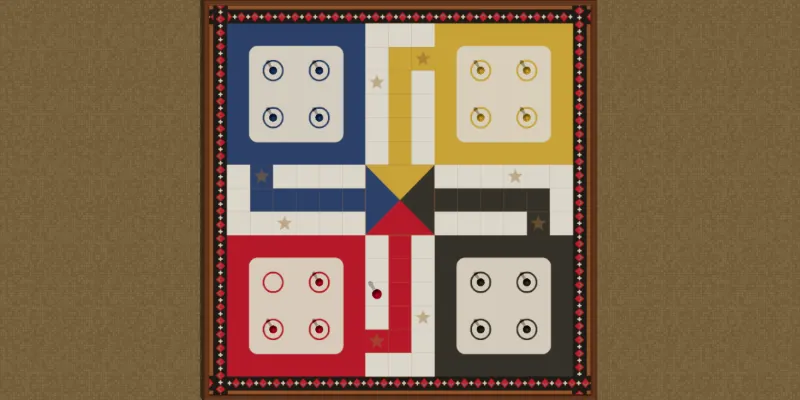
Ludo is an English board game patented in 1891, and it is a copy. The game it copies is pachisi, the cross-shaped race of South Asia, played with cowrie shells for dice.
Nepal still plays pachisi in one place for one night of the year. This page is about that night, and about how pachisi reached a box in England.
- Also called
- Pachisi (पचिसी, पच्चीस), chaupar. In Maithili पच्चीसी
- Played
- Ludo everywhere. Pachisi with cowries in Mithila, around Janakpur, on Kojagara night
- Earliest record
- Pachisi: the courtyard boards at Fatehpur Sikri, about 1570s. Ludo: Alfred Collier's English patent of 1891
Pachisi, the cross
A pachisi board is a cross: four arms, each three columns of eight squares, round a home in the middle. The pieces go out down the middle of their own arm, round the whole cross and back up their own middle column. Safe squares are marked on the cloth, a piece that lands on an enemy elsewhere sends it home, and the last step needs an exact throw. It is thrown with cowrie shells, and the count of shells landing mouth up is the move.
The oldest secure evidence for pachisi in India is the giant board laid into the courtyard of Akbar's palace at Fatehpur Sikri, built in the 1570s. The story that Akbar played on it with slave girls as the pieces is a legend, and the writers who repeat it say so.
Kojagara night in Janakpur
Kojagara, the full moon of Kojagrat Purnima, is a Maithil festival for the newly married. The bride's family sends a load of paan and makhana to the groom's home, and the groom is blessed.
Then they play. Onlinekhabar, reporting from Janakpurdham in 2019 and again in 2020, wrote that after the meal it is the custom to play pachisi with cowries, with eight cowries and sixteen pieces, between the groom and the bride's brothers. Maithili Wikipedia adds that the cowries and the dice come from the bride's family. A game that a new husband plays against his wife's brothers, on her family's shells, is the kind of thing a festival keeps for a reason, even when nobody says the reason out loud.
In the dictionary and the valley
The Nepal Academy's dictionary knows the game. It names pachisi with kauda and ganjifa among the games played for money, and its word थर्की is both a game of moving pieces round the squares of a four-cornered cloth and the cloth that pasa and pachisi are played on. Asia InCH, an inventory of Asian crafts, lists the pachisi board as a craft of Nepal that is endangered.
Nobody has written down the Janakpur rules. Onlinekhabar says eight cowries, other accounts of pachisi say six or seven, and what each count of mouths is worth in Janakpur, nobody has printed. Nor what the phrase "पासाका चौसठ्ठी" in the Janakpur report means.
How pachisi became Ludo
British officers and their families took pachisi home from India in the nineteenth century, and English makers boxed it. Alfred Collier was granted British patent 14636 for "Royal Ludo" in 1891, and by 1896 it was on sale in England as Ludo. The English game kept the race, the capture and the safe squares, put the cross inside a square, and swapped the cowries for a single die.
That is the Ludo that came back to South Asia, on cardboard and then on phones. It is played here too, with house rules on the page that sets a table up, and the cowries are on the Kauda page.
Sources
Every fact above comes from one of these. Where a page could only be read in a search summary, or a claim has no source at all, the text says so.
- मिथिला क्षेत्रमा यसरी मनाइँदैछ कोजाग्रत पूर्णिमा, Onlinekhabar, 26 Asoj 2076 (in Nepali)
- मिथिला क्षेत्रमा कोजाग्रत पूर्णिमालाई 'कोजगरा' को रुपमा मनाइँदै, Onlinekhabar, 14 Kartik 2077 (in Nepali)
- कोजागरा, Maithili Wikipedia
- थर्की, पच्चीस: नेपाली बृहत् शब्दकोश, Nepal Academy (in Nepali)
- Pachisi / Board game of Nepal, Asia InCH
- Pachisi, Wikipedia
- How Pachisi, An Indian Board Game, Became Ludo, Shrenik Rao, Madras Courier, 11 September 2018