How to play Byapar
The property trading game every family knows, on a board of Nepal's places: buy, auction, trade, build hotels and collect rent until the richest player wins.
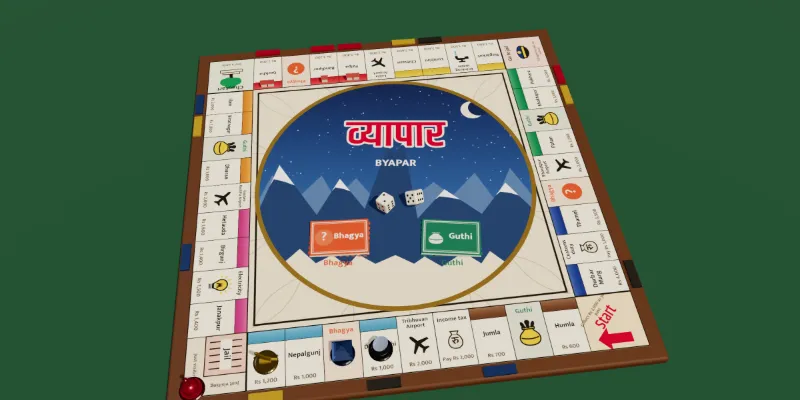
- Players
- 2-6
- What you need
- Two dice, a token each, a board of 40 squares and two decks
- How long
- About half an hour at thirty rounds
What Byapar is
Byapar is the property trading game that every family in Nepal knows from a boxed board, whether it came from a toy shop in Bhotahiti or a cousin's suitcase. You throw two dice, walk round the board, buy the places you stop on, and charge rent to everybody who stops on yours.
This board is made of Nepal's own places. The remote Karnali districts are the cheapest, the far west and the Madhesh come next, then the hill towns and the eastern towns, Chitwan and Lumbini, Pokhara and the old cities of the valley, and finally Thamel and Durbar Marg. The four transport squares are airports, Lukla among them, and the two services are electricity and drinking water.
Two to six can play, against bots, round one phone, or online with friends. A game is played to thirty rounds and the richest player wins, so it fits an evening rather than taking one. Choose to play until one player is left if you want the long game.
The board
Forty squares go round the board. Twenty-two are places in eight colour groups, two places at each end of the board and three in every other group. Four are airports and two are services. Owning places is what the game is about.
The rest are squares that do something: Start, which pays your salary every time you pass it, three Bhagya squares and three Guthi squares where you draw a card, two taxes, the jail, Chautari where nothing happens, and the police square that sends you to jail.
The bands show the groups. Places get dearer the further they are round the board from Start, and so do their rents and the houses you can build on them.
A turn
- Before you throw, you may build, mortgage, lift a mortgage or offer another player a trade.
- Throw both dice and walk your token that many squares round the board.
- Do what the square says: buy it, pay its rent, pay a tax, draw a card or go to jail.
- Build if you can and want to, then end your turn.
Throw doubles and you throw again after your move. Throw doubles three times in one turn and the third throw sends you straight to jail without moving.
Buying places
Stop on a place nobody owns and you may buy it from the bank at the price printed on it. The deed shows what it charges: its rent, double that once you own the whole group, and much more with houses and a hotel.
If you do not buy it, it goes to auction among everybody, you included. Turning down a place nobody else can afford can be a way to get it cheaply.
Auctions
Bidding goes round the table starting with the player who turned the place down. On your turn to bid you raise the highest bid, by as little as ten rupees, or drop out. Once you drop out you are out of that auction.
When only the highest bidder is left, they pay their bid to the bank and the place is theirs. If nobody bids at all, the place stays with the bank and the next player to stop on it may buy it.
Rent
Stop on somebody else's place and you pay them its rent. Nothing is paid on a place that is mortgaged.
- A place with nothing built charges its rent, and twice that when one player owns its whole group.
- An airport charges more the more airports its owner holds: Rs 250 for one up to Rs 2,000 for all four.
- A service charges forty times the dice you threw, or a hundred times if the owner holds both.
Houses and hotels
Once you own every place in a colour group and none of it is mortgaged, you may build houses on it, on your turn, paying the house cost printed on the deed. Houses go up evenly across the group, one place at a time.
When every place in the group has four houses, the next step on each is a hotel, which charges the most rent on the board. You can sell houses back to the bank for half what they cost, the most built place first.
Bhagya and Guthi
Stop on a Bhagya square and you draw a Bhagya card. Most of them move you: to Start, to a place, to the next airport where you pay double, back three squares for a bandh, or to jail. Stop on a Guthi square and you draw a Guthi card, which mostly pays or costs money: a Dashain bonus, a hospital bill, Deusi money from every player, repairs on every house you own.
One card in each deck gets you out of jail. Keep it until you need it, or trade it. Every other card goes back under its deck once it is read.
Jail
You go to jail by stopping on the police square, by a card, or by three doubles in a row, and you go straight there without passing Start. In jail you still collect rent and may still build and trade. To get out, on your turn:
- pay a fine of Rs 500 and throw as usual,
- use a bail card if you have one, or
- throw for doubles: doubles walk you out, anything else keeps you in.
After three throws without doubles you pay the fine and walk your third throw. Stopping on the jail square from an ordinary throw is just a visit.
Short of money
If you owe more than you have, you must raise it: sell houses back to the bank for half their cost, or mortgage places for half their price. A mortgaged place charges no rent until you pay back the loan and a tenth more.
Nothing in a group with houses on it can be mortgaged, so sell the houses first. The table settles every debt in order, and pays it as soon as you have raised enough.
If you cannot raise what you owe, you are bankrupt and out of the game. Everything you have goes to the player you owed, mortgages and all. If you owed the bank, your places go back to the bank.
Trading
Before you throw you may offer any other player a trade: places, money and bail cards, any mix on either side. They accept it or turn it down. You may make up to three offers a turn.
A place can only be traded when nothing is built anywhere in its group. Trades are how most groups get completed, because the dice rarely give one player a whole group. A bot will ask for the place that finishes its set, and it will not hand you yours cheaply.
Winning
At the end of the last round the richest player wins. Worth is your money, every place at its price, half its price if it is mortgaged, and every house and hotel at what it cost.
Choose to play until one player is left and the game goes on until everybody else is bankrupt, which is how the printed rules have it and can take a long time.
How to play it well
- Buy almost everything early. Every place you own is a place nobody else can complete a group with.
- Three houses on a group is where the rent leaps. Get there quickly rather than spreading money thin.
- The orange and red groups are stopped on more than most, because they are a throw or two after the jail.
- Keep some money back for the rents ahead of you. Mortgaging costs a tenth to undo, and selling houses costs half.
- Trade for the place that completes your group, and be wary of the trade that completes someone else's.
Settings
The defaults are the printed rules, played to thirty rounds. A house rule a family argues about is a setting.
| Setting | Standard | What it changes |
|---|---|---|
| Difficulty | Medium | Stronger bots buy shrewdly, bid to what a place is worth to them, build to hotels and trade for their sets. |
| Game length | 30 rounds, then the richest wins | Fifteen rounds is a quick game, fifty a long one, and the last one is the printed game, played to the last player. |
| Starting money | Rs 15,000 | Less money makes every rent hurt sooner. More makes a slower, richer game. |
| Places dealt at the start | None | Deals places out before the first throw, so groups and trades come sooner. |
| A place nobody buys | Goes to auction | Off, a place nobody buys simply stays with the bank. |
| Taxes and fines | Off | On, taxes, fines and money paid to the bank by a card wait on Chautari for whoever stops there. |
| Stopping on Start pays double | Off | On, stopping exactly on Start pays the salary twice. |
Words
- Byapar (व्यापार)
- Trade, business. The name of the game.
- Bhagya (भाग्य)
- Fortune. The deck of cards that mostly moves you.
- Guthi (गुठी)
- The community trust that runs a neighbourhood's festivals and feasts. The deck of cards that mostly pays or costs money.
- Chautari (चौतारी)
- The stone resting platform under a pipal tree where walkers set down their loads. The free corner of the board.
- Bhansar (भन्सार)
- Customs duty. One of the two taxes.
- Dhito (धितो)
- A mortgage. Half a place's price from the bank, paid back with a tenth on top.
- Lilam (लिलाम)
- An auction.
- Tat palṭinu (टाट पल्टिनु)
- To go bankrupt. Out of the game, with everything going to whoever you owed.
Every rule on this page is the one the app plays by. Change any of them on the game's own page before you start.