How to play tic-tac-toe
Called katakut (काटाकुट) in Nepali, also written काटा कुट and typed kaatakut, and played as X O. In Britain it is noughts and crosses.
Tic-tac-toe is a game for two on a board of nine squares, one playing X and the other O. You take turns putting one mark on an empty square, and the first to get three of their own in a line, across, down or corner to corner, wins. A full board with no line is a draw.
In Nepal it is katakut (काटाकुट), the game in the back of every school exercise book. Two careful players draw nearly every game, so a match here is several games, and the first move goes back and forth between you.
Set the table up with your own house rules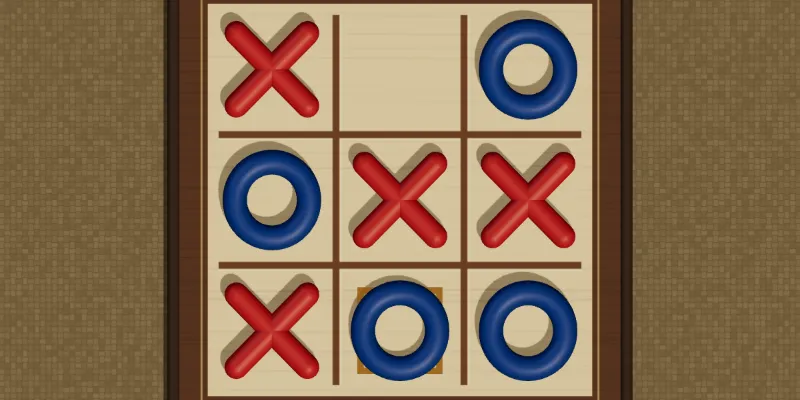
- Players
- 2
- What you need
- Nine squares and two marks, X and O
- How long
- A game takes under a minute
Rules checked 20 October 2026. How these rules are written
What tic-tac-toe is
Tic-tac-toe is a game for two on a board three squares wide and three deep. One player puts down X and the other O, one mark a turn, until somebody has three of their own in a straight line.
A line can run across, down, or from corner to corner, so the board has eight lines in all. If every square fills and nobody has a line, the game is a draw.
The board
- Draw two lines across and two lines down to make nine squares. Here the squares are cut into a wooden plank.
- One player is X and the other is O. You choose your mark on the game page and keep it for the whole match.
- X makes the first move of the first game. After that, the first move goes back and forth between you.
Taking a turn
On your turn, put one mark on any empty square. That is the whole move. A mark never moves once it is down, and nothing is ever taken off the board.
Before you play, look for two things. Can you finish a line of your own? Then do it, because that wins. Does your opponent have two in a line with the third square empty? Then put your mark on that square, or they win on their next turn.
On the screen, every square you may play shows a small dot. Tap one and your mark drops in. The mark your opponent put down last is ringed, so you can see what they did.
The fork
A block stops one line. So the way to win is to make two threats with a single move: two lines, each with one square missing. Your opponent can fill only one of those squares, and you take the other.
That is a fork, and every win between two people who block properly comes from one. Forks start in the corners, because a corner sits on three lines and an edge square on only two.
The other half of the game is seeing a fork coming and stopping it a move early, usually with a threat of your own that your opponent has to answer.
How a game ends
A game ends the moment somebody makes a line of three. The winning line is struck through so both players can see it.
If the ninth square fills and nobody has a line, the game is a draw. When both players are careful, every game ends like this. That is how the game is made, and it is why a match here is several games.
A match
A match is one, three or five games, chosen on the game page. Five is the usual setting: a game takes under a minute, and one game between careful players settles very little.
Each player keeps their mark for the whole match while the first move goes back and forth. X opens the first game, O the second, X the third. Going first is the only edge this game has, and this shares it out.
Every game of the match is played, and whoever wins more of them wins the match. A drawn game counts for nobody, and a match that ends level is a draw.
Some tables play it the other way: whoever lost the last game opens the next one. That is a setting on the game page.
Playing better
- Start in a corner. Your opponent has one good reply, the middle, and every other reply loses to a fork.
- If your opponent starts in a corner, take the middle. If they start in the middle, take a corner.
- When you hold the middle and your opponent holds two opposite corners, play an edge square. A corner there lets them fork you.
- Block before you build. A line of your own is no use if theirs is finished first.
Settings
Everything on the game page, before you press Play.
| Setting | Standard | What it changes |
|---|---|---|
| Who is playing | With bots | With bots sets you against a bot. On this phone seats two people, who pass the phone between turns or leave it lying flat between them. Friends online plays over a link. Watch the bots, the link under the button, sets two bots against each other. |
| Your mark | X | The mark you play for the whole match. X opens the first game. On this phone it is the first player's mark. |
| Games | 5 | One, three or five games. Every game of the match is played, even once one player can no longer be caught. |
| Difficulty | Medium | Easy takes a win when it sees one but misses a block about half the time. Medium always blocks and never plans a fork. Hard never loses. |
| Who opens the next game | Each in turn | Each in turn shares the first move out over the match. Whoever lost is the playground rule: the loser opens the next game, and after a draw the turn goes on as usual. |
The words
- Katakut (काटाकुट)
- What tic-tac-toe is called in Nepal. In Britain it is noughts and crosses.
- X
- The cross. It opens the first game of a match.
- O
- The ring. It opens the second game.
- Line
- Three squares in a row, a column or a diagonal. The board has eight.
- Fork
- One move that makes two lines at once, each one square short. Only one of them can be blocked.
- Draw (बराबरी)
- A full board with no line. Between two careful players, the usual result.
How other families play it
Every family plays it a little differently. These are the ways we know of. The ones with a button are house rules this table can play.
Whoever lost opens
The playground way: whoever lost the last game makes the first move of the next, and after a draw the first move goes on taking turns. It is a setting on the game page.
Questions people ask
What are the rules of tic-tac-toe?
Two players take turns putting their mark, X or O, on an empty square of a three by three board. The first to have three in a line across, down or corner to corner wins. If all nine squares fill with no line, the game is a draw.
Who goes first in tic-tac-toe?
X opens the first game here. After that the first move goes back and forth, X, then O, then X again. On the game page you can choose the playground rule instead, where whoever lost the last game opens the next one.
Can you always win tic-tac-toe?
No. If both players block every threat, the game is always a draw. You win only when your opponent misses a block or lets you make a fork, two lines at once with one move.
What is the best first move in tic-tac-toe?
A corner. Your opponent then has one safe reply, the middle square, and every other reply loses to a fork. If they open in a corner, take the middle. If they open in the middle, take a corner.
How many ways are there to win tic-tac-toe?
Eight lines: three across, three down and two corner to corner. The middle square is on four of them, each corner on three, and each edge square on two.
What is tic-tac-toe called in Nepali?
Katakut, काटाकुट. In Britain it is noughts and crosses. This page and the board are both in Nepali as well.
How many games are in a match?
One, three or five, chosen on the game page, and five unless you change it. Every game is played, a drawn game counts for nobody, and whoever wins more games wins the match.
Can you beat the hard bot at tic-tac-toe?
No, the hard bot never loses, so the best you can do is draw. Medium always blocks but never plans a fork, so a fork beats it. Easy misses about half its blocks.
Every rule on this page is the one the app plays by. Change any of them on the game's own page before you start.