How to play Mancala
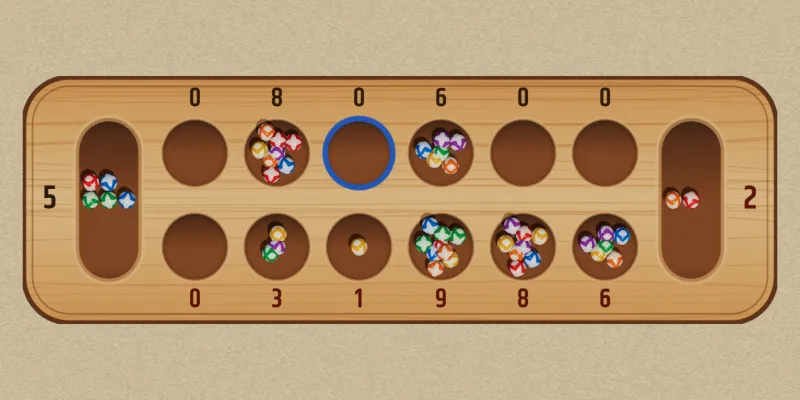
A game for two: seeds sown round a board of twelve houses, captured across it, and counted in two stores.
- Players
- 2
- What you need
- A board of twelve houses and two stores, and 48 seeds
- How long
- Five to ten minutes a game
What Mancala is
Mancala is a family of games played with seeds or stones on a board of pits, from West Africa to Indonesia. Here it is played on a carved board with a row of six houses for each player and a store at each end, and the seeds are glass marbles.
Each player owns the row nearest them and the store on their right. The aim is to have more seeds in your store than the other player has in theirs when the game ends.
Playing it here
- On your turn, the houses you may sow from glow. Tap one.
- Its seeds are picked up and sown one at a time round the board, and the count beside every house changes as they go.
- Watch where the last seed lands. That decides whether anything is captured, and in Kalah whether you go again.
On a phone held upright the board stands up, with South’s row down the left and South’s store at the bottom. On a wider screen it lies across. Either way the seeds go round the same way.
Sowing
A turn is one sowing. Pick up every seed in one of your houses, then drop them one at a time into the houses that follow, going round the board anticlockwise: along your row towards your store, then back along the other row.
A house with many seeds can carry a sowing all the way round the board and back past where it began.
Kalah: the store and the capture
In Kalah your sowing drops a seed into your own store as it passes, but never into the other player’s store. If your last seed lands in your own store, you sow again.
If your last seed lands in one of your own houses that was empty, and the house across from it on the other row has seeds, you take them all, with your last seed, into your store.
Oware: twos and threes
In Oware nothing is sown into the stores, and a house of twelve or more skips the house it came from. Captures happen on the other player’s row: if your last seed makes two or three in a house there, you take them, and so on back along the houses before it while each holds two or three.
A sowing that would take every seed the other player has takes none at all.
You must leave the other player something to play. When their row is empty, you must sow a house that reaches it if you can. If you cannot, the game ends and you keep the seeds on your own row.
How a game ends
In Kalah the game ends when one row is empty. The other player puts every seed left on their own row into their store, and the stores are counted.
In Oware the game ends when one player has more than half the seeds, at 25 of 48, when both have 24, or when the game goes round in a circle, in which case each player keeps what is on their own row. The most seeds in a store wins, and the same number is a draw.
A match
A match is one, three or five games. Each player keeps the same row for the whole match, South opens the first game, and the first move goes back and forth after that unless the table says whoever lost opens.
Going first matters: Kalah with four seeds was solved in 2000, and with perfect play the first player wins.
A few tips
- In Kalah, look for a house whose seeds land exactly in your store. Several of those in a row can make a long turn.
- Count the seeds in the other player’s houses before you sow. A house that will reach one of your empty houses is a capture waiting for them.
- Keeping seeds in the houses nearest your store gives you short sowings to use later, when you need one.
- In Oware, houses on your row with one or two seeds are what the other player captures. Fill them or empty them.
Settings
Mancala has these settings, and the page asks first who is playing.
| Setting | Standard | What it changes |
|---|---|---|
| Who is playing | Against the computer | Against the computer, with a friend online, or two people on one phone, which the board is made for: nothing is hidden and nobody acts on the other’s turn. |
| Your row | South | Which row you play. South opens the first game. |
| Rules | Kalah | Kalah, the version most apps play, or Oware, the game of Ghana and the Caribbean. |
| Seeds in each house | 4 | How many seeds each house starts with in Kalah, from three to six. More seeds make a longer game. Oware always starts with four. |
| Games | 1 | One, three or five games make the match. |
| Difficulty | Medium | Easy looks one sowing ahead and sometimes not at all, medium looks four ahead, and hard looks about ten. |
| Who opens the next game | Each in turn | Who opens each game after the first: each in turn, or whoever lost the last one. |
Words
- House
- One of the twelve small pits, six on each row. You sow from your own.
- Store
- The long pit at your end of the board, where the seeds you win are kept.
- Sow
- To pick up all the seeds in a house and drop them one at a time into the houses that follow.
- Capture
- Taking seeds from the board into your store, by where your last seed lands.
Every rule on this page is the one the app plays by. Change any of them on the game's own page before you start.