How to play Hearts
A trick game for four where every point is a bad one: take no hearts, and keep clear of the queen of spades.
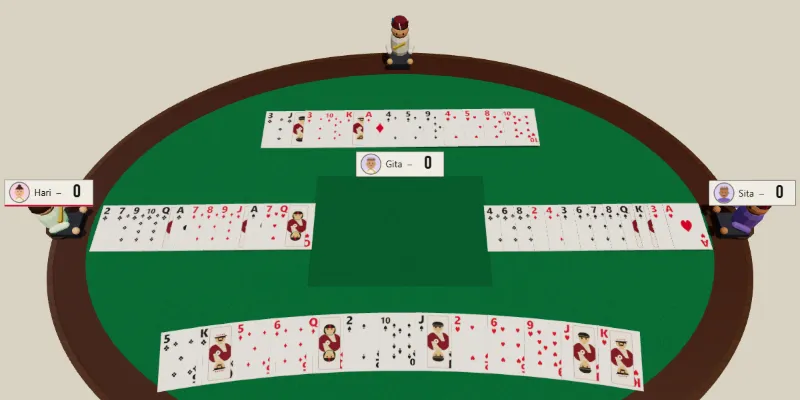
- Players
- Exactly 4
- What you need
- One pack of 52 cards
- How long
- Six to ten hands, until somebody reaches 100
What Hearts is
Hearts is a trick-taking game for four players, each playing for themselves, with one pack of 52 cards and no trump. It is the opposite of Call Break: instead of winning tricks, you want to avoid taking the cards that score.
Every heart you take is a point against you, and the queen of spades is thirteen. The match ends when somebody reaches the target, and the player with the fewest points wins.
The deal and the pass
- All 52 cards are dealt, thirteen to each player.
- Everybody chooses three cards to pass. On the first hand they go to the next player, on the second to the player before, on the third across the table, and on the fourth nobody passes. Then it starts again.
- The cards change hands together, so nobody sees what they are given until they have chosen what to give.
Pass the cards that would cost you: the queen of spades if you have few spades to hide her among, the ace and king of spades that would catch her, and high hearts. Passing every card of a short suit leaves you void in it, which is useful later.
A trick
The player to move puts down a card, and everybody follows in turn with a card of the same suit if they have one. If you have none of the suit led, you may play anything.
The highest card of the suit led takes the trick. There is no trump. Whoever takes it leads the next one.
Two rules about leading
The player holding the two of clubs leads it to the first trick.
On the first trick nobody may play a heart or the queen of spades, unless they hold nothing else. The first trick is always free of points.
Nobody may lead a heart until a heart has been played on another suit. That is called breaking hearts. A player whose hand is all hearts may lead one anyway.
The points
When the hand is over, each player counts the cards in the tricks they took: one point for every heart and thirteen for the queen of spades. That is twenty-six in all.
The points are added to your total. Lower is better.
Shooting the moon
If one player takes every heart and the queen of spades, all twenty-six points, they have shot the moon. They score nothing for the hand, and every other player scores twenty-six.
It is a gamble. Try for it and miss one heart, and you have taken twenty-five points yourself.
The end of a match
Hands are dealt until somebody reaches the target, 100 points or 50 for a quicker game. Then the player with the fewest points wins.
If the fewest points are shared, another hand is dealt to settle it.
A few tips
- Get rid of a short suit early. Once you are void in it, you can throw your worst cards when it is led.
- Play your highest card that still loses the trick. High cards are dangerous to keep until the end.
- If you do not hold the queen of spades, lead low spades to make whoever has her play her.
- Watch who is taking the points. If one player has all of them so far, somebody has to take a heart to stop the moon.
Settings
Two things change from table to table, and you can set both before you start.
| Setting | Standard | What it changes |
|---|---|---|
| Play until somebody reaches | 100 | The score that ends the match. 50 is a quicker game. |
| Passing before each hand | Next, back, across, then none | Where the three cards go before each hand: round the table in turn, always to the next player, or not at all. |
Words
- Trick
- One card from each player. The highest card of the suit led takes it.
- Hearts broken
- A heart has been played, so hearts may now be led.
- The queen of spades
- The card worth thirteen points, as much as all thirteen hearts together.
- Shooting the moon
- Taking all twenty-six points in one hand, which gives them to everybody else instead.
- Void
- Holding no cards of a suit, so you may play anything when it is led.
Every rule on this page is the one the app plays by. Change any of them on the game's own page before you start.