How to play Texas Hold'em poker
Texas Hold'em is the poker the world plays. You get two cards that only you see, five more are dealt face up in the middle for everybody, and the best five out of your seven win. In between there are four rounds of betting, and most hands are won by the player still in when everybody else has folded.
- Players
- 2 to 6
- What you need
- 52 cards and a pile of chips
- How long
- Ten hands, a minute or two each
What the game is
Two to six players sit round the table, each with the same pile of chips. Every hand, each player is dealt two cards face down. Five shared cards are then dealt face up in the middle in three stages, and you make your hand from the best five of the seven you can use.
Between the stages everybody bets. You can stay in by matching the biggest bet, raise it to make the others pay more, or fold and give up what you have already put in. A hand ends when one player is left, or when the last card has been dealt and the betting is over, and then the best hand takes the pot.
The blinds and the deal
- One seat holds the dealer button, which moves one seat to the left after every hand.
- The player to the button's left puts in the small blind, and the next player the big blind, which is twice as much. These two forced bets are what there is to play for before anybody has looked at a card.
- Everybody is dealt two cards face down, one at a time, starting with the small blind.
With only two players the button is the small blind. That is the one change to the order, and it keeps the button acting last after the flop.
A round of betting
Betting goes round the table to the left. On your turn there is a bet in front of you, or there is not, and you have up to three choices.
- Fold: give up the hand and whatever you have put in. You are only offered this when there is something to pay.
- Check, when nobody has bet on this round: stay in for nothing.
- Call: put in enough to match the biggest bet. If you have less than that, calling puts all your chips in.
- Bet or raise: put in more than the biggest bet. A raise has to be at least as big as the last bet or raise on this round, and with no limit you may put in everything you have.
The round ends when everybody still in has acted and has put in the same amount, or has nothing left to put in. Before the flop the first to act is the player left of the big blind, and the big blind acts last, so it may raise even when everybody else has only called.
After the flop the first to act is the first player still in to the left of the button.
The board
- The flop: three cards face up in the middle, then a round of betting.
- The turn: a fourth card, then a round of betting.
- The river: the fifth and last card, then the last round of betting.
Before each stage the dealer burns the top card, putting it aside face down, so nobody can have glimpsed the card that comes next. The board belongs to everybody. Every player still in uses the same five.
The hands, best first
A poker hand is always exactly five cards. These are the nine kinds, and any kind beats every kind below it.
When two hands are the same kind, the higher cards win, and then the next ones down. Two hands that each hold a pair of queens are compared on their next card, the kicker. Suits never decide anything, so two hands can be exactly level, and then they share the pot.
The ace is the highest card, and it is also the lowest in one hand only: ace, two, three, four, five, the smallest straight. A straight cannot go round the corner, so queen, king, ace, two, three is nothing.
Your best five
You may use both of your cards, one of them, or none and play the board's five. Whatever five are best count, and the rest are ignored.
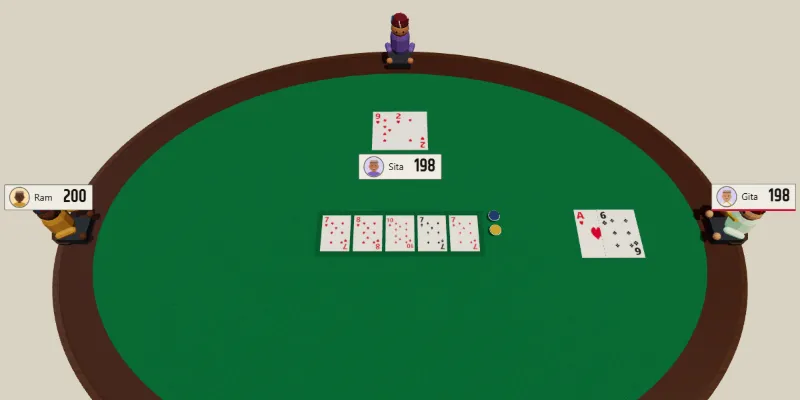
In the picture the board has a pair of nines, but your two spades and three of the board's make a flush, which beats the pair, so the pair does not count.
How a hand ends
If everybody but one player folds, that player takes the pot at once and does not have to show their cards.
Otherwise, once the betting after the river is over, everybody still in turns their cards over. This is the showdown, and the best hand takes the pot.
A bet that nobody called goes back to whoever made it before the pot is paid. A match is a number of hands, ten by default, and the player with the most chips at the end wins it. A player who runs out of chips is out, and the match ends early if only one player has any.
All in, and side pots
You can never be made to fold for lack of chips. If a bet is more than you have, you can call with everything you have, and you are all in. You stay in the hand to the showdown without betting again.
But you can only win from each other player as much as you put in yourself. So the pot is split. The main pot holds what everybody matched up to your amount, and you can win it. Whatever the others bet above that goes into a side pot, which only they can win.
At the showdown the main pot goes to the best hand among everybody, and each side pot to the best hand among those who paid into it. That is how the best hand at the table can take less than the whole pot.
Chips, not money
Poker is played for money in most places it is played, and Nepali citizens may not play in the country's casinos. This table is different. The chips belong to the match, everybody starts with the same pile, they buy nothing, and they cash out to nothing. What you win is the hand, and nothing here touches your coins.
Settings
The defaults are four players, blinds of one and two, two hundred chips each, which is a hundred big blinds, and no limit. That is the usual game.
| Setting | Standard | What it changes |
|---|---|---|
| Players | 4 | Two to six. Fewer players means more hands worth playing, because there are fewer hands to beat. |
| Betting | No limit | With a pot limit a bet can be no bigger than the pot, so nobody can push everything in before the flop. |
| Blinds | 1 and 2 | Bigger blinds against the same chips make every hand cost more, and a match shorter. |
| Chips each | 200 | More chips means more room to wait for a good hand. |
| Hands in a match | 10 hands | How many hands the match lasts. |
| Difficulty | Medium | Easy bots call too often and rarely raise. Hard ones fold weak hands and bet strong ones. |
Playing well
- Most two-card hands are not worth paying for. A pair, two high cards, or two of one suit close together are the usual reasons to stay in before the flop.
- Weigh the price. If calling costs a quarter of what you would win, you need to win more than one time in four to make it worth it.
- Acting last is an advantage, because you see what everybody else did first. Play more hands on the button and fewer just after the big blind.
- A bet is a story about your hand. Bet when you are strong so that weaker hands pay you, and now and then when you are not, so that nobody can read you.
The words
- Blind
- A forced bet before the deal: the small blind and the big blind, from the two seats left of the button.
- Button
- The marker for the dealer's seat. It moves one seat left every hand and acts last after the flop.
- Flop, turn, river
- The first three board cards, the fourth and the fifth.
- Check
- Stay in without betting, when nobody has bet on this round.
- Call
- Match the biggest bet.
- Raise
- Put in more than the biggest bet, so that everybody else has to match it again.
- All in
- Every chip you have is in the pot. You stay in to the showdown but can win only as much from each player as you put in.
- Kicker
- The highest card outside a pair or set, which decides between two hands of the same kind.
Every rule on this page is the one the app plays by. Change any of them on the game's own page before you start.