How to play 2048
Written २०४८ in Nepali, where it also reads as a year of the Bikram Sambat. Also searched as the 2048 game, merge, number merge and number puzzle.
2048 is a puzzle for one on a board of four by four. Each swipe slides every tile one way, and two tiles of the same number that meet join into one tile of their sum. Build a tile of 2048, then play on for a higher score until no swipe can move a tile.
After every swipe a new 2 or 4 appears on an empty cell. Each join scores the number it makes, so a 2048 built from 2s is worth 20,480 points on the way.
Set the table up with your own house rules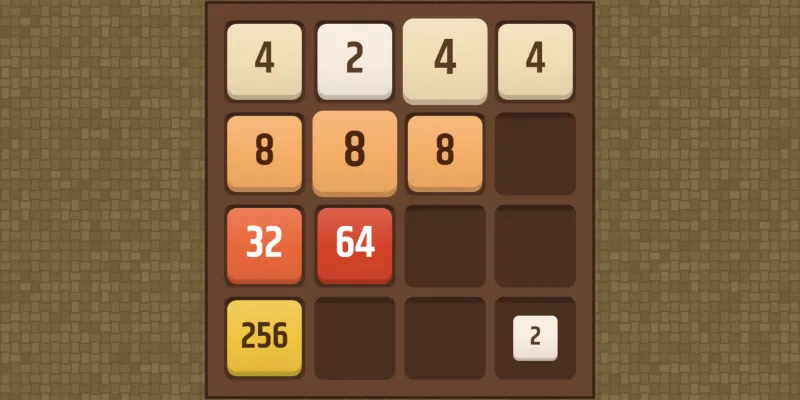
- Players
- 1
- What you need
- A board of four by four and numbered tiles
- How long
- Five to thirty minutes, for as long as a tile can move
At a glance
| Tile made | Scores | Built from 2s, in all |
|---|---|---|
| 4 | 4 | 4 |
| 8 | 8 | 16 |
| 16 | 16 | 48 |
| 32 | 32 | 128 |
| 64 | 64 | 320 |
| 128 | 128 | 768 |
| 256 | 256 | 1,792 |
| 512 | 512 | 4,096 |
| 1024 | 1,024 | 9,216 |
| 2048 | 2,048 | 20,480 |
Each 4 that appears by itself skips the join of two 2s, so a real game scores a little less than the last column.
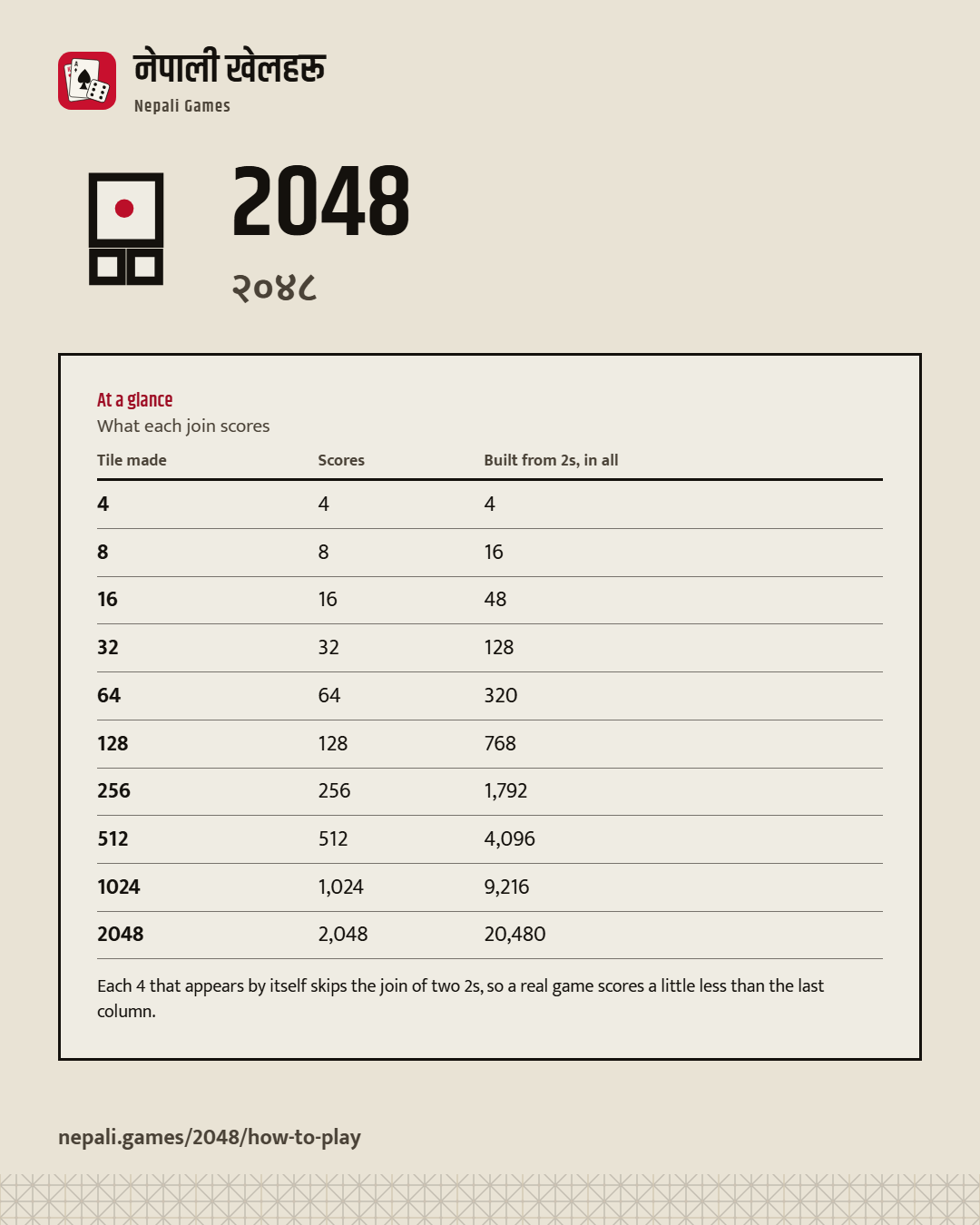 The same table on one card, to keep on your phone or send to the family group. Tap to open it.
Rules checked 20 October 2026. How these rules are written
What 2048 is
2048 is a puzzle for one player on a board of sixteen cells. Each tile carries a number, and every number is a power of two: 2, 4, 8, 16 and so on. You never place a tile. You swipe, and every tile on the board slides that way at once.
When two tiles with the same number meet, they become one tile of their sum. Two 2s make a 4, two 4s make an 8, and ten doublings from a 2 make 2048, the tile the game is named after. Reaching it does not end the game. You can play on for a 4096 and a higher score.
Playing it here
- Swipe up, down, left or right anywhere on the table. On a computer the arrow keys and W, A, S and D do the same.
- Every tile slides as far as it can that way, and tiles that meet a twin join into one.
- A new tile appears on an empty cell, and it is your turn again.
A swipe counts the moment your finger has moved far enough, so you do not need to lift it first. You can swipe again while the tiles are still sliding. A swipe that would move nothing is not a move, and nothing happens.
Every tile slides
A swipe moves every tile, never only one. Each tile travels until it reaches the edge of the board or a tile it cannot join.
So a swipe decides where every tile goes, and the board after it is the same whichever tile you were looking at. That is what makes the game a puzzle. Each move changes the whole board.
Two of a kind join
Two tiles with the same number that meet in a swipe become one tile with their sum, in the cell nearer the wall they slid towards.
A tile made in a swipe does not join again in the same swipe. A row of four 2s swiped left gives two 4s, and it takes a second swipe to join those into an 8. Where three equal tiles meet, the two nearest the wall join first.
A new tile after every move
After every swipe that moves something, a new tile appears on an empty cell. It is a 2 nine times in ten and a 4 the tenth time. Two tiles are on the board when a game starts.
When the game ends
No swipe can move a tile only when every cell is full and no two tiles next to each other, across or up and down, carry the same number. While there is an empty cell, or a pair that could join, you play on.
When nothing can move, the game asks whether to undo the last swipe or to end the game there. Ending it gives your final score.
Undo
Undo takes back the last swipe: the board, the score and the tile that came after it, so swiping the same way again brings the same tile. You can undo one swipe at a time, as far back as the first. On a computer, U or Z does the same.
A game with an undo in it is played to the end like any other, but its score is not kept as your best or as today’s score. Undo lets you try every direction and keep the one that worked, and a best has to mean a game played without that.
Scoring
Each join scores the number on the tile it makes. Two 2s joining into a 4 score 4, and two 1024s joining into 2048 score 2048. Nothing else scores.
So the score grows faster the bigger the tiles you build. Building one 2048 out of 2s scores 20,480 along the way. Your best score is kept on the game’s page, and on your account when you are signed in.
Today’s game and a new game
Today’s game brings the new tiles in the same order for everybody in Nepal: the same 2s and 4s, each in the same share of the empty cells. Where a tile lands still depends on how you played, but the luck is the same for everybody. It changes at midnight in Kathmandu.
A new game is dealt at random, and you can play as many as you like.
A few tips
- Pick a corner and keep your biggest tile in it. Most good games are played with two directions most of the time, for example down and left, and a third only when they are stuck.
- Keep the row along that corner full and in order, biggest first. A full row cannot slide sideways, so the big tile stays put.
- Build the next tile up beside the biggest one, so that when it is ready the two join without moving anything else.
- Avoid the direction that pulls your biggest tile out of its corner. If you have to, swipe back straight away.
Settings
There is one choice, which game to play. The board, the tiles and the scoring are the same in every game, so a best score always means the same game.
| Setting | Standard | What it changes |
|---|---|---|
| Game | Today’s game | Today’s game brings everybody the same tiles today. A new game is dealt at random. |
Words
- Tile
- A square on the board with a number on it, always a power of two.
- Swipe
- A move: every tile slides one way, up, down, left or right.
- Join
- Two tiles with the same number meeting in a swipe and becoming one tile with their sum.
- Corner
- Where most players keep their biggest tile, so the rest can be built up beside it.
How other families play it
Every family plays it a little differently. These are the ways we know of. The ones with a button are house rules this table can play.
Smaller and bigger boards
Some versions play on three by three, which is short and tight, or five by five, which is long and roomy. Each is a different game with different scores, and the table here keeps to four by four so that a best score always means the same game.
Questions people ask
How do you play 2048?
Swipe up, down, left or right, and every tile slides that way as far as it can. Two tiles of the same number that meet join into one tile of their sum, and a new 2 or 4 appears after every swipe. Keep joining until you have built a tile of 2048.
What happens when you reach 2048?
The game goes on. Reaching 2048 does not end it, so you can keep playing for a 4096 and a higher score, until no swipe can move a tile.
How is the score counted in 2048?
Each join scores the number on the tile it makes. Two 2s make a 4 and score 4, and two 1024s make 2048 and score 2048. Nothing else scores, and the table at the top of this page shows what each tile adds up to.
Is the new tile in 2048 a 2 or a 4?
A 2 nine times in ten and a 4 the tenth time. It appears on an empty cell after every swipe that moves something. Two tiles are on the board when a game starts.
Why do four 2s make two 4s and not an 8?
Because a tile made in a swipe does not join again in the same swipe. A row of four 2s swiped left gives two 4s, and the next swipe joins them into an 8. Where three equal tiles meet, the two nearest the wall join.
When is a game of 2048 over?
When every cell is full and no two tiles side by side, across or up and down, carry the same number. Then the game asks whether to undo the last swipe or to end there with your score.
Can you undo a move in 2048?
Yes, here, one swipe at a time as far back as the first, and the same new tile comes back after it. A game with an undo in it is played to the end, but it is not kept as your best or as today's score.
What is the best strategy for 2048?
Keep your biggest tile in one corner and play mostly two directions, for example down and left. Keep the row along that corner full and in order, and build the next tile up beside the biggest so the two can join without moving anything else.
Every rule on this page is the one the app plays by. Change any of them on the game's own page before you start.