How to play gatta (five stones)
Five small stones on a floor. Toss one up, do something with the others before it comes down, and catch it, through seven stages each harder than the last.
- Players
- 2-4
- What you need
- Five small, smooth, round stones
- How long
- A game takes ten minutes or so
What gatta is
Gatta (also gatti, ghutta, gotta, or chaga in Bhaktapur) is the five-stone game of Nepal's courtyards and verandas. Children have played it on mud-plastered floors for generations, mostly girls, and it is remembered from Jhapa and Bara to Kathmandu and Bhairahawa.
One of the five is the striker. You toss it up, and while it is in the air the same hand picks stones off the floor, puts them down, or pushes them somewhere. Then it catches the striker before it lands.
The stages go from picking up one stone at a time to sweeping stones into a cave made by your other hand. The first player through every stage wins.
What you need
Five small stones, round and smooth enough to sit still and small enough that several fit in one hand. Any floor will do: a courtyard, a veranda, a room. Two to four players is usual, and you can play alone.
A turn
- Throw the four stones down on the floor and keep the striker. How hard you throw decides how far they spread.
- Toss the striker up.
- While it is up, do what the stage asks, with the same hand.
- Catch the striker before it lands. Then toss again for the next part of the stage. Your turn goes on until you foul.
Stages one to four
- One at a time: pick up one stone each toss, four tosses.
- Two at a time: pick up two together each toss, two tosses.
- Three, then one: three together on one toss, the last on the next.
- Down and up: toss and put all four down, then toss again and pick all four up.
Stages five to seven
- The gate: your other hand makes an arch on the floor with its thumb and forefinger. Push one stone under it each toss, four times.
- The cave: your other hand cups the floor, open towards you. Push a stone in each toss, then lift the hand away and pick all four up together.
- The heart: the next player makes a heart with their two hands. Carry a stone into it each toss, then they lift their hands and you pick all four up.
Fouls
- Dropping the striker: it lands and the hand is not there.
- Touching a stone you are not taking, or moving one already done with.
- Picking up too few, or too many, for the stage.
- Pushing a stone into the hand that makes the gate or the cave, rather than through it or in.
After a foul the stones pass to the next player. When they come back to you, you start the stage you fouled on again.
The end
The first player through every stage wins. With the setting for three turns each, the game stops after everybody's third turn and the most stages cleared wins.
Other ways to play
Let's Play Initiative Nepal teaches seven stages in Bhaktapur, and that is what this game plays. ECS Nepal describes eight, with a stage of catching all five on the back of the hand. Republica names stages kukur, bagh and paan without saying which is which.
Some play with three tries at each stage before the stones pass on, and some with five, seven or nine stones. The Kathmandu Post remembers whoever cleared the most stages as the winner.
If your village played it differently, tell us through the feedback on this page. The rules here are what the written sources agree on.
Playing it here
Press where the stones should land and drag to throw them: a longer drag spreads them wider. For the gate and the cave, drag your other hand to a clear spot and let go.
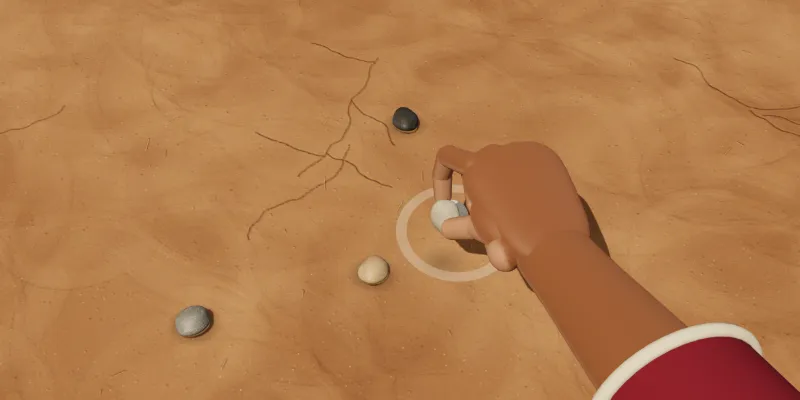
To toss, press where your hand should be and swipe up. A longer swipe tosses higher and gives you more time, and a swipe to the side carries the striker that way. A ring shows where it will come down.
While the striker is up, your finger is your hand. Touch the floor, sweep over the stones the stage asks for, and lift your finger on the ring to catch. Lift before the striker lands.
A few tactics
- Throw the stones wide for one at a time and close together for twos and threes, so the ones you want lie in a group.
- Toss from right beside the stones you are going for. The striker comes down near where it left your hand.
- A high toss buys time but strays further. Toss only as high as the sweep needs.
- Come at a stone from the side away from its neighbours, so the fingertip never passes near them.
Settings
Every setting is on the game's page before you start. These are the defaults, and what changing each one does.
| Setting | Standard | What it changes |
|---|---|---|
| Who is playing | Against a bot | Play bots, friends online, or up to four people on this phone |
| Difficulty | Medium | How quick and steady a bot's hand is |
| Stages | All seven | The first four only, the ones played with one hand |
| Tries at each stage | One | Three tries at each stage before the stones pass on |
| How it ends | First through every stage | Three turns each, and the most stages wins |
| Time in the air | Normal | Slow keeps the striker up longer, quick shorter |
| Landing ring | On | Off, you judge where the striker will land yourself |
| Speed | 1× | Plays the other players' tosses and the pauses faster, never your own toss |
Words
- Gatta (गट्टा)
- The game, and each of its small round stones.
- The striker
- The one stone tossed up on every turn. The other four are played with while it is in the air.
- Chaga
- The name Let's Play Initiative Nepal uses for the game in Bhaktapur.
- Kukur, bagh, paan
- Dog, tiger and leaf: names Republica gives for some stages, without saying which.
Every rule on this page is the one the app plays by. Change any of them on the game's own page before you start.