How to play Jutpatti
Also written jut patti and जुटपत्ती. Jut means matched and patti a playing card. In English the nearest name is Pairs.
Jutpatti is a Nepali card game for two to six players, five cards each, where the first hand made all of pairs wins. On your turn you take one card, from the face-down stock or the top of the face-up pile, and throw one. When the six cards you hold after a draw are three pairs, you say jut and take the round.
A card turned up at the deal sets the joker rank, one below it, and a joker pairs with anything.
Set the table up with your own house rules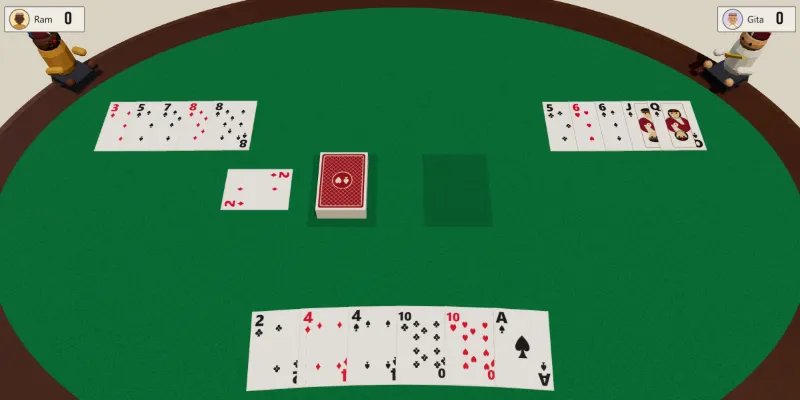
- Players
- 2 to 6
- What you need
- One pack of 52 cards
- How long
- A round takes a few minutes
Rules checked 20 October 2026. How these rules are written
What the game is
You start with an odd number of cards, usually five. On your turn, you draw one card and discard one, keeping your hand at five. As soon as you form a hand consisting entirely of pairs, you declare 'jut' and win the round.
That is the entire game. There is no bidding, no trump suit, no points to tally, and no way to lose points. It is typically the first game children learn and the perfect quick game while waiting for others to arrive.
The deal
- Shuffle one pack of 52 cards.
- Draw lots for who goes first. Deal five cards each, one at a time around the table, starting with that player. Next round, the first turn passes to the player after them.
- Turn the next card face up beside the pack. It sets the joker rank for the round and then stays where it is. It is never drawn and never shuffled back in.
- What is left of the pack is the stock. The pile starts empty, so whoever goes first has only one thing they can do: draw from the stock.
The joker rank
The card turned up at the deal does not join anybody's hand. Its job is to choose the wild rank, and the usual rule is the rank one below it. Turn a seven and every six at the table is wild. Turn an ace and kings are wild, because the ranks run in a circle.
A wild card pairs with anything you like. It is not a card of that rank, so two wild cards are allowed to pair with each other, which is worth remembering when you are one card short.
Because the turned card is one rank away from the wild one, all four wild cards are still in the game. Tables that make the turned card's own rank wild are playing with three. Both ways are offered in the settings, along with using the two printed jokers instead and playing with no wild cards at all.
A turn
- Take one card. Either the top of the face-down stock, which nobody has seen, or the top card of the face-up pile, which everybody has.
- Throw one card face up onto the pile. Your hand is back to the size it started at and the turn moves on.
One card in, one card out, with no way to pass. You may not throw back the card you have just taken off the pile, so picking something up commits you to it for at least a turn.
Only the top card of the pile is available. You can never dig down through it for the card you threw two turns ago.
If the stock runs out, the pile is turned over and shuffled back into a new one, all but its top card, and the game carries on. Nobody runs out of cards and no round ever ends in a draw.
What counts as a pair
Two cards of the same rank. Suits and colours are irrelevant, and so is which of the two is higher, because nothing here is higher than anything else.
A card of the joker rank pairs with whatever is left over.
Your hand is complete when every card is in a pair and nothing is left on its own. Nothing is laid on the table while you play. The pairs stay in your hand and nobody sees them until the round ends.
Saying jut
You declare after you have drawn and instead of throwing a card away, so you win holding six cards rather than five. Every hand at the table is turned over, and that is the round.
There is no penalty for getting it wrong, because getting it wrong is not possible. The app only offers the button when your hand really is all pairs, and a table playing with real cards simply checks.
Nobody is punished for what they were caught holding either. The round has a winner and nothing else.
Keeping score
A round won is worth one. Nothing is counted and nothing is deducted, so the scoreboard is simply how many rounds each person has taken.
Playing against the bots on this site, you can deal as many rounds as you like. An online table against other people runs to five rounds, and whoever has won most of them takes the match. A tie at the top is a draw and any coins staked go back where they came from.
Things worth knowing
- Watch what people take off the pile. Somebody who picks up a nine is holding a nine, and throwing your spare nine away hands them the round.
- Watch what has been thrown. Two jacks already on the pile means your lone jack has one partner left in a stock of thirty cards, and it is time to let it go.
- Hold the wild card. It is the one card that turns any spare into a pair, so it is worth more late in the round than the near miss you are hanging on to.
- Drawing blind from the stock tells nobody anything. Taking from the pile tells everybody something. That is the whole price difference between the two.
The settings
Every table in Nepal plays a little differently, so the game's own page lets you change what yours does before you start. These are the ones that change the game rather than the speed of it.
| Setting | Standard | What it changes |
|---|---|---|
| Players | 3 | How many seats, from 2 to 6. Fewer players means a longer stock and a slower round. |
| Cards | 5 cards | Deal seven instead and you are declaring on four pairs rather than three, which roughly doubles the length of a round. |
| Joker | One below the turned card | Or the turned card's own rank, or one above it, or the two printed jokers, or no wild cards at all. With no wild cards every pair has to be a real one. |
| Difficulty | Medium | How much the bots remember. They all play the same way. An easy bot forgets half of what it has seen, and a perfect one forgets nothing. |
The words
- Jutpatti (जुटपत्ती)
- The game. Jut is to come together or match, patti is a playing card, so the name is roughly matched cards.
- Jut (जुट)
- What you say when your hand is all pairs. It ends the round.
- Jodi (जोडी)
- A pair.
- Thupro (थुप्रो)
- The face-down stock you draw blind from.
- Phaleko patti (फालेको पत्ती)
- The face-up pile. Literally the thrown cards.
- Joker (जोकर)
- The wild rank for this round. Note that it means a rank, not a printed joker card, unless the table has chosen to play with the printed ones.
- Gaddi (गड्डी)
- A pack of cards.
How other families play it
Every family plays it a little differently. These are the ways we know of. The ones with a button are house rules this table can play.
Seven cards
Deal seven each instead of five, and you need four pairs to say jut rather than three. A round runs roughly twice as long.
The turned card's own rank is wild
Some tables make the turned card's own rank the joker. The turned card stays out of play, so only three jokers are left in the game.
One above the turned card
The joker is the rank above the turned card: turn a seven and eights are wild. All four of them stay in play.
The two printed jokers
The pack's two printed jokers are shuffled in and nothing is turned up. They are the only wild cards.
No jokers
Nothing is wild, so every pair has to be a real one, two cards of one rank.
Questions people ask
How do you play Jutpatti?
Each player gets five cards. On your turn take one card, from the face-down stock or the top of the face-up pile, and throw one. The first player whose hand is all pairs after a draw says jut and wins the round.
What is Jutpatti called in English?
Pairs is the nearest English name. Jut means matched and patti a playing card, and the first hand made all of pairs wins.
How many cards does each player get in Jutpatti?
Five, from one pack of 52, for two to six players. A setting deals seven, and then you need four pairs rather than three.
Which card is the joker in Jutpatti?
The rank one below the card turned up at the deal. Turn a seven and sixes are wild, turn an ace and kings are. Settings make it the turned rank itself, the rank above, the two printed jokers, or no wild card at all.
Can two jokers make a pair in Jutpatti?
Yes. A joker pairs with any card, another joker included.
Can you throw back the card you just picked up?
No. A card taken from the pile has to stay in your hand for at least that turn. Only the top card of the pile can be taken.
When can you say jut?
Right after you draw, when every card in your hand is in a pair. You say jut instead of throwing a card, so you win holding six. Here the button only appears when the hand really is all pairs.
What happens when the stock runs out in Jutpatti?
The pile, all but its top card, is shuffled into a new stock and play goes on. No round ends in a draw.
How is Jutpatti scored?
A round won is worth one, and nothing else is counted. Against the bots you deal as many rounds as you like. Online a match is five rounds, and most rounds won takes it.
Every rule on this page is the one the app plays by. Change any of them on the game's own page before you start.