How to play Solitaire
Patience for one: three games laid out on the table, each won by getting every card home.
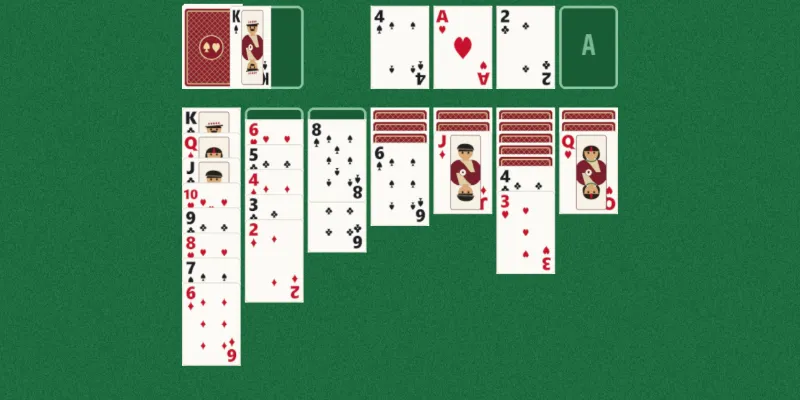
- Players
- 1
- What you need
- One pack of 52 cards, or two for Spider
- How long
- Five to twenty minutes a deal
What Solitaire is
Solitaire, also called patience, is a card game for one. The cards are dealt out into columns, and the aim is to move every one of them onto four piles at the top, one for each suit, built up from the ace to the king.
Three games are here. Klondike is the one most people mean by the word. Spider is played with two packs and builds whole suits inside the columns. FreeCell deals every card face up and gives you four cells to park cards in, so nearly every deal can be won by thinking it through.
Playing it here
- Press on a card and drag it to another pile. Any cards on top of it come along, as long as they are in order.
- Or tap a card. It goes where it goes best: home if it can, otherwise onto a column that takes it, and tapping it again carries it on to the next one.
- Tap the stock to turn cards over. In Spider a tap deals one card onto every column.
- Undo takes back your last move, and you can keep pressing it. Hint lights up a move worth making on the table.
When every card can go home with nothing left to decide, Finish plays them home for you. Give up ends a deal you cannot win, after asking. A deal is never ended for you.
Down in the columns, up at home
In a column, a card goes on a card one higher. In Klondike and FreeCell it must also be the other colour, so a red seven goes on a black eight. A run built like that moves as one.
At home it is the other way up. Each pile starts with an ace and takes the next card of the same suit, two, three and on up to the king.
Klondike
Seven columns are dealt, from one card to seven, with only the top card of each face up. The other 24 cards are the stock.
Tap the stock to turn cards onto the waste, one at a time or three, as the settings say. Only the top card of the waste can be played. When the stock runs out, a tap turns the waste back over to be the stock again, as often as you like.
When a face-down card is left on top of a column it turns over by itself. Only a king, or a run starting with a king, may go into an empty column, and a card may be brought back down from home onto a column if you need it.
Spider
Two packs, 104 cards, are dealt into ten columns, with the top card of each face up and 50 cards in the stock. With one suit every card is a spade, with two they are spades and hearts, and with four they are two full packs.
Any card goes on a card one higher, whatever its suit, but only a run of one suit moves together. When a column holds a whole suit from the king down to the ace, it is taken off and goes home. Take off all eight and the deal is won.
A tap on the stock deals one card onto every column, five times in a deal. It needs every column to have a card first.
FreeCell
Every card is dealt face up into eight columns. Above them are four cells, each of which holds any one card, and the four piles for home.
A run can move together only if it could have been moved a card at a time through the empty cells and columns. With three empty cells you can move four cards, and an empty column doubles that. Any card may go into an empty column.
Winning, and when a deal is stuck
A deal is won when every card is home. Your time is kept, and the fastest win at each game is your record.
Not every deal of Klondike or Spider can be won. When nothing on the table helps any more, Hint says so. You can undo back to where things went wrong and try another way, or give the deal up and start a new one.
Today’s deal and a new deal
Today’s deal gives everybody in Nepal the same cards at each game, so you can compare times with anybody who played it. It changes at midnight in Kathmandu.
A new deal is shuffled at random, and you can play as many as you like. Your fastest wins and the deals you have won are kept on the game’s page, and on your account when you are signed in. A deal won with a hint counts as won, but not for your best time.
A few tips
- Turn over the face-down cards first. In Klondike and Spider a card you cannot see is a card you cannot plan with, so work on the longest columns.
- Empty columns are worth a lot. Do not fill one with the first card that fits.
- In Spider, build in suit whenever you can. A run of one suit moves as one, and a mixed one does not.
- In FreeCell, keep cells empty. Every card parked in a cell makes the longest run you can move shorter.
Settings
Choose which game to play, and the rule that makes it easier or harder. Your records are kept for each choice separately, so a best time always means the same game.
| Setting | Standard | What it changes |
|---|---|---|
| Game | Klondike | Klondike, Spider or FreeCell, each described above. |
| Klondike turns | One card at a time | Klondike only. Turning three at a time puts fewer cards within reach and makes a deal harder. |
| Spider is dealt in | One suit | Spider only. More suits make runs of one suit harder to build. Four suits is for experts. |
Words
- Column
- One of the piles cards are dealt into, built down a card at a time.
- Home
- The piles at the top where each suit is built up from the ace. Also called the foundations.
- Stock
- The face-down cards left over after the deal, turned or dealt a few at a time.
- Waste
- In Klondike, where cards turned from the stock lie. Its top card can be played.
- Run
- Cards in order down a column, which can be moved together.
- Cell
- In FreeCell, a place that holds any one card for a while.
Every rule on this page is the one the app plays by. Change any of them on the game's own page before you start.