How to play Belote
Belote is the partnership card game of France, for four players in two sides with 32 cards. After five cards each one is turned up, and its suit may be taken as trump, where the jack and the nine rank highest. Runs and fours of a kind are declared on the first trick, and the side that took the trump must score at least as much as the other.
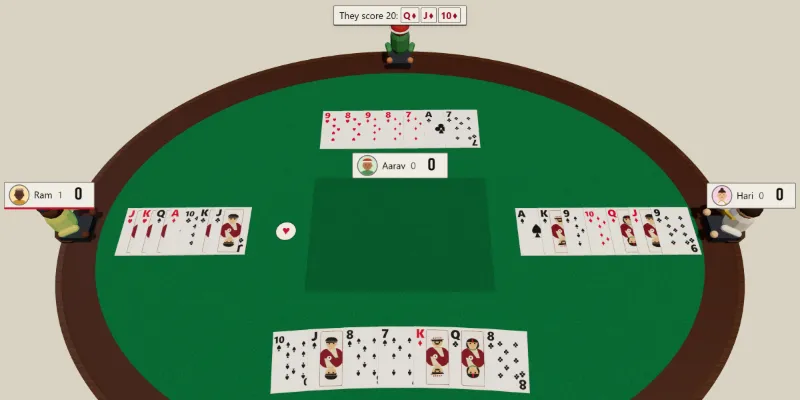
- Players
- Exactly 4, in two sides
- What you need
- 32 cards, sevens up to aces
- How long
- Deal after deal until a side reaches 501
What it is
Belote is the card game France plays in its cafés, and Bulgaria, Armenia, the Levant and the Gulf play it too, as blot and belot. Four players sit in two sides, partners opposite, with thirty-two cards. One side takes a trump from a card turned up on the table, and then both sides try to win the points in the tricks.
The side that took the trump has to make at least as many points as the other side. If it does, both sides score what they made. If it does not, it scores nothing and the other side scores everything. The first side to 501 wins the match.
The cards
The pack is sevens up to aces in four suits. Each card has two places, one for the trump suit and one for the rest.
In trumps the jack is the best card and worth 20, then the nine worth 14, then the ace, ten, king, queen, eight and seven. In the other suits the ace is best, then the ten, king, queen, jack, nine, eight and seven, and the jack is worth only 2.
The cards add up to 152, and whoever takes the last trick gets 10 more, so every deal is worth 162.
The deal
- The dealer gives three cards to each player and then two more, so everybody holds five.
- The next card goes face up on the table. Its suit is the first one offered as trump.
- Players take the trump or pass, in turn from the dealer's left. How that works is the next section.
- The player who takes picks up the turned card. Then the dealer gives three more to each of the others and two to the taker, so everybody holds eight.
Taking the trump
In the first round each player in turn may take the turned card's suit as trump, or pass. The first to take ends the round.
If all four pass, there is a second round, starting again from the dealer's left. This time each may name any other suit as trump, or pass.
If all four pass twice, nobody takes. The cards go back and the next player deals. A hand worth taking has the jack or the nine of the suit, or three trumps and an ace beside them, and the turned card counts as yours if you take.
The play
- The player on the dealer's left leads the first trick. After that, whoever took a trick leads the next.
- You must follow the suit that was led. When trumps are led, you must also beat the best trump on the table if you can.
- If you cannot follow and an opponent is winning the trick, you must trump. If an opponent has already trumped, you must go over that trump if you can, and play a lower one if you cannot.
- If you cannot follow and your partner is winning, you are free: throw any card, or trump.
The highest trump takes the trick, or the highest card of the suit led if no trump was played.
Declarations
Some hands score before a trick is taken. Three cards in a row in one suit are 20, four are 50 and five are 100, in the order ace, king, queen, jack, ten, nine, eight, seven. Four of a kind score too: jacks 200, nines 150, and aces, tens, kings or queens 100. A card counts in one declaration only.
Each player says what they hold as they play to the first trick. Only the side with the single best declaration scores, and it scores all of its declarations. Four of a kind beats any run, a longer run beats a shorter one, then the higher top card, then a run in trumps. The app works all of this out for you and shows the winning side's cards when the first trick is taken.
The king and queen of trumps in one hand are belote and rebelote, worth 20 to that side whatever else happens. You say belote as you play the first of them and rebelote with the second.
Scoring
At the end of a deal each side adds up its trick points, its declarations if it held the best, and 20 for belote and rebelote.
If the side that took the trump has at least as much as the other side, both sides score what they made. If it has less, it is dedans, which means inside: it scores nothing except its belote, and the other side scores 162 and every declaration of both sides.
A side that takes every trick has a capot, worth 252 instead of 162. A side that takes no trick loses its declarations, but never its belote.
Points add up deal after deal. The first side to reach 501 wins, and if both reach it on the same deal, the side with more wins. If they are level, one more deal is played.
Playing it well
- Take on the jack or nine of trumps with one or two more trumps and an ace. A lone jack with nothing beside it is how a side goes dedans.
- When your side took, pull the trumps early with the jack, so the opponents cannot trump your aces later.
- Do not lead a ten while the ace of its suit is still out. The ace will fall on it and take 21 points.
- When your partner's card is sure to win, throw your tens and aces on it. Those points are yours.
Settings
These are the choices that change the game. The difficulty only changes the bots.
| Setting | Standard | What it changes |
|---|---|---|
| Match to | 501 | 1001 is the classic match. 501 is half as long, which suits a phone. |
| Declarations score | On | Off, only belote and rebelote score, which is how tournaments play. |
| A tie is held over (litige) | Off | On, an exact tie scores the defenders' points and holds the takers' over for whoever wins the next deal. |
| Difficulty | Medium | Easy takes too often and plays loosely. Hard counts the trumps and keeps its tens back. |
Coinche, where the trump is bid for with a number, is not here yet.
The words
- Atout
- The trump suit, in French.
- Belote, rebelote
- The king and queen of trumps in one hand, worth 20, said aloud as each is played.
- Dedans
- Inside. The side that took the trump made less than the other side and scores nothing.
- Capot
- Every trick to one side, worth 252.
- Litige
- A dispute: an exact tie, under the house rule that holds the takers' points over.
- Dix de der
- Ten for the last trick, which makes the deal worth 162.
Every rule on this page is the one the app plays by. Change any of them on the game's own page before you start.