How to play Last Card
Last Card is the shedding game played with a deck of coloured cards. Match the card on the pile by its colour, its number or its symbol, use the action cards to slow the next player down, and be the first to empty your hand. Whatever is left in everybody else's hand is your score.
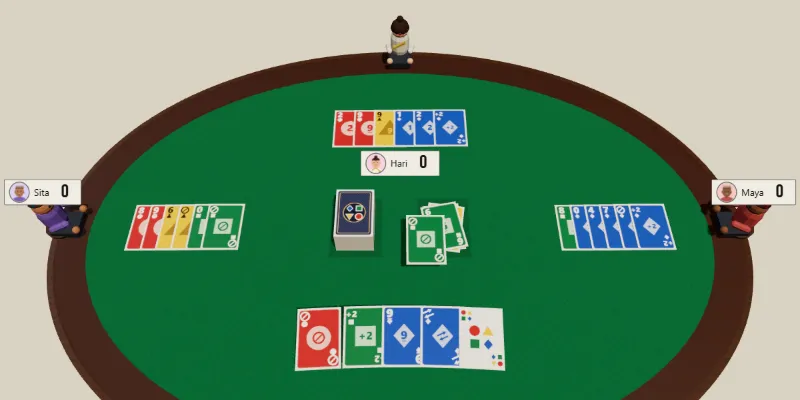
- Players
- 2 to 6
- What you need
- Its own deck of 108 cards
- How long
- A few minutes a round, played to a score
What the game is
Everybody holds seven cards, and there is one pile in the middle. On your turn you put one card on the pile, and it has to match the card on top: the same colour, the same number or the same symbol. If you have nothing that matches, you draw.
The first player to play their last card takes the round. It is one of the card games that come out at Dashain, and a whole family can learn it in one game.
Four colours, four shapes
The deck has four colours: red, yellow, green and blue. Here each colour also has its own shape: red is a disc, yellow a triangle, green a square and blue a diamond. The shape is in the corner of every card, under its number, and large in the middle.
So a player who cannot tell red from green can still play: match the shape and you have matched the colour. The colour chooser and the line under the score show the shape as well.
The deck
There are 108 cards. In each colour there is one 0, two of every number from 1 to 9, and two each of the three action cards: Skip, Reverse and Draw Two. That is 25 cards a colour.
Then there are eight wilds, which have no colour of their own: four Wilds and four Wild Draw Fours.
The deal
- Shuffle the whole deck and deal seven cards to each player, one at a time.
- Put the rest face down as the draw pile.
- Turn the top card over to start the pile. The player after the dealer goes first.
If the card turned up is an action card, it acts on the first player: a Skip skips them, a Reverse means the dealer goes first and play runs the other way, and a Draw Two makes them take two and miss their turn. A Wild lets the first player choose its colour.
A Wild Draw Four never starts the pile. It goes back into the draw pile and another card is turned.
A turn
- Play one card that matches the top of the pile by colour, number or symbol, or play a wild.
- If you cannot play, draw one card. If that card plays, you may play it straight away or keep it.
- Either way, play then passes to the next player.
You may draw even when you have a card that plays. Keeping a card back is a real choice, most often a wild you would rather save. After drawing, only the card you drew may be played that turn.
If the draw pile runs out, the pile is shuffled back in under its top card, and play goes on.
The action cards
A Skip makes the next player miss their turn.
A Reverse sends play the other way round the table. With two players it works like a Skip, so you play again.
A Draw Two makes the next player take two cards and miss their turn. Each action card matches its colour, and any card with the same symbol.
The wilds
A Wild goes on anything. When you play one you choose the colour that comes next, and the next player has to match that colour or play a wild of their own.
A Wild Draw Four does the same, and the next player also takes four cards and misses their turn.
Some tables let a player challenge a Wild Draw Four played while the player held a card of the colour on the pile. This table has no challenge: a Wild Draw Four may be played at any time.
The last card
When a player is down to one card, everybody at the table has to know. At a real table you say so out loud, and a player who forgets can be made to draw.
Here the table says it for you, in the log and on your seat, every time. Nobody is ever caught out for forgetting.
The score
The player who goes out scores the cards left in everybody else's hand. A number card is worth its number, a Skip, Reverse or Draw Two 20, and a wild 50. Nobody else scores anything that round.
If the last card played is a Draw Two or a Wild Draw Four, the next player still takes the cards, and they count to the winner.
The match
Scores carry over from round to round, and the first player to reach the target wins the match. The published target is 500. This table plays to 300 unless you choose otherwise, which is about seven rounds and eleven minutes at four players.
You can also play a single round, or to 200 or 500. The dealer moves one seat round the table every round.
Playing it well
- Keep your wilds for when nothing else plays. A wild played early is a card you will miss later, and fifty points if somebody else goes out.
- When you choose a colour, choose the one you hold most of.
- Save a Skip or a Draw Two for the player after you when they are down to one or two cards.
- Once anybody is close to going out, play your heaviest cards first. What you are holding is what they will score.
- Watch who draws. A player who draws on a colour does not have it, so turning the pile to that colour slows them down.
This table's settings
The defaults are the published rules. Stacking and drawing until a card plays are the two house rules tables most often add, and both are here.
| Setting | Standard | What it changes |
|---|---|---|
| Players | 2 to 6, four by default | More players means more cards in hands when somebody goes out, so a round scores more. |
| Play to | 500 published, 300 here | One round, 200, 300 or 500. A lower target is a shorter match. |
| Stacking | Off | A Draw Two can be answered with another Draw Two and a Wild Draw Four with another Wild Draw Four. The cards add up, and whoever cannot answer takes them all and misses a turn. |
| With nothing to play | Draw one | Keep drawing until a card plays, then play it or keep it. Hands grow faster and rounds last longer. |
| Difficulty | Medium | Easy plays whatever matches. Hard keeps its wilds, chooses its colours and saves its action cards for the player who is close. |
Words
- Wild
- A card with no colour, which goes on anything and names the next colour.
- Skip
- The next player misses their turn.
- Reverse
- Play goes the other way round the table.
- Draw Two
- The next player takes two cards and misses their turn.
- Stacking
- Answering a Draw card with the same Draw card, so the cards pass on to the next player.
- Going out
- Playing your last card, which takes the round.
Every rule on this page is the one the app plays by. Change any of them on the game's own page before you start.