How to play Dehla Pakad
Called दहलमारा (dahalmara, dahal mara) in Nepal, and also written दहला पकड. In English: Catch the Tens. Also called Mendikot.
Dehla Pakad is a trick-taking card game for four players in two partnerships, played with one pack for the four tens. A trick goes to the highest trump or the highest card of the suit led, but its cards stay in the middle until the same player wins two tricks running and takes the lot. The side with more tens wins the hand, and the first side to two kots, all four tens in one hand or seven hands in a row, wins the match.
A two-two split goes to the side that did not deal. The trump is made by the first player who cannot follow suit. Nepal calls the game दहलमारा, and it comes out at festivals, played more by elders than by the young.
Set the table up with your own house rules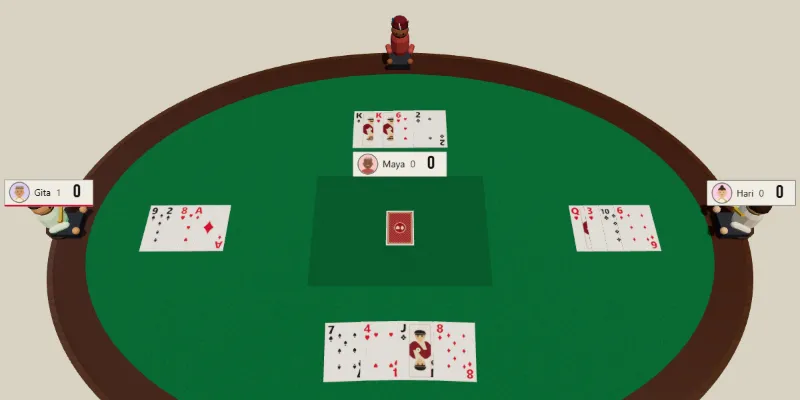
- Players
- 4, in two sides
- What you need
- One pack of 52 cards
- How long
- Two kots, about eight hands
At a glance
| What your side did | What it wins |
|---|---|
| Took all 4 tens | The hand and a kot |
| Took 3 tens | The hand |
| Took 2 and did not deal | The hand |
| Took 2 and dealt | Nothing: the other side has the hand |
| Won 7 hands in a row | A kot |
Only the tens count. The same player winning two tricks in a row takes the middle, and the last trick takes whatever is left. A match is to two kots here, and one or three in the settings.
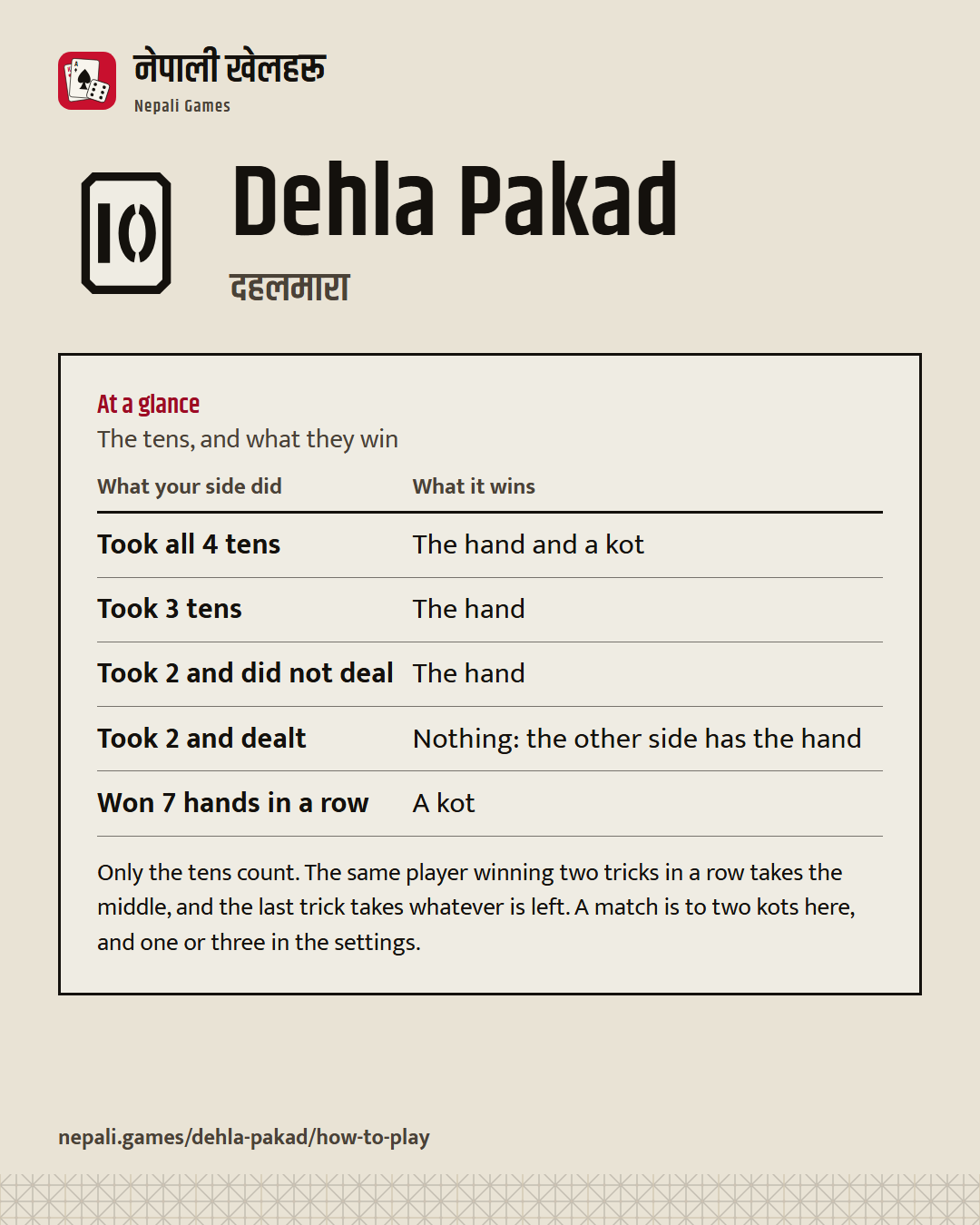 The same table on one card, to keep on your phone or send to the family group. Tap to open it.
Rules checked 20 October 2026. How these rules are written
What the game is
Four players compete in two partnerships, with teammates sitting across from each other. Using a standard 52-card deck (ace high down to two), each hand consists of 13 tricks. At the end of the hand, each side counts the tens they have captured.
Capturing all four tens wins a 'kot' for your side, while taking the majority of the tens wins the hand. A match is usually played to a set number of kots (default is two). Popular across North India, the game is also widely played in Nepal during festivals, where it is known as दहलमारा.
The deal
- The dealer gives five cards to each player, one at a time, starting with the player on their right.
- Then the trump is made, in one of the two ways below.
- Once it is, the dealer gives out the other eight each, so everybody ends with thirteen.
Making the trump
In the usual way, play starts with five cards each and no trump. The first player who cannot follow suit throws a card of another suit, and that suit becomes trump for the rest of the hand. That card is already a trump, so it may win the trick, unless a later player who also cannot follow throws a higher trump.
When that trick is over the dealer gives out the rest of the cards. If everybody follows suit through all five tricks, a card is drawn from the tricks played and its suit is trump.
In the other way, a house rule here, the player to the dealer's right looks at their first five cards and names the trump. The rest are dealt and that player leads.
A trick
The player to the dealer's right leads the first trick. You must follow the suit led if you can. If you cannot, you may play anything, including a trump.
The highest trump wins the trick. With no trump in it, the highest card of the suit led wins. The winner leads to the next trick.
The middle, and taking it
Winning a trick does not take it. Its cards go face down into the middle, on top of any tricks already there.
- When the same player wins two tricks in a row, that player takes the whole middle for their side.
- Partners winning one each does not count. It has to be the same player.
- After a take, the next trick starts a new pile, so it cannot count as the first of the next pair with the trick before it.
The player who wins the thirteenth and last trick takes whatever is left in the middle, whoever won the trick before. Everybody saw the tens go in, so the table shows how many cards and how many tens are waiting there.
Who wins the hand
- All four tens: that side wins the hand and a kot.
- Three tens: that side wins the hand.
- Two each: the side that did not deal wins the hand. The dealer's side needs three.
Who deals next depends on it. If the dealer's side wins, the deal passes to the right. If the other side wins with all four tens, it passes to the dealer's partner. If the other side wins with two or three, the same player deals again.
Kots
A kot is won by taking all four tens in a hand, or by one side winning seven hands in a row. Winning a kot starts the count of hands in a row again from nothing.
The first side to the agreed number of kots wins the match. In case a match ever runs very long, it stops after forty hands and the side with more kots has it.
Settings
The defaults are the trump made by the first player who cannot follow, and a match to two kots, which is about eight hands.
| Setting | Standard | What it changes |
|---|---|---|
| How the trump is made | The first who cannot follow | Chosen from five cards, the trump is known before the first trick, and the chooser plays the whole hand knowing it suits them. |
| Kots to win | 2 | One kot is a short match of a few hands, three a long one. |
| Difficulty | Medium | Easy bots throw tens anywhere. Hard ones count the cards, feed tens to a partner who is about to take the middle, and fight hardest for a trick that would give the other side two in a row. |
Playing well
- Watch who won the last trick. If an opponent did, the next trick decides whether they take the middle, so beat it with whatever you can.
- If your partner won the last trick and is winning this one, throw your ten on it.
- Keep tens out of tricks the other side may take. A ten in the middle is only safe when your side can win twice running.
- When you have just won a trick, lead your surest winner: a top trump or the highest card left of a suit.
The words
- Dehla (दहला)
- A ten. The only cards that count.
- Kot (कोट)
- All four tens in one hand, or seven hands in a row. Matches are played to a number of them.
- Trump (तुरुप)
- The suit that beats all the others, made in play or chosen from five cards.
- The middle
- The face-down pile of tricks nobody has taken yet.
How other families play it
Every family plays it a little differently. These are the ways we know of. The ones with a button are house rules this table can play.
The trump chosen from five cards
Pagat's account gives a second way to make the trump: the player on the dealer's right looks at their first five cards and names it, then the rest are dealt and that player leads. The trump is known before the first trick. The settings have it.
Questions people ask
What is Dehla Pakad in English?
Catch the Tens. Dehla is a ten and pakad is a catch, because the four tens are the only cards that count. It is also called Mendikot, and in Nepal दहलमारा.
How many players play Dehla Pakad?
Four, in two partnerships, with partners sitting opposite. Each gets thirteen cards from one pack of 52: five first, and eight more once the trump is made.
How is the trump decided in Dehla Pakad?
By the first player who cannot follow suit: the card they throw makes its suit trump for the rest of the hand. If all five opening tricks are followed, a card drawn from them names the trump. A house rule has the player on the dealer's right choose it from their first five cards instead.
Does the winner of a trick take the cards in Dehla Pakad?
No. The trick goes face down into the middle, and the middle is taken only when the same player wins two tricks in a row. Partners winning one each does not count. The winner of the last trick takes whatever is left.
What is a kot in Dehla Pakad?
All four tens taken in one hand, or seven hands won in a row. The first side to two kots wins the match here, and the settings offer one or three.
Who wins a hand of Dehla Pakad?
The side with three or four tens. With two each, the side that did not deal wins, so the dealer's side needs three.
Who deals next in Dehla Pakad?
If the dealer's side won, the deal passes to the right. If the other side won with all four tens, it passes to the dealer's partner. If the other side won with two or three, the same player deals again.
Is Dehla Pakad played the same way in Nepal?
Nobody has been found writing the Nepali rules down, so this table plays the one full written account, Pagat's. If your family plays दहलमारा differently, the page on how the rules here are checked says how to tell us.
Every rule on this page is the one the app plays by. Change any of them on the game's own page before you start.