How to play Block Puzzle
One player, a board of eight by eight, and three pieces at a time to fit on it.
- Players
- 1
- What you need
- A board of eight by eight and a tray of three pieces
- How long
- Five to twenty minutes, for as long as the board has room
What Block Puzzle is
Block Puzzle is a game for one. You fit pieces of coloured blocks onto an empty board of eight cells by eight, three pieces at a time, and a row or a column that fills up clears.
There is no winning. The game goes on for as long as there is room for a piece, and what you play for is the score.
Playing it here
- Press on a piece in the tray and drag it onto the board. With a finger it floats a little above your fingertip, so you can see where it is going.
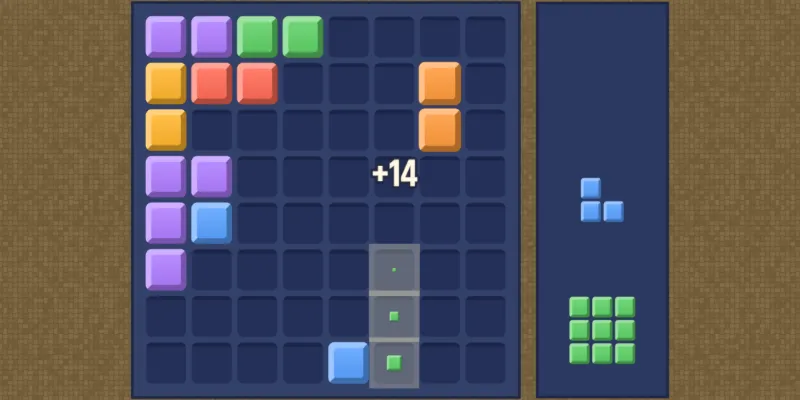
- A faint copy of the piece shows where it would land. If it fills a row or a column, that line lights up.
- Let go where the faint copy shows and the piece is down. Let go anywhere it does not fit and it goes back to the tray.
- When all three pieces are down, three new ones come.
You can also tap a piece to pick it and then tap the board where it should go. With a mouse, the faint copy follows the pointer before you click.
Where a piece can go
A piece goes on empty cells only, every one of its blocks on the board. It cannot sit on a block that is already there, or hang over the edge.
The pieces come in any order, so leave room. A board with one big open space takes any piece, and a board with many small holes takes only small ones.
Rows and columns clear
The moment a row or a column has a block in all eight of its cells, every block in it goes and the cells are empty again. Rows and columns are checked together, so one piece can clear a row and a column at once.
Clearing lines is the only way the board ever empties. A game is won or lost on how often you can do it.
Pieces never turn
A piece goes on the board the way it came. There is no turning it round, so an L facing left and an L facing right are two different pieces.
The pieces are a single block, two blocks, straight lines of three, four and five across or down, squares of two and three, blocks of two by three, small and large corners, the L and J of four, the T, and the S and Z. Small and middling pieces come more often than big ones.
When the game ends
The game ends when none of the pieces left in the tray fits anywhere on the board. A piece with nowhere to go is drawn faded, and while one piece still fits, you play on.
A new set of three is never dealt with nothing in it that fits. If none of the three would fit, the set is drawn again, so a game ends on how the board was played and not on one bad deal. Only one of the three is promised, though, not all three.
Scoring
Every placement scores three ways:
- One point for every block placed. A piece of four is four points.
- A bonus for the lines that piece clears, which grows with how many go at once: 10 for one, 30 for two, 60 for three, 100 for four, then 150 and 210.
- A combo bonus for clearing on placements in a row. The second clear in a row adds 20, the third 40, the fourth 60, and so on. A placement that clears nothing ends the run.
So a piece of n blocks that clears L lines as the k-th clear in a row scores n + 10 × L × (L + 1) ÷ 2 + 20 × (k − 1).
Clearing two lines at once is worth 30 where clearing them one at a time is worth 20, and three placements in a row that each clear one line earn bonuses of 10, 30 and 50. Building up to clear several lines together, and keeping a run going, is where the big scores come from.
Today’s game and a new game
Today’s game deals the same pieces in the same order to everybody in Nepal, so you can compare scores with anybody who played it. It changes at midnight in Kathmandu.
A new game is dealt at random, and you can play as many as you like. Your best score and the games you have played are kept on the game’s page, and on your account when you are signed in.
A few tips
- Keep one corner of the board open. A square of three needs a three by three space, and it is the piece that ends most games.
- Fill along the edges first. A block against the edge leaves the middle open for the long pieces.
- Look at all three pieces before you place the first. The order you place them in often decides whether the third one fits.
- Avoid single empty cells walled in on four sides. Only a single block can fill one, and singles are rare.
Settings
There is one choice, which game to play. The board, the pieces and the scoring are the same in every game, so a best score always means the same game.
| Setting | Standard | What it changes |
|---|---|---|
| Game | Today’s game | Today’s game gives everybody the same pieces today. A new game is dealt at random. |
Words
- Tray
- Where the three pieces wait to be placed.
- Line
- A row or a column of eight cells. A full one clears.
- Combo
- Clears on placements one after another, which add to the score.
- Faint copy
- The outline on the board of where a piece you are holding would land.
Every rule on this page is the one the app plays by. Change any of them on the game's own page before you start.