How to play Minesweeper
A puzzle for one: a field of covered cells with mines under some of them, cleared by reading the numbers.
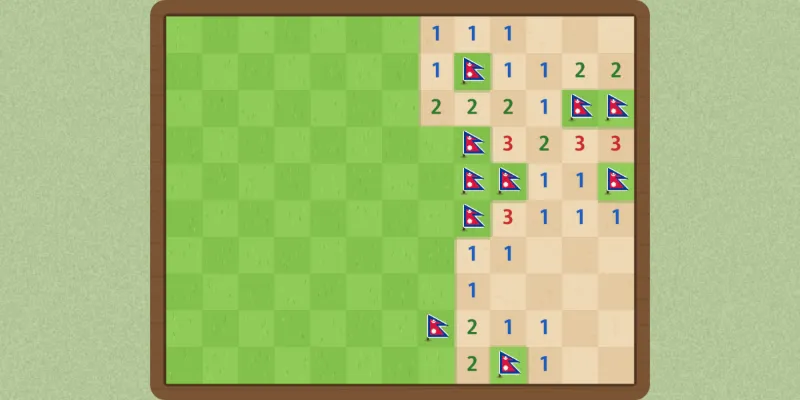
- Players
- 1
- What you need
- A field of 8 by 10 to 12 by 16 cells
- How long
- One to ten minutes a field
What Minesweeper is
Minesweeper is a puzzle for one. The field is a grid of covered cells, and some of them hide a mine. The aim is to open every cell that does not.
An open cell shows a number: how many of the eight cells around it, corners included, hold a mine. A cell with no mines around it opens its neighbours by itself, so one press can open a whole patch.
Playing it here
- Tap a covered cell to open it.
- Hold a cell for a moment to put a flag on it, where you have worked out a mine is. Hold it again to take the flag off.
- Keep going until every cell without a mine is open.
The game opens a patch for you at the start, so the first move is already a reading. The Flag button makes a tap put flags down until you press it again. On a computer, a right click flags, F switches the Flag button and H asks for a hint.
Reading the numbers
Count a number’s covered neighbours. If there are exactly as many as the number, every one of them is a mine. If the number already has that many flags around it, every other covered neighbour is safe.
Most of the game is those two thoughts, passed from one number to the next. Two numbers side by side often settle a cell neither could settle alone: a 1 and a 2 touching the same covered cells tell you where the 2’s second mine must be.
Flags and opening around a number
A flag marks a mine you have found. It stops a slip of the thumb from opening that cell, and the count beside the clock says how many mines are still unflagged.
Once a number has as many flags around it as its value, tap the number itself and every other covered cell around it opens at once. It is quick, but a flag in the wrong place makes it open a mine, so flag only what you are sure of.
No field needs a guess
In the classic game a field was dealt at random, and many ended with two cells and nothing to choose between them. Here every field is checked before you get it: from the opening patch, the numbers alone can clear it to the last cell.
So when you feel stuck, there is always something to read. Look for two numbers working together, or count the mines left once the field is nearly done. Hint shows one cell the numbers prove, and a flag that is wrong.
How a field ends
The field is cleared the moment the last cell without a mine opens, and every mine gets its flag. The clock stops there, and your time is kept as your best at that size if you took no hint.
Open a mine and it goes off, and the field is lost. Every other mine turns up so you can see where they were, and any flag in the wrong place is crossed out.
Today’s field
Each size has a field of the day, the same for everybody in Nepal, which changes at midnight in Kathmandu. Play it as often as you like: your best time on it is kept.
A new field is dealt fresh every time, as many as you like.
A few tips
- Start where the numbers are small. A 1 in a corner of the open patch usually gives its mine away first.
- Learn the 1-2-1 along a wall: the two cells facing the 1s are mines and the one facing the 2 is safe. With 1-2-2-1 it is the two in the middle that are mines.
- Flag a mine once you are sure, then look at the numbers around it again. A flag often makes its neighbours’ numbers easy.
- Near the end, compare the mines left with the covered cells left. Sometimes the count alone says which are safe.
Settings
Minesweeper has one setting, the size of the field, and the page asks first whether you want today’s field or a new one.
| Setting | Standard | What it changes |
|---|---|---|
| Field | Easy, 8 by 10, 10 mines | How big the field is and how many mines it holds, from 10 mines on 8 by 10 cells to 38 on 12 by 16. A bigger field has more mines to the cell as well as more cells. |
Words
- Number
- What an open cell shows: how many of the eight cells around it hold a mine.
- Flag
- A mark you put on a covered cell you have worked out is a mine. Here it is Nepal’s flag.
- Opening around a number
- Tapping a number whose flags already add up to it, which opens every other covered cell around it at once.
- Patch
- The cells one press opens at once, spreading out through every cell with no mine around it.
Every rule on this page is the one the app plays by. Change any of them on the game's own page before you start.