How to play Dominoes
Dominoes is played with a set of 28 tiles, each marked with two numbers from blank to six. Players take turns setting a tile on either end of a line, matching the number already there. Set your last tile first and you score what the others are left holding.
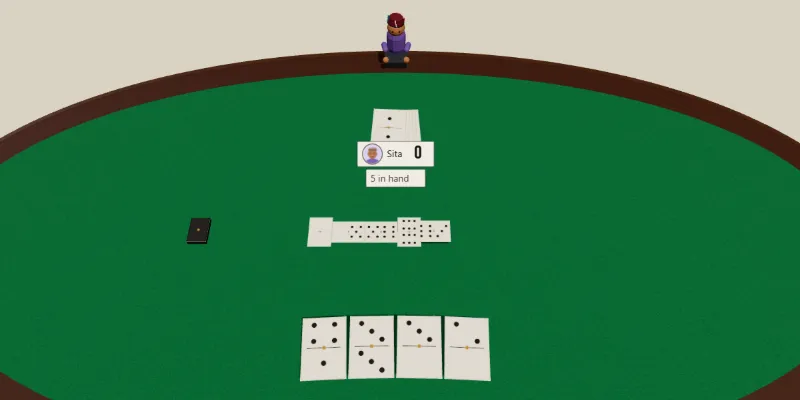
- Players
- 2 to 4
- What you need
- A double-six set of 28 tiles
- How long
- A few minutes a hand, played to a score
What the game is
Every player holds a hand of tiles, face down to everybody else. One line of tiles grows across the middle of the table, and it only ever grows at its two ends. On your turn you set one tile on an end, where one of its numbers matches the number showing there.
The first player to set their last tile wins the hand and scores the pips left in everybody else's. It is the game a phone or a café table in Nepal knows as domino, and it takes a minute to learn.
The set
A double-six set has 28 tiles, one for every pair of numbers from blank to six. Seven of them are doubles, with the same number on both halves. Each number appears on eight halves across the set.
The dots are called pips. A tile's weight is its pips added up: the double six is the heaviest at twelve and the double blank the lightest at nought.
The deal and the first tile
- Shuffle the tiles face down and deal seven to each player with two or three players, or six each with four.
- The rest stay face down at the side as the boneyard.
- In the first hand, whoever holds the highest double sets it down to start the line.
If nobody was dealt a double, the heaviest tile starts the line instead.
In every hand after the first, the winner of the hand before leads, with any tile they like. If the hand before was a tie, the lead moves one seat on.
A turn
- Look at the two numbers showing at the ends of the line.
- Set one tile from your hand on an end, with its matching half against that end.
- Play then passes to the next player.
If a tile matches both ends, you choose the end. The table lights both ends, and a tap on one sets the tile there.
A double is set across the line rather than along it, but it is played like any other tile: the double four goes on a four. When the line reaches the edge of the table it turns and comes back the other way, which changes nothing about the play.
When nothing fits
In the draw game, a player with no tile that fits draws from the boneyard, one tile at a time, until a tile fits. That tile is then set straight away. The table draws for you, so there is nothing to tap.
The last two tiles in the boneyard are never drawn. A player who cannot set a tile when only those two are left passes, and play moves on.
The block game
In the block game nobody draws. A player who cannot set a tile simply passes. Because more tiles stay in hands, a hand is shorter and ends blocked more often.
In both games, a hand is blocked when nobody can set a tile and nobody can draw. It ends at once, and the player holding the fewest pips wins it.
The score
The player who goes out scores all the pips left in the other players' hands.
When a hand is blocked, the player with the fewest pips wins it and scores the pips in the other hands less the pips in their own. If two players tie for fewest, nobody scores that hand.
The match
Scores carry over from hand to hand, and the first player to reach the target wins the match. This table plays to 100 unless you choose otherwise, which with two players is about ten hands.
You can also play a single hand, or to 50 or 150.
Playing it well
- Get rid of heavy tiles early. Whatever you are holding when somebody goes out is what they score.
- Play your doubles while you can. A double fits only one number, so it is the tile most likely to be stranded.
- Keep a variety of numbers in your hand, so whichever end is left open, you can answer it.
- Watch what the others draw on. A player who draws when the ends show a four and a one holds neither, so leaving a four or a one at the ends slows them down.
- Count. Each number is on seven tiles. If the rest of a number's tiles are on the line or in your hand, leaving that number at an end means nobody else can follow it.
This table's settings
The defaults are Pagat's published rules of the draw game, with one target for every table size.
| Setting | Standard | What it changes |
|---|---|---|
| Players | 2 to 4, two by default | Three or four players means more tiles in hands when somebody goes out, so a hand scores more, and a smaller boneyard. |
| Game | Draw game | The draw game lets a stuck player draw from the boneyard. The block game does not, so players pass instead. |
| Play to | 100 | One hand, 50, 100 or 150. A lower target is a shorter match. |
| Difficulty | Medium | Easy sets whatever fits. Medium sheds heavy tiles and plays doubles early. Hard also counts what each player lacks, and Perfect plays each choice out to the end of the hand. |
Words
- Tile
- One domino: a piece with two numbers, one on each half.
- Pips
- The dots on a tile. A tile's weight is its pips added up.
- Double
- A tile with the same number on both halves. It lies across the line.
- Boneyard
- The tiles nobody was dealt, face down at the side, drawn from in the draw game.
- Blocked
- When nobody can set a tile and nobody can draw. The lightest hand wins.
- Going out
- Setting your last tile, which wins the hand.
Every rule on this page is the one the app plays by. Change any of them on the game's own page before you start.