How to play Gulam Chor
Also written gulamchor, and Julaamchor in Onlinekhabar's list of Dashain card games. The name means Jack Thief. In English the same game is Old Maid.
Gulam Chor, Jack Thief, is a card game of pairs for two to six players. One jack comes out of the pack, the rest is dealt, and everybody throws their pairs. Then each player in turn takes a card blind from the next hand and throws any pair it makes, and the last player left holding a card, the odd jack, is the chor.
Nothing in it is decided by skill, which is why children learn it first. A match here is five rounds unless you change it, and whoever was the chor fewest times wins.
Set the table up with your own house rules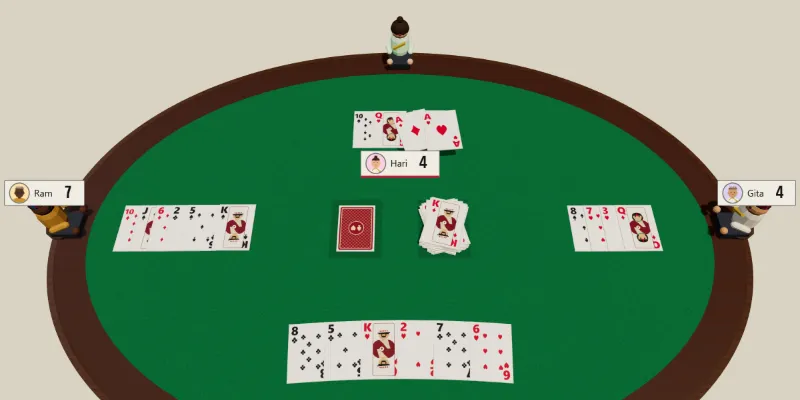
- Players
- 2 to 6
- What you need
- One pack of 52 cards
- How long
- Five rounds, a few minutes each
Rules checked 20 October 2026. How these rules are written
What Gulam Chor is
Gulam Chor is often the first card game children learn, and it's a family favourite during Dashain. The only rule is to make pairs, and there are no winners, only one loser.
The loser is the 'chor' (the thief), the last player left holding a single card when everyone else has emptied their hands. Traditionally, the chor must pay a fun forfeit, like singing a song or doing a dance.
The card taken out
Before the deal one card comes out of the pack and is put aside face down. Its rank is now one card short, so of its three that are left, two can pair and the third cannot. That third card is the one to be rid of.
The name says a jack, so here a jack comes out and everybody knows the card to fear. Many tables take out any card without looking at it instead, so nobody knows which rank is the odd one until the end. The table’s settings have both.
The deal
The rest of the pack is dealt round the table, one card at a time, until it is gone. Some players get a card more than others.
Every player throws their pairs face up in the middle straight away. Two cards of the same rank make a pair, whatever their suits. After that no hand holds two cards of one rank.
A turn
- Hold your cards so the next player cannot see them.
- On your turn, take one card from the next player’s hand without seeing it.
- If it pairs with a card of yours, throw the two in the middle. If not, keep it.
- The turn passes to the player you took from, who takes from the next hand along.
There is nothing to choose between the cards you are offered, and nothing you can do about the ones taken from you. The game is the waiting, and the face somebody makes when they take the jack.
Going out
A player whose hand empties is out, safe for the round. It can happen on your turn, when a card you take pairs your last one, or on somebody else’s, when they take your last card.
Players who are out are passed over, and the next hand along is the next one with cards in it.
The chor
Every card but one has a partner, so the round always ends the same way: every hand empties but one, and that one holds a single card of the rank that came out. That player is the chor.
The card set aside is turned over beside it, so everybody can see the pair that never could be.
The match
A match is a number of rounds, and each round deals again with the first turn moving on a seat. The table counts how many times each player was the chor. A table may also play with no limit, the way families often do: it goes on until the people at it agree to stop, and whoever made the table ends it between rounds.
Whoever was the chor least often wins the match. If two or more share the fewest, the match is a draw.
At this table
On your turn the next player’s cards are lit. Tap any of them to take it, or press Take a card, which takes one for you. They are all the same until they are turned over.
Your pairs are thrown for you, since a pair can only be thrown. Each seat shows how many cards it holds, and below that how many times it has been the chor.
Options
Every table here plays the rules above. These are what a family decides before the first deal.
| Setting | Standard | What it changes |
|---|---|---|
| Players | 4 | Two to six. With more players the hands are smaller and the rounds quicker. |
| Rounds | 5 | How many rounds a match lasts. No limit plays on until the table agrees to stop. |
| Taken out of the pack | A jack | A jack, so everybody knows the card to fear, or a card nobody sees, so nobody knows until the end. |
The words
- Gulam Chor (गुलाम चोर)
- The jack thief. Onlinekhabar spells it Julaamchor in its list of Dashain card games.
- Gulam (गुलाम)
- The jack. The other court cards are missi for the queen and badshah for the king.
- Chor (चोर)
- The thief: the player left holding the odd card at the end of a round.
- Jodi (जोडी)
- A pair: two cards of one rank.
How other families play it
Every family plays it a little differently. These are the ways we know of. The ones with a button are house rules this table can play.
A card nobody sees
Any card is taken out face down without looking, so nobody knows which rank is the odd one until the end. Onlinekhabar describes it this way, and so does a Nepali account on Tumblr. The table has it as a setting.
Pairs of one colour
Some tables pair only cards of the same rank and colour, two red sevens or two black ones. The table here pairs by rank alone, whatever the suits, which is the simpler way.
Old Maid
The English game is the same with a queen taken out instead of a jack, and it is sometimes played taking from the player before you rather than the next. That changes nothing, and the table here takes from the next hand.
Questions people ask
How do you play Gulam Chor?
Take one jack out of the pack, deal the rest, and everybody throws their pairs. Then take turns drawing a card blind from the next player's hand, throwing any pair it makes. The player left holding the last card, the odd jack, is the chor.
Which card is taken out in Gulam Chor?
A jack, as the name says, so everybody knows the card to fear. Many tables take out any card unseen instead, and then nobody knows the odd rank until the end. The table has both.
How many players can play Gulam Chor?
Two to six here, with one pack of 52. The more players, the smaller the hands and the quicker the rounds. The scorekeeper for a real pack takes three to eight.
Do suits matter for a pair in Gulam Chor?
No. Two cards of the same rank are a pair, whatever their suits or colours.
Who is the chor in Gulam Chor?
The last player holding a card when every other hand is empty. That card is always the odd one of the rank taken out.
Can you choose which card to take?
Any card of the next hand, but you cannot see them, so no card is a better choice than another. The turn then passes to the player you took from.
Who wins a game of Gulam Chor?
Whoever was the chor fewest times over the match, five rounds as the table comes, or three or ten. If two or more share the fewest, the match is a draw.
What is Gulam Chor in English?
Jack Thief: gulam is the jack and chor a thief. The English game Old Maid is played the same way.
Every rule on this page is the one the app plays by. Change any of them on the game's own page before you start.