How to play Mahjong Solitaire
Patience for one with mahjong tiles: a heap of tiles in layers, cleared two matching tiles at a time.
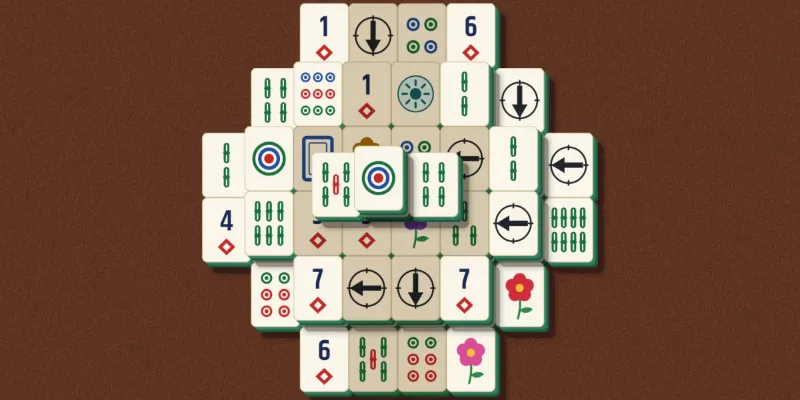
- Players
- 1
- What you need
- Mahjong tiles, 60 to 102 of them
- How long
- Three to ten minutes a deal
What Mahjong Solitaire is
Mahjong Solitaire is a patience game for one, played with the tiles of the Chinese game of mahjong rather than its rules. The tiles are laid out in a heap of several layers, and the aim is to take them all off, two at a time.
Two tiles can be taken when they show the same face and both are free. Take the last pair and the heap is cleared.
Playing it here
- Tap a free tile. It lights up.
- Tap another free tile with the same face, and both go. Tap a tile that does not match and that one is picked instead.
- Keep going until the heap is gone.
Undo takes back as many moves as you like, and Start again puts every tile back where it was dealt. Hint lights a pair worth taking, and Shuffle deals the tiles left onto the places left. On a computer, U undoes, H asks for a hint and S shuffles.
Which tiles are free
A tile is free when nothing lies on any part of it, and the tile beside it on its own layer, either on its left or on its right, is gone. A tile with neighbours on both sides is held, and so is a tile with another resting on it, however open its sides are.
At the table a held tile is drawn a little darker, so the free ones stand out. Taking a tile never holds another one, so a tile that is free stays free.
What matches
Most tiles match only a tile with the same face: a five of dots with a five of dots, an east wind with an east wind. There are four of each, so a face can be taken twice.
The flowers and the seasons are different. There is one of each of the four flowers, and any flower matches any other flower. The four seasons work the same way among themselves. A flower never matches a season.
The tiles
There are three suits, each numbered one to nine: dots, which are rings, bamboo, which are sticks, and characters, which show their number over a red seal. Here the characters print their numbers in your own numerals, so a Nepali page shows them in Devanagari.
Then the honours: four winds, drawn as an arrow pointing east, south, west or north, and three dragons, a red flame, a green leaf and a white tile with a blue frame.
Stuck, and the shuffle
Sometimes no free pair is left. Then the table says so, and you can Undo to an earlier choice, end the deal, or Shuffle.
A shuffle keeps every tile on the table but deals them again onto the places that are left, arranged so the heap can still be cleared. You can shuffle whenever you like, but a deal won after a shuffle, like a deal won after a hint, does not count as a best time.
How a deal ends
The deal is won the moment the last pair is taken. The clock stops there, and your time is kept as your best at that layout if you took no hint and did not shuffle.
You can give a deal up at any time, and it counts as lost.
Every deal here is built so it can be cleared: the computer lays the tiles out by taking them off in pairs from the full heap, so there is always a way through from the start. A lost deal is never a deal that could not be won.
Today’s deal
Each layout has a deal of the day, the same for everybody in Nepal, which changes at midnight in Kathmandu. Play it as often as you like: your best time on it is kept.
A new deal is laid out fresh every time, as many as you like.
A few tips
- Watch for the last two tiles of a face lying one on the other. They can never both be free, so free the one underneath before it is too late.
- When three tiles of a face are free, take the pair that opens up the most, and keep the third for later.
- Work the tall stacks down early. The tiles under them are the ones that run out of time.
- Long rows open from their ends. Clearing an end frees the tile behind it.
Settings
Mahjong has one setting, the layout, and the page asks first whether you want today’s deal or a new one.
| Setting | Standard | What it changes |
|---|---|---|
| Layout | Stupa, 60 tiles | Which heap the tiles are laid out in: the Stupa of 60 tiles, the Durbar square of 82, or the Pagoda of 102 in five tiers, after Nyatapola in Bhaktapur. A bigger heap is a longer and harder deal. |
Words
- Free
- A tile with nothing on it and its left or right side open. Only free tiles can be taken.
- Held
- A tile that is not free, because a tile lies on it or it has neighbours on both sides.
- Pair
- Two tiles with the same face, or two flowers, or two seasons, taken together.
- Layout
- The shape of the heap the tiles are dealt into.
- Shuffle
- Dealing the tiles left onto the places left, so a stuck heap can be cleared.
Every rule on this page is the one the app plays by. Change any of them on the game's own page before you start.