How to play Arrows
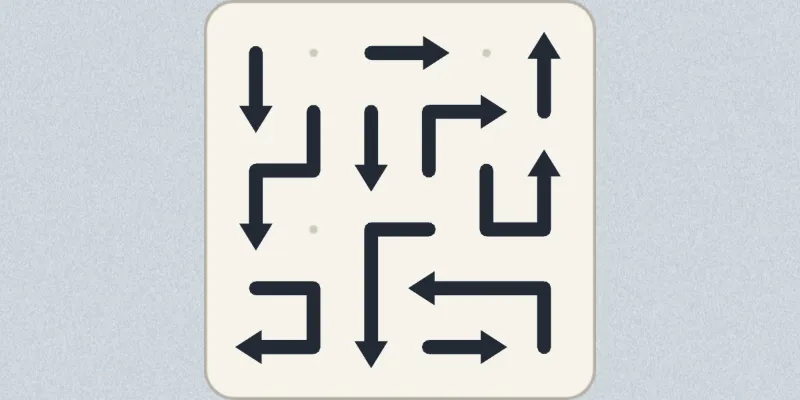
A puzzle for one: a board packed with arrows, each tapped away once nothing stands in its way.
- Players
- 1
- What you need
- A board of arrows, 6 to 12 cells across
- How long
- One to five minutes a board
What Arrows is
Arrows is a puzzle for one. The board is a grid packed with arrows, each a line that winds through a few cells and ends in a head. The aim is to take every arrow off the board.
An arrow leaves the way its head points, sliding out along its own line like a train along its track. It can only go when nothing lies between its head and the edge of the board.
Playing it here
- Tap anywhere on an arrow.
- If its way out is clear, it flies off the board. If not, it bumps into the arrow in its way and comes back, and you lose a heart.
- Keep going until the board is clear.
Hint lights an arrow that can fly, and Start again puts every arrow and every heart back. On a computer, H asks for a hint.
Which arrows can fly
Follow the head straight on, the way it points, to the edge of the board. If every cell on the way is empty, the arrow can fly. If any arrow lies across that line, even just its tail, it cannot yet.
Only the head's direction matters. An arrow's body can bend any way it likes, and it follows its head out wherever the head goes.
Hearts
You start with three hearts. Each tap on an arrow that cannot fly costs one, and when the last is gone, the board is lost. Start again gives them all back, with every arrow.
If you would rather look than count, the settings can take the limit away. Then a wrong tap costs nothing, but a board cleared that way does not count as a best time.
There is no wrong order
Taking an arrow away only ever empties cells, so it can never block another arrow. An arrow that can fly now can still fly later.
So there is no plan to get wrong. The whole puzzle is seeing which arrows are free, and the board opens up as you clear it.
How a board ends
The board is cleared the moment the last arrow flies. The clock stops there, and your time is kept as your best at that size if you took no hint and played with hearts.
Every board here is made so it can be cleared, by laying lines first and then taking them off one at a time, each only when it has a way out. A lost board is never a board that could not be cleared.
Today’s board
Each size has a board of the day, the same for everybody in Nepal, which changes at midnight in Kathmandu. Play it as often as you like: your best time on it is kept.
A new board is made fresh every time, as many as you like.
A few tips
- Start at the edges. An arrow whose head is on the edge pointing out is always free.
- Trace the line out from the head with your eye before you tap. One stray tail in the way is enough to stop it.
- When you clear an arrow, look at what it was in the way of. Those are the arrows most likely to be free next.
- Not sure? A hint costs nothing but your best time, and a wrong tap costs a heart.
Settings
Arrows has two settings, and the page asks first whether you want today’s board or a new one.
| Setting | Standard | What it changes |
|---|---|---|
| Board | Easy, 6 by 6 | How big the board is, from six cells across to twelve. A bigger board has more arrows, and longer ones that wind round each other. |
| Wrong taps | Three hearts | Whether a wrong tap costs a heart, three to a board, or nothing at all. With no limit a board is not kept as a best time. |
Words
- Head
- The pointed end of an arrow. It says which way the arrow leaves.
- Way out
- The cells from an arrow’s head straight on to the edge of the board.
- Free
- An arrow whose way out is empty, so a tap sends it off the board.
- Heart
- What a tap on an arrow that cannot fly costs. Three to a board.
Every rule on this page is the one the app plays by. Change any of them on the game's own page before you start.