How to play Gomoku
Two players, a board of fifteen lines by fifteen, and a bowl of stones each, black and white. Take turns putting a stone on an empty point, and the first to make an unbroken line of five wins.
It is played across East Asia, where it is often called five in a row, and it is the same idea as tic-tac-toe on a board big enough that it stops being a draw.
- Players
- 2
- What you need
- A board of fifteen lines by fifteen, black and white stones
- How long
- A game takes three to five minutes
What gomoku is
Gomoku is a game for two on a board ruled with fifteen lines each way. One player has black stones and the other white, and they take turns putting one stone on any empty point where two lines cross.
Stones never move and are never taken. The first to have five of their own colour in an unbroken line, across, down or on a slant, wins. If the board fills and nobody has five, the game is a draw.
The board
- Stones go on the points where the lines cross, not in the squares between them. There are 225 points, and five of them carry a dot so the eye can find its place.
- Black always moves first. Moving first is an advantage, so in a match of several games the colours change hands between games.
- You choose your colour for the first game on the game page. On this phone, it is the first player's.
Taking a turn
On your turn, put one stone on any empty point. That is the whole move. Before you do, look for two things. Can you make five? Then do, because that wins. Does your opponent have four in a line with the fifth point open? Then you must take that point yourself, or they win next turn.
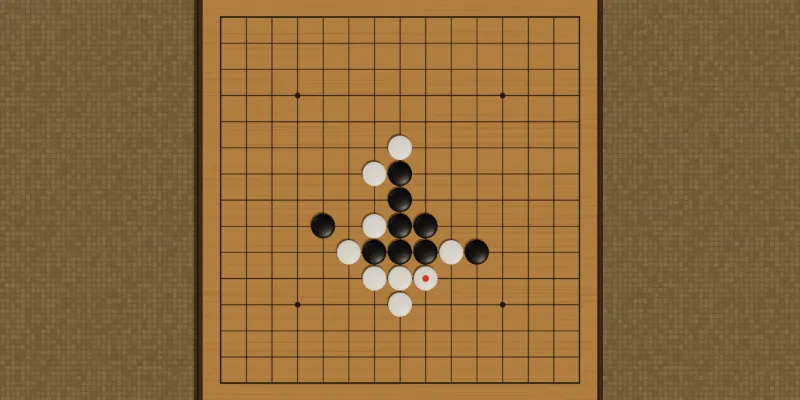
On a phone a point is smaller than a fingertip, so touch the board and slide: a line along the row and the column under your finger shows where the stone will go, and it is placed when you lift your finger. With a mouse, click the point. The stone placed last carries a small red dot, so you can see what your opponent just did.
Fours and open threes
A four must be answered at once, because it threatens five. An open four, four in a row with both ends empty, cannot be answered at all: white blocks one end and black plays the other.
So an open three, three in a row with room at both ends, is a threat too. It is one move from an open four. If your opponent makes one, close an end of it now, unless you can make a four of your own, which they must answer first.
Games are won by making two threats with one stone: two fours, or a four and an open three. Your opponent can stop only one of them.
How a game ends
A game ends the moment somebody makes five in a row. One stone can finish two lines at once, and every line it made is struck through.
If every point fills and nobody has five, the game is a draw. Between two players who block well that is rare, because the board is large and a game usually ends long before it fills.
Which line wins
There are three ways to play, chosen on the game page.
- Five or more in a row: any unbroken line of five or longer wins. The usual way, and the default here.
- Exactly five: a line of six or more does not count for either player. Only five exactly wins.
- Renju: black, who moves first, may not play a stone that makes two open threes at once, two fours at once, or a line of six or more. Black wins only with exactly five. White has no limits and wins with five or more.
Renju exists to make up for black's first move. Under it, the points closed to black are marked with a cross while black is to move, and the game will not let black play there. A stone that makes five is never closed.
A match
A match is one, three or five games, chosen on the game page. Three is the usual setting: a game takes a few minutes, and three is a sitting.
Every game of the match is played, and whoever wins more of them wins the match. A drawn game counts for nobody, and a match that ends level is a draw. Black changes hands each game, or goes to whoever lost the last game if the table plays that way.
Playing better
- Play near the stones already down. A stone far from the others helps no line.
- Answer an open three at once, and close the end that leaves your opponent least room.
- Before you answer a threat, see whether you have a four. Your opponent must block it, and a run of fours can win the game outright.
- Build in more than one direction. Two lines that cross at an empty point are a fork waiting to happen.
Settings
Everything on the game page, before you press Play.
| Setting | Standard | What it changes |
|---|---|---|
| Who is playing | With bots | With bots sets you against a bot. On this phone seats two people, who pass the phone between turns or leave it lying flat between them. Friends online plays over a link. Watch the bots, the link under the button, sets two bots against each other. |
| Your colour in the first game | Black | Your colour in the first game. Black moves first, and the colours change hands after it. On this phone it is the first player's. |
| Games | 3 | One, three or five games. Every game of the match is played, even once one player can no longer be caught. |
| Difficulty | Medium | Easy takes a win when it sees one but misses a block about half the time. Medium always blocks a four and an open three and looks three stones ahead. Hard looks further, hunts for a win by a run of fours, and sees yours coming. |
| Which line wins | Five or more in a row | Five or more, exactly five, or renju, as described above. |
| Who has black next game | Each in turn | Each in turn gives black to the other player every game. Whoever lost gives it to the player who lost the last game, and after a draw it changes hands as usual. |
The words
- Gomoku (गोमोकु)
- The game's Japanese name, meaning five pieces. Also called five in a row.
- Point (बिन्दु)
- A place where two lines cross, where a stone goes.
- Four
- Four of one colour in a line with a point left that would make five. It must be blocked at once.
- Open three
- Three in a row with room at both ends, one move from an open four.
- Overline
- A line of six or more. It wins under freestyle, not under exactly five, and renju forbids it to black.
- Renju
- The rules that limit black's moves to make up for moving first, and the name of the game played under them.
Every rule on this page is the one the app plays by. Change any of them on the game's own page before you start.